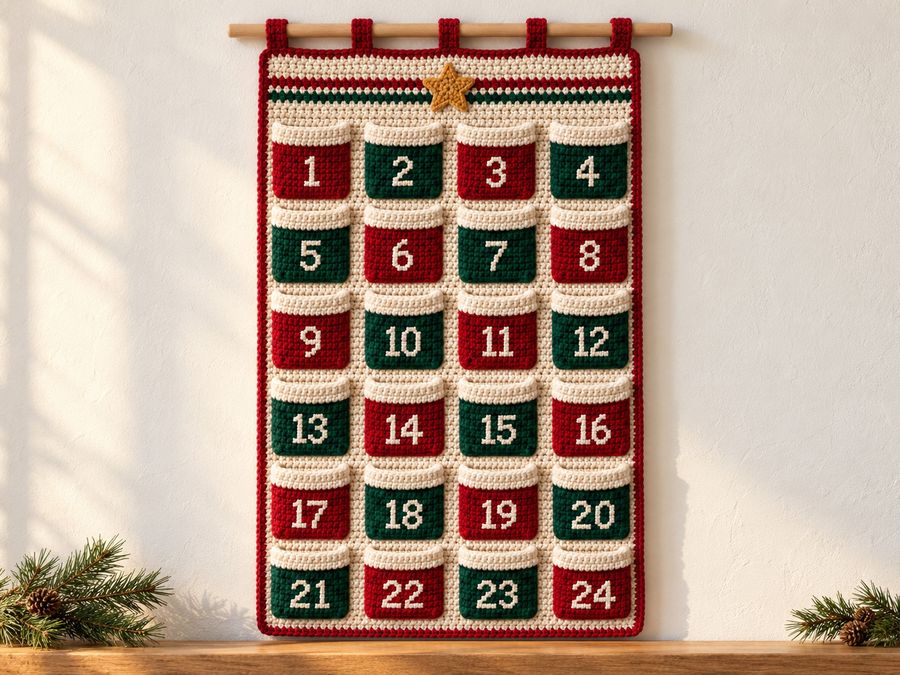
This crochet advent calendar pattern makes a 24 pocket Christmas countdown wall hanging, about 45 x 69 cm / 17.75 x 27 in, with the numbers 1 to 24 cross stitched in cream from a number chart. Every piece is single crochet worked flat in rows in 4, medium (worsted) yarn on a 4 mm (US G-6) hook, so the skill level is Easy. Each pocket is about 8.8 x 8.4 cm / 3.5 x 3.3 in.
This page follows the calendar in the order you meet it: the numbering, the yarn, the size, the assembly and the fillers. One practice pocket from our pattern is written out in full, free, so you can try the stitch and check your gauge first. Our pattern makes a reusable calendar. You crochet it once. It comes out again every December.
What the 24 pocket advent calendar is made of
The 24 pocket advent calendar in our pattern is made of five kinds of piece, which you work separately in single crochet and sew together:
| Piece | How many | Colour | Size |
|---|---|---|---|
| Panel | 1 | Cream with green and red stripes | 44 x 68 cm / 17.25 x 26.75 in (75 sts x 129 rows) |
| Pockets | 24 | 12 Red and 12 Green, each with a Cream cuff and a Cream number | 8.8 x 8.4 cm / 3.5 x 3.3 in (15 sts x 16 rows) |
| Star | 1 | Gold | 6.5 cm / 2.5 in across (3 rounds) |
| Hanging tabs | 5 | Red | 3 x 5.3 cm / 1.2 x 2 in folded (5 sts x 20 rows) |
| Border | 1 round | Red | adds 1 stitch all round |
The table starts with the one big piece, and the panel holds more stitches on its own than all 24 pockets together: 9,675 against 5,760. So the panel is your long stretch. The pockets go quickly.
Our calendar is a classic Christmas countdown in red, cream, green and gold, with no characters or faces. Our pattern calls the colours cranberry red and forest green. A striped header in green and red carries a gold star, and the whole hanging rides on a wooden dowel through five red tabs. It is made to come out every December, so nothing on it dates it to one year.
The numbers are not crocheted in with colour changes. They are cross stitched on top in Cream with a yarn needle, after you finish each pocket. That keeps each pocket to plain rows with one colour change, for the cuff.
How the pockets are numbered and placed
The pockets are numbered with cream cross stitch from a number chart and placed on the panel with a table that gives each pocket’s panel rows and stitches. Together they make your countdown read like a calendar page. Both count stitches and rows, not centimetres. So the layout stays the same even when your gauge is a little off, and because placement goes by panel rows and stitches rather than by eye, every row of four lines up.
Cross stitch numbers on single crochet
Each number is cross stitched in Cream over the single crochet grid of the pocket, with one cross over one stitch. Our chart puts every number on pocket Rows 5 to 9. Two digit numbers start at columns 5 and 9, with one empty column between the digits. One digit numbers start at column 7, so they sit in the middle.
Each single crochet makes a small square on the fabric, and you work one cross over it in four moves:
- Bring the needle up at the bottom left of the square.
- Go down at the top right.
- Come up at the bottom right.
- Go down at the top left.
Keep every top stitch crossing in the same direction. Then the numbers look even. Stitch the number while the pocket is still loose, before you sew it on. Fasten your number thread on the wrong side of the pocket only. That way it never shows through the cuff.
Makers stitching over single crochet for the first time often find the base colour peeks through the crosses. Our pattern answers it three ways. Use a blunt yarn needle, because it lets you slide between the strands without splitting them. Cross every top stitch the same way. Practise a few crosses on your gauge swatch, or on the free practice pocket below, before you number the real pockets. Our pattern also advises that cotton and cotton blends give the sharpest numbers.
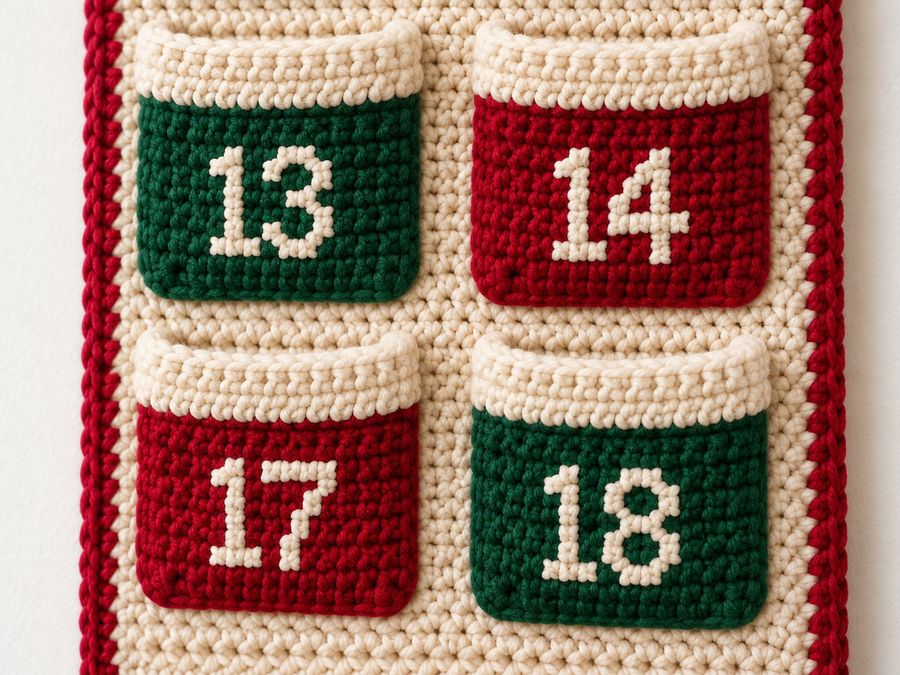
This close-up shows the cream crosses sitting one per stitch on the red and green advent pockets.
The pocket grid: six rows of four
The pocket grid is six rows of four that reads like a calendar page: 1 to 4 across the top, 21 to 24 across the bottom. Red and green alternate in a checkerboard. The Red pockets are 1, 3, 6, 8, 9, 11, 14, 16, 17, 19, 22 and 24; the rest are Green. No two neighbouring pockets share a colour.
In our pattern, each pocket covers 16 panel rows and 15 panel stitches. Three stitches separate the columns, and three rows separate the rows of pockets, with a three stitch margin down each side of the panel. The full placement table in our pattern gives the exact rows and stitches for all 24.
Our pattern adds four habits that keep the grid straight. Place a stitch marker in the first stitch of every 10th panel row, so the pocket rows are easy to find later. Pin a whole row of four before you sew any of them. Start sewing at the bottom row, 21 to 24, and work up, because the panel lies flatter that way. Lay a ruler across each row of four before you sew, to check it is level.
Free practice pocket
The free practice pocket is one complete pocket from our calendar pattern: 15 single crochet wide and 16 rows tall, with a Cream cuff, about 8.8 x 8.4 cm / 3.5 x 3.3 in. It uses the same stitch, colour change and gauge as all 24 in our calendar, so it tells you how the calendar will feel on your hook before you start the panel.
You need 4, medium (worsted) yarn in Red or Green and in Cream, a 4 mm (US G-6) hook and a yarn needle. Our pattern uses US terms. The ch 1 at the start of each row turns the work and is not counted as a stitch. The number in brackets is the stitch count you should have at the end of the row.
Foundation: With Red or Green, leave a 60 cm / 24 in tail for sewing, ch 16. (16 ch)
Row 1 (RS): Sc in 2nd ch from hook and in each ch across, turn. (15)
Rows 2 to 12: Ch 1, sc in each st across, turn. (15)
At the end of Row 12, change to Cream on the last yarn over: work the last stitch in the old colour until two loops are left on the hook, then pull Cream through both loops. Cut the old colour, leaving a tail to weave in later.
Rows 13 to 16 (Cream): Ch 1, sc in each st across, turn. (15)
Fasten off, leaving a 30 cm / 12 in Cream tail. Rows 1 to 12 are the coloured body. Rows 13 to 16 are the cream cuff along the open top of the pocket.
Measure the finished pocket. At our pattern’s gauge, 15 stitches come to about 8.8 cm / 3.5 in. If your pocket is wider, go down a hook size; if it is narrower, go up one. Then practise a one digit number on it: Rows 5 to 9, starting at column 7. We give this one piece in full. The number chart, the placement table, the panel, the star, the tabs and the border stay in our full pattern.
Yarn, hook and gauge for the advent calendar
The advent calendar takes 4, medium (worsted / Aran) yarn in four colours and a 4 mm (US G-6) hook, at a gauge of 17 sc and 19 rows = 10 cm / 4 in in single crochet after light blocking. Our pattern lists each colour by what it makes:
| Colour | Used for | Metres | Yards |
|---|---|---|---|
| Cream | panel, pocket cuffs and numbers | about 450 m | about 495 yd |
| Red | 12 pockets, stripe, border and tabs | about 150 m | about 165 yd |
| Green | 12 pockets and stripe | about 110 m | about 125 yd |
| Gold | star | about 5 m | a little |
Cream does most of the work in our calendar, close to two thirds of the yarn, because it is the panel, every cuff and all 24 numbers. Gold is only the star.
Choose an acrylic, cotton or wool blend, and use one yarn for every piece so your pockets match the panel gauge. The hook is 4 mm (US G-6), “or the size that gives the gauge”, in our pattern’s words. Make a 20 stitch by 20 row swatch in single crochet before you start. Too many stitches in 10 cm, go up a hook size. Too few, go down. Gauge (UK: tension) decides the finished size and how well the pockets line up with the panel rows, so make the swatch before the panel.
The Craft Yarn Council “Standard Yarn Weight System” lists 5.5 to 6.5 mm (US I-9 to K-10 1/2) hooks and 11 to 14 stitches per 4 in for category 4 yarn, and the council calls those ranges guidelines only. Our pattern works much tighter than that. Follow the pattern’s gauge, not the chart. The council’s “FAQs” page says to work a gauge swatch to be sure when you swap one yarn for another in the same weight.
Beyond the yarn, you need a wooden dowel about 55 cm / 22 in long and 12 mm / 0.5 in thick, about 70 cm / 28 in of twine, ribbon or a crochet chain for hanging, a yarn needle, scissors, stitch markers, rust free pins and a measuring tape.
Makers often find single crochet stitches come out taller than they are wide, so a square chart looks stretched on the fabric. At this calendar’s gauge, the arithmetic runs the other way: 17 stitches in 10 cm makes each stitch about 5.9 mm wide, and 19 rows makes it about 5.3 mm tall. The stitches are close to square. So when you match the gauge, your numbers come out the shape our chart draws them. Off gauge, they stretch.
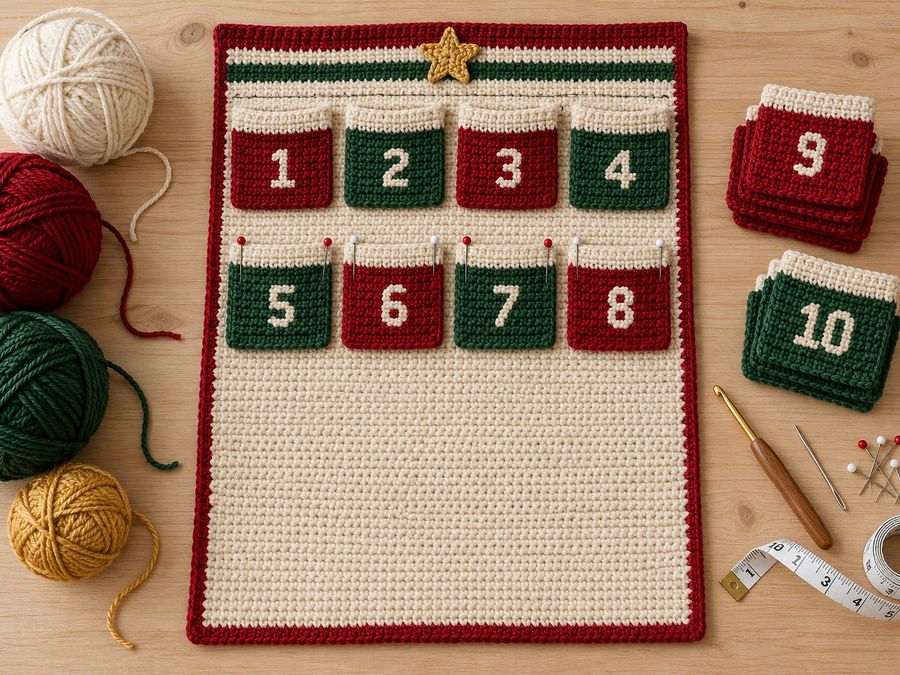
The work in progress shows the cream panel from our pattern with the first row of four pockets sewn on and the second row pinned before sewing.
Finished size of the calendar and each pocket
The finished calendar is about 45 x 69 cm / 17.75 x 27 in, and about 72 cm / 28.25 in tall with the tabs. Every piece in our pattern has its own size:
| Piece | Stitches and rows | Size |
|---|---|---|
| Panel | 75 sts x 129 rows | about 44 x 68 cm / 17.25 x 26.75 in |
| Panel with border | 77 sts x 131 rows | about 45 x 69 cm / 17.75 x 27 in |
| 15 sts x 16 rows | about 8.8 x 8.4 cm / 3.5 x 3.3 in | |
| Hanging tab | 5 sts x 20 rows, folded in half | about 3 x 5.3 cm / 1.2 x 2 in folded |
| Star | 3 rounds | about 6.5 cm / 2.5 in across |
| Whole hanging | panel, border and tabs | about 45 x 72 cm / 17.75 x 28.25 in |
Read the table by its middle column: every size comes from a stitch and row count in our pattern, which is why the pieces fit together.
Each pocket opening in our calendar is about 8.8 cm / 3.5 in wide. That gives you room for a wrapped sweet, a folded note or a tiny ornament. The coloured body takes Rows 1 to 12 of the pocket, and the Cream cuff takes Rows 13 to 16. Only the overall size changes if your gauge is slightly different. The layout stays the same, because it is counted in stitches and rows. Your pockets still line up.
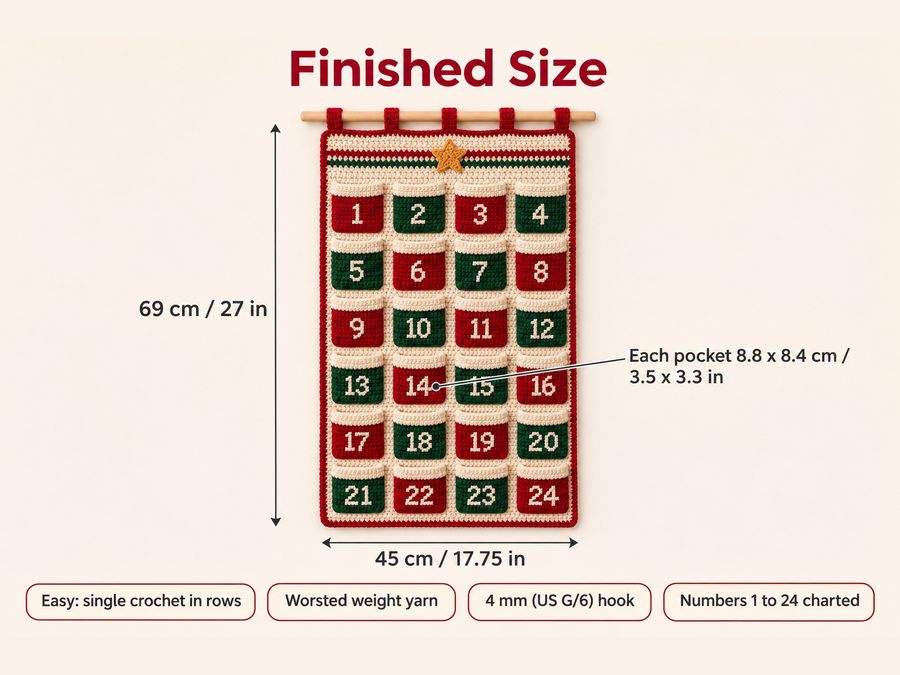
The marked photo shows the advent calendar’s finished width and height on the whole hanging.
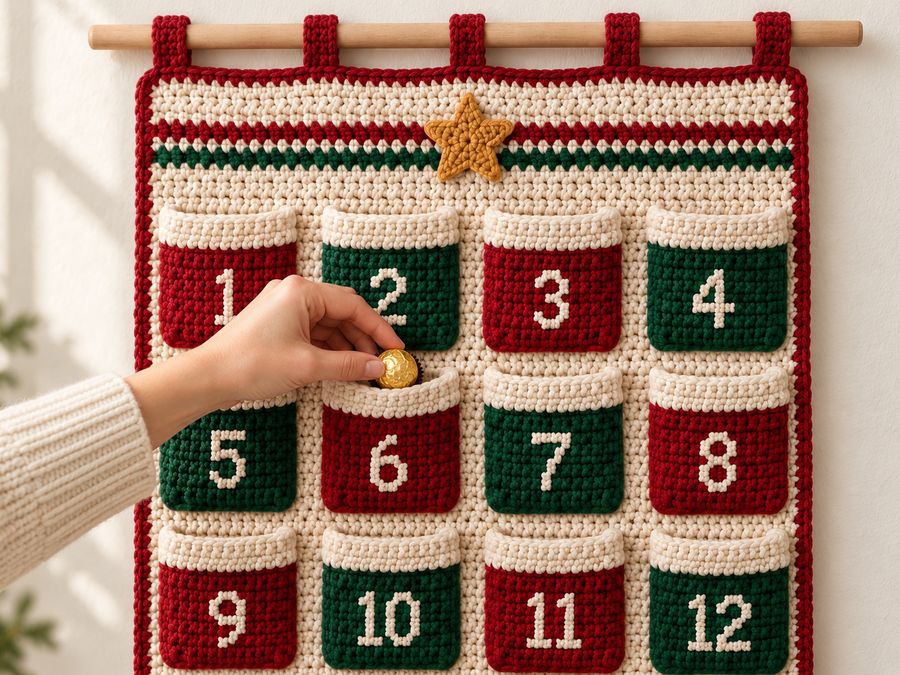
A wrapped chocolate dropping into one pocket of our calendar gives the scale of a single day of the countdown.
How to crochet and assemble the advent calendar
You crochet and assemble the advent calendar in seven steps, from the panel to the hanging tabs:
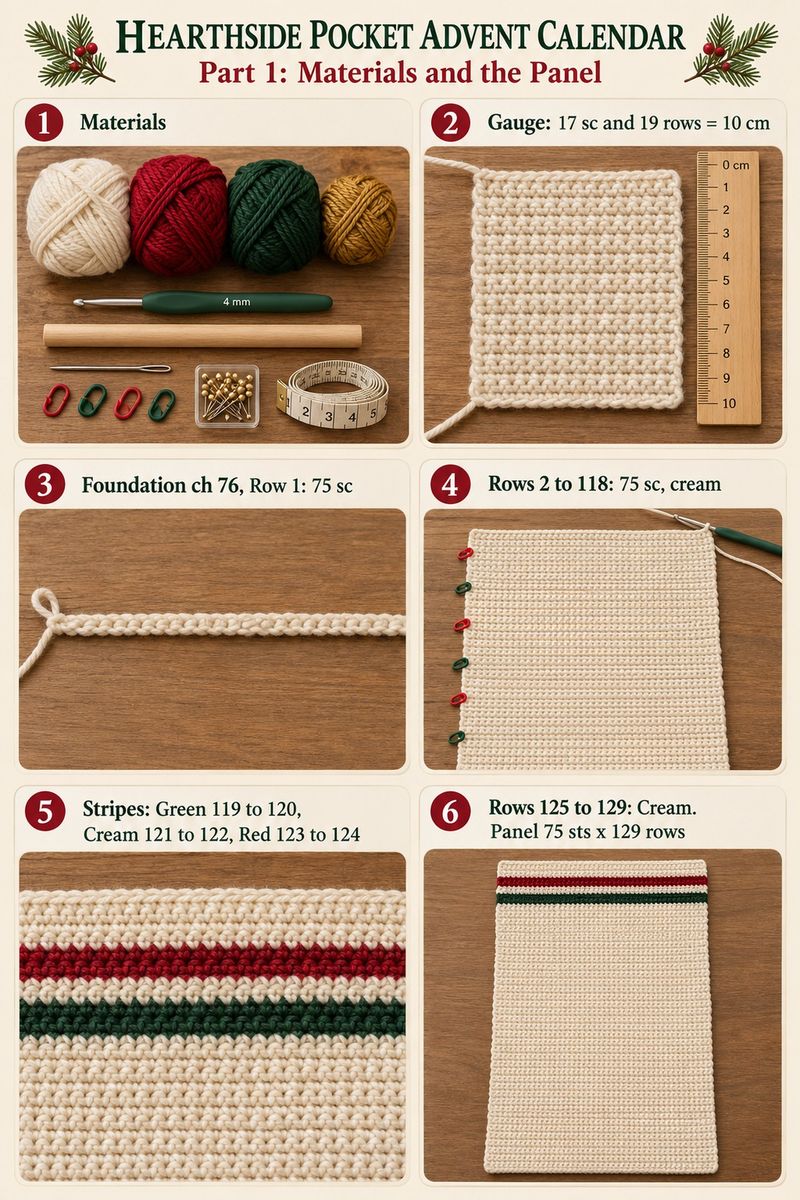 Crochet the panel
Work 75 single crochet wide for 129 rows in Cream, with a green stripe from Row 119 and a red stripe from Row 123.
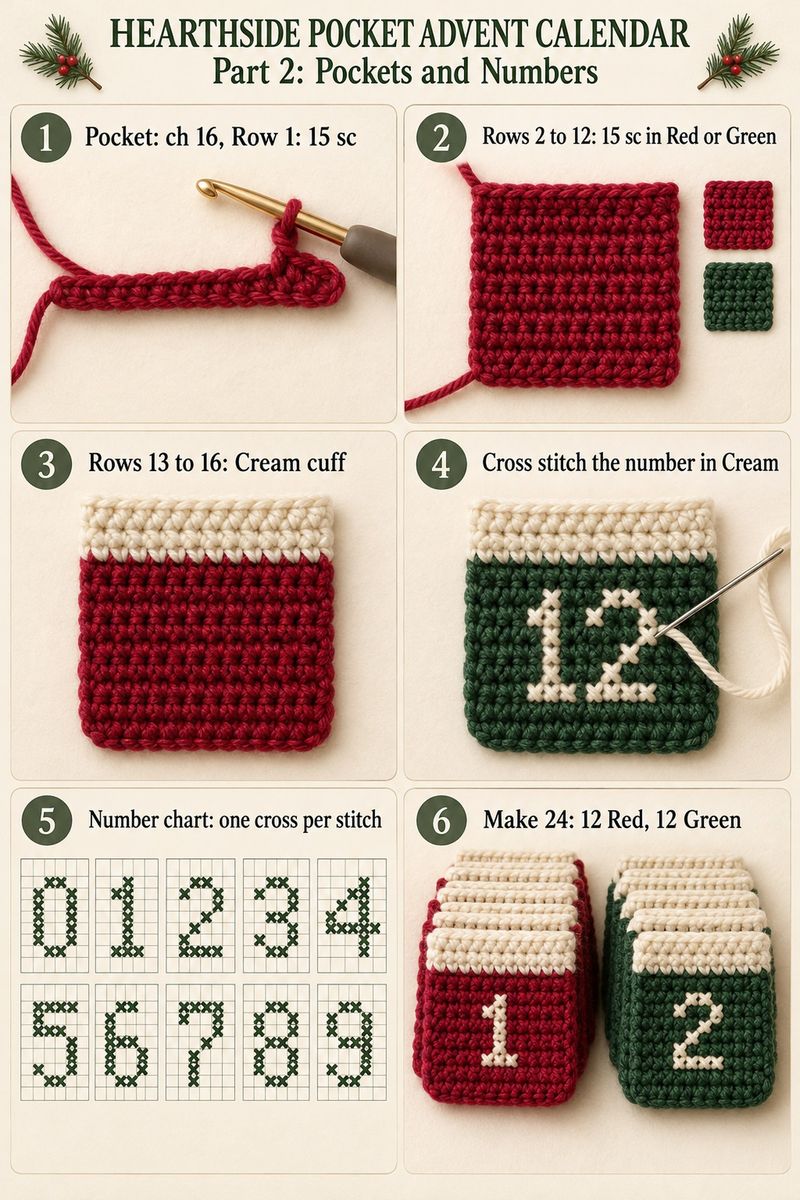 Crochet 24 pockets
Make each pocket 15 stitches by 16 rows: 12 rows in Red or Green, then 4 rows of Cream cuff.
- Cross stitch the numbers
Stitch each number in Cream while the pocket is still loose.
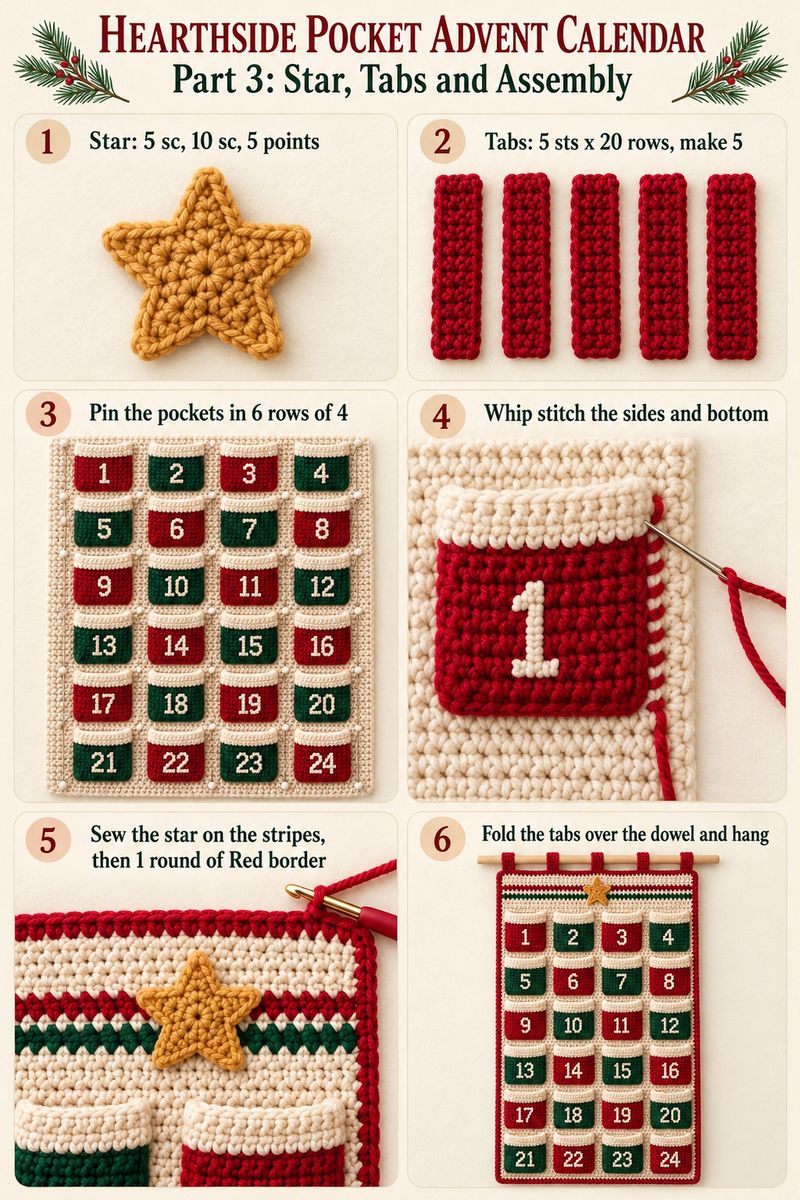 Sew on the pockets
Pin each pocket by the placement table and whip stitch the bottom and sides, leaving the top of the cuff open.
- Sew on the star
Centre the gold star over stitch 38, across the green and red stripes.
- Work the border
Work one round of red single crochet all the way round the panel, 412 stitches.
- Add the tabs and dowel
Fold and sew the five tabs to the wrong side, then slide in the dowel and tie the cord to both ends.
The seven steps run in build order, and the three step pictures from our pattern cover the panel, the pockets with their numbers, and the assembly.
The order matters. You stitch the numbers before sewing because a loose pocket is much easier to handle than one fixed to the panel. You sew the tabs last, after the border, so they sit snugly behind it. “Start in November and the calendar is ready to fill for the 1st of December,” our pattern says. The pockets are quick and all the same, so our pattern suggests you make them in batches of six.
Every crocheted piece is single crochet, apart from a few stitches in the star points. If the stitch is new to you, learn it first with How to Single Crochet: A Step by Step Guide for Beginners, then make the free practice pocket.
The panel’s Rows 2 to 118 are one long cream stretch of the same row, and our pattern suggests a pencil tally of the rows so you never lose your place. An online tracker does the same job: see the Online Crochet Row Counter: Count Rows and Stitches.
Stitches and skill level
The advent calendar uses five stitches and four techniques, and its skill level is Easy on the Craft Yarn Council scale. Our pattern’s stitches, in US terms with their UK names:
| US term | UK term | Where it is used |
|---|---|---|
| chain (ch) | chain | foundation chains |
| slip stitch (sl st) | slip stitch (ss) | star joins |
| single crochet (sc) | double crochet (dc) | every piece |
| half double crochet (hdc) | half treble (htr) | star points |
| double crochet (dc) | treble (tr) | star points |
The table shows single crochet doing almost all the work; the taller stitches appear only in the star points.
Our pattern teaches four techniques in its techniques section:
- colour change
- magic ring
- cross stitch
- whip stitch
Our pattern sits at the Easy level, which the Craft Yarn Council defines in its “Project Levels” standard as “Projects may include simple stitch patterns, color work, and/or shaping.” Its own scope line reads: chain, single crochet, colour changes, magic ring, cross stitch and simple sewing. The rating fits because the only colour work is two stripes on the panel and one colour change per pocket, so you never carry two colours in one row. The council’s four levels are Basic, Easy, Intermediate and Complex; “beginner” is not one of its labels. Read every sc here as a UK double crochet if you learned UK terms. The full US to UK list sits in the Crochet Abbreviations and US to UK Stitch Names.
You can follow the pattern as written if you crochet left handed. The charts show the right side.
Common mistakes and how to fix them
Many problems on a single crochet wall hanging come from the stitch count changing by one, so the fixes below start with counting:
| Problem | Cause | Fix |
|---|---|---|
| The panel grows by 1 stitch every row | The turning ch 1 was worked as a stitch | Skip the ch 1; you should have 75 stitches at the end of Row 1 (15 on a pocket) |
| Row 1 has 76 stitches instead of 75 | The first stitch went into the 1st chain from the hook | Start in the 2nd chain from the hook |
| The panel starts to lean | Working into the turning chain instead of the last stitch | Work into the last stitch of each row |
| A small step shows at the colour change | The new colour was started on a new stitch | Finish the last stitch of the old colour with the new colour |
| The panel puckers around the pockets | Whip stitches pulled too tight | Pull them snug, not tight |
| A row of pockets sits crooked | Pockets sewn without checking the line | Pin all four, lay a ruler across, sew from the bottom row up |
| The calendar hangs crooked | Tabs of different lengths | Make all five tabs 20 rows |
| The bottom edge curls | The fabric was not blocked flat | Spray lightly, pat flat on a towel, pin the edge while it dries |
The first two problems in our table are pure counting errors, which is why counting comes first.
Makers often find a long single crochet panel comes out wavy, even after blocking. The fix in our pattern starts much earlier. Our pattern puts a stitch count in brackets at the end of every row as your checkpoint. Count your stitches every 10 rows and mark every 10th row, because one stitch gained or lost on some rows, often at the turning chain, is what makes the sides wave. Blocking flattens a panel. It cannot put back a missing stitch.
Tiny crochet ornaments to fill the pockets
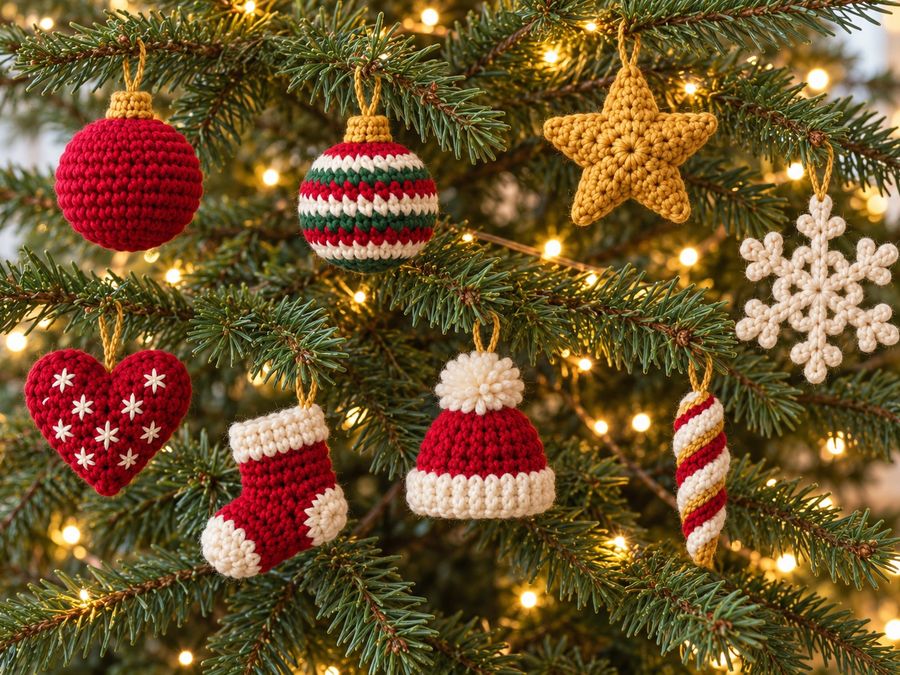
Tiny crochet ornaments of about 3 to 5 cm / 1.25 to 2 in fit our 8.8 cm / 3.5 in pockets with room to spare. Our Tiny Christmas Ornaments pattern sizes its 30 ornament patterns for “an advent calendar pocket”, among other uses. For an advent calendar, our ornament pattern suggests you start in early November: “two or three ornaments an evening fills all 24 days in time.”
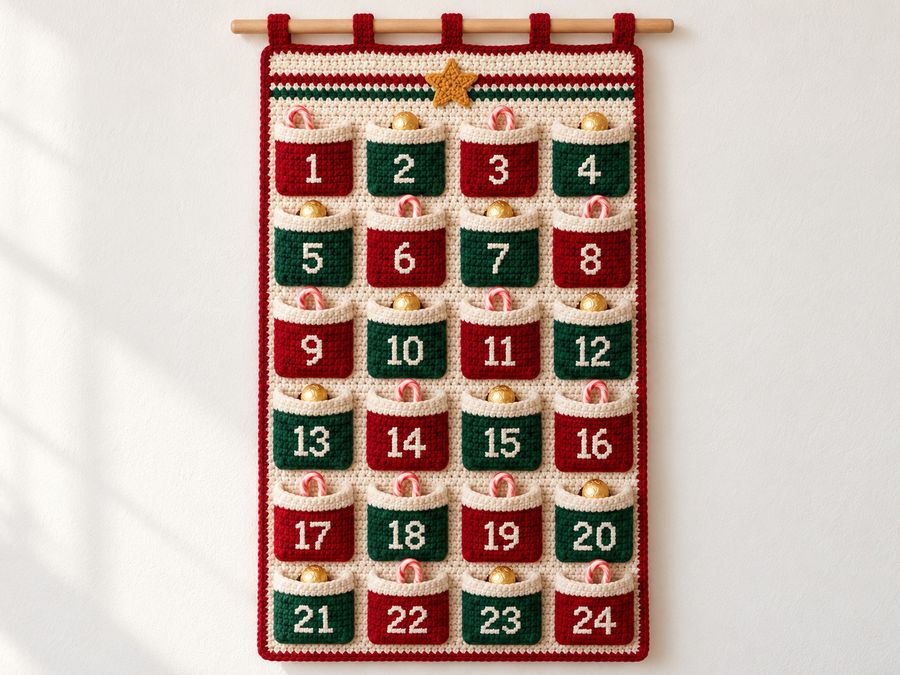
Filled pockets show the kind of treat an 8.8 cm advent pocket holds: candy canes and wrapped sweets.
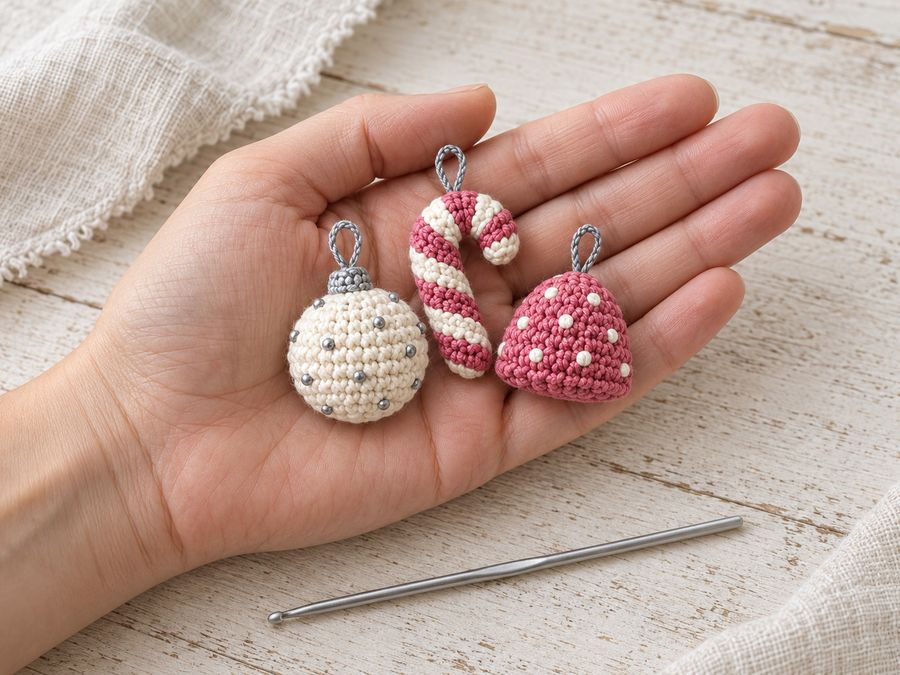
The ornaments in a palm give their size next to the pocket they fill.
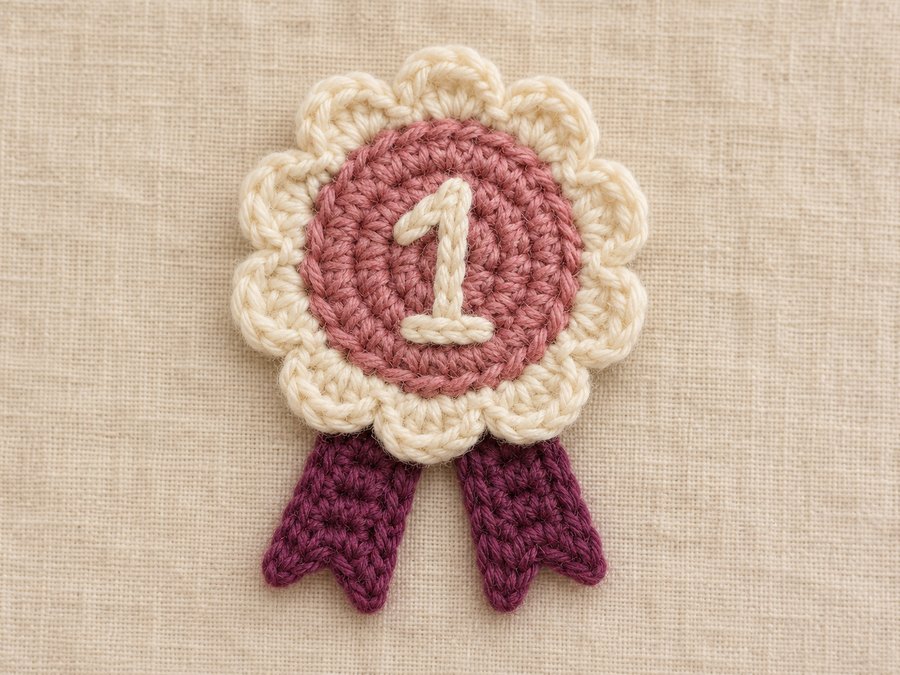
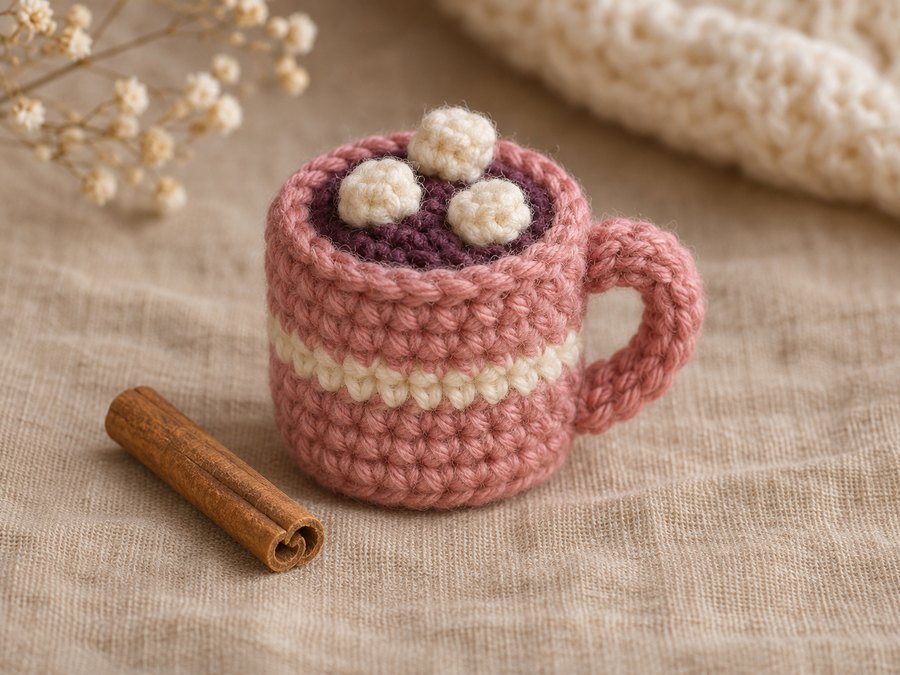
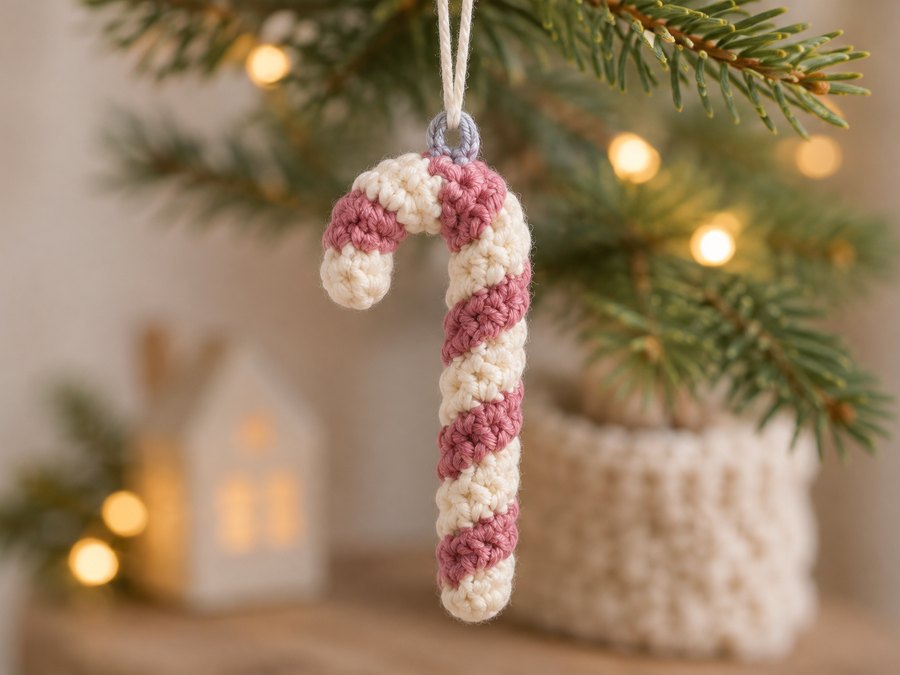
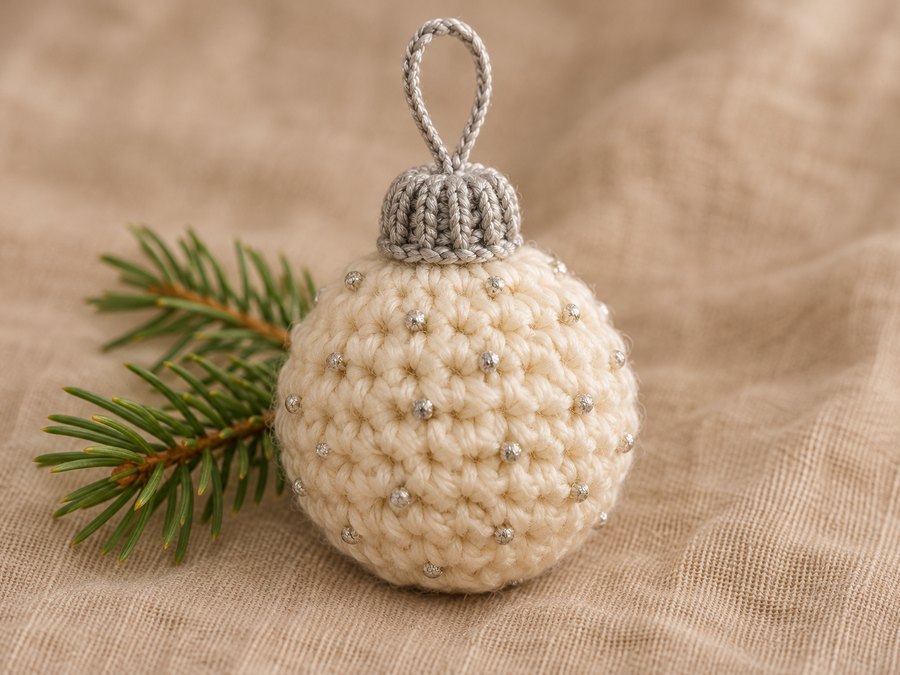
Six of the thirty follow. Four have an advent idea in their own pattern notes; the Candy Cane is one of the quickest at 10 minutes, and the Snow Bauble is the one to learn first. Every card gives the same facts in the same order: yarn, hook, skill level, time and what each one is best for.
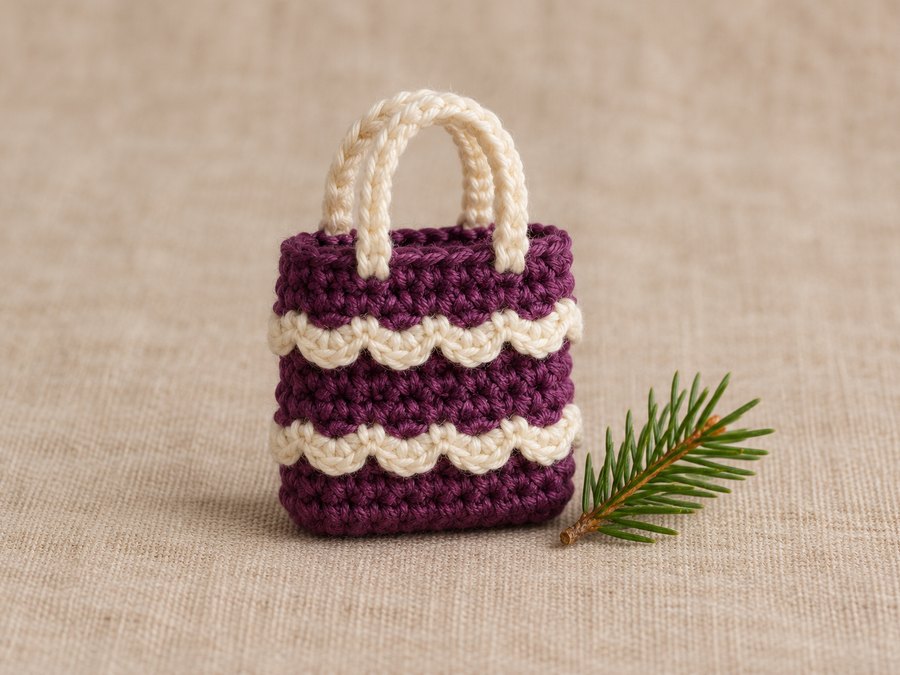
Gift Bag
- Yarn
- 3, light (DK)
- Hook
- 2.75 mm (US C-2)
- Skill level
- Beginner
- Time
- 20 minutes
- Best for
- a folded note inside
The Gift Bag is a flat plum bag with ivory bands and two handles, 3.6 cm / 1.5 in wide. It opens, so you can tuck a tiny treat or a folded note inside.
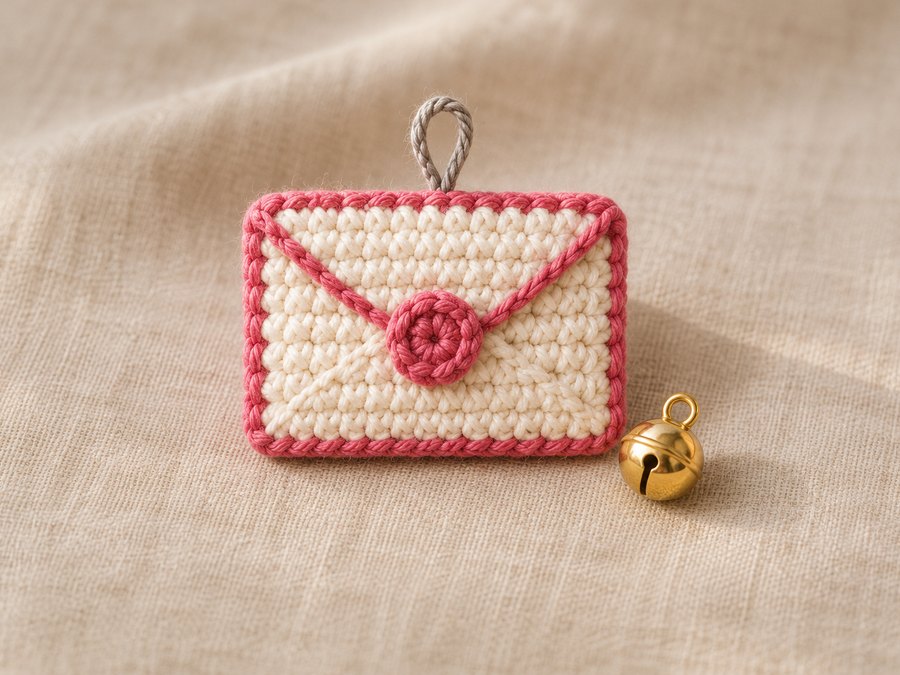
Mini Envelope
- Yarn
- 3, light (DK)
- Hook
- 2.75 mm (US C-2)
- Skill level
- Beginner
- Time
- 15 minutes
- Best for
- a written wish or an advent number
The Mini Envelope is an ivory envelope with a rose seal, 3.6 cm / 1.5 in wide. It really opens. Slip a folded paper note inside before it goes in the pocket.
Ribbon Rosette
- Yarn
- 3, light (DK)
- Hook
- 2.75 mm (US C-2)
- Skill level
- Beginner
- Time
- 10 minutes
- Best for
- a numbered rosette
The Ribbon Rosette is a rose and ivory rosette with two plum tails, 3.2 cm / 1.25 in across. Embroider a number on the centre in Ivory and you have a numbered advent rosette.
Hot Cocoa Mug
- Yarn
- 3, light (DK)
- Hook
- 2.75 mm (US C-2)
- Skill level
- Beginner
- Time
- 20 minutes
- Best for
- a tiny folded note
The Hot Cocoa Mug is a rose mug with plum cocoa and ivory marshmallows, 2.2 cm / 0.75 in tall. Tuck a tiny folded note in the mug and you have a small surprise.
Candy Cane
- Yarn
- 3, light (DK)
- Hook
- 2.75 mm (US C-2)
- Skill level
- Beginner
- Time
- 10 minutes
- Best for
- a quick daily make
The Candy Cane is a slim ivory and rose striped cane, 5 cm / 2 in tall, with a chenille stem inside so it holds its hook. It is the tallest of the six. It still fits standing up.
Snow Bauble
- Yarn
- 3, light (DK)
- Hook
- 2.75 mm (US C-2)
- Skill level
- Beginner
- Time
- 20 minutes
- Best for
- the first ornament to learn
The Snow Bauble is an ivory ball with a small silver cap, 2.7 cm / 1 in across. Make it first, because its ball shape is the base for most of the round ornaments in the set.
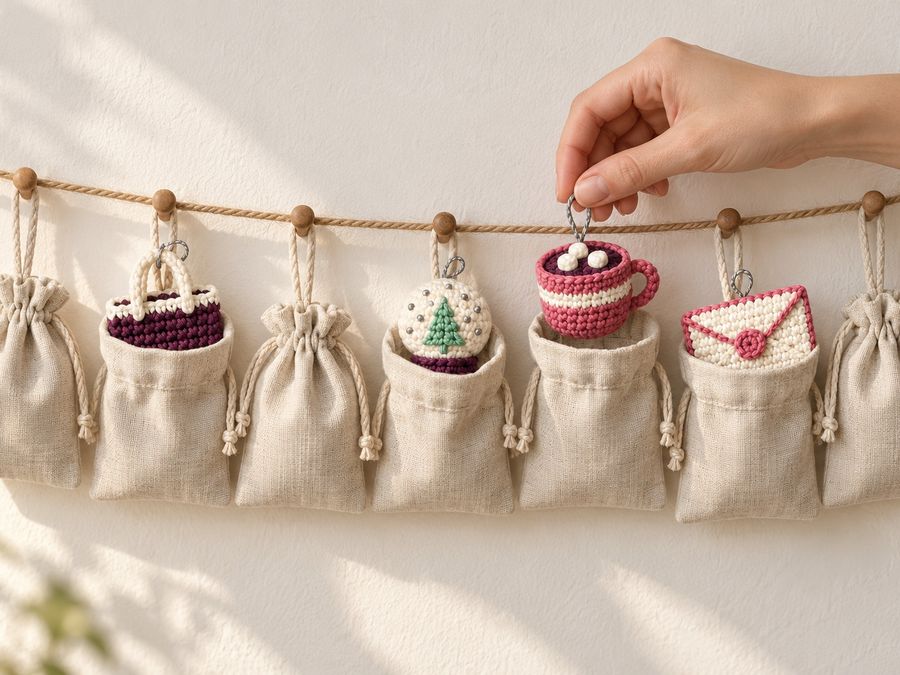
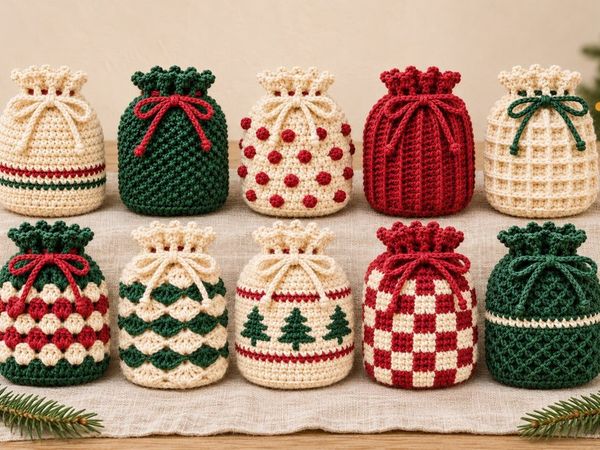
Four of the tiny ornaments sit in linen bags here, the same daily surprise an advent pocket gives.
Ornaments are one filler among several. Our calendar pattern suggests wrapped sweets, folded notes and little activities for each day, and it comes with 24 printable pocket cards, each with a family idea for one day, plus blank cards for your own. Each card is about 6 x 6.5 cm, so you can slip one into each 8.8 cm opening.
Keep small items out of reach of young children. Heavy items stretch the pockets, so keep each filling light. Our ornament pattern warns that the pieces contain small parts, and the Candy Cane has a chenille stem. They are decorations, not toys.
More shapes, from bells to snowflakes, sit in our guide to Crochet Christmas Ornament Patterns: 15 Types to Make.
Hanging, storing and washing the calendar
The calendar hangs on a wall, a door or the side of a bookcase. Our pattern hangs it from a dowel slid through the five tabs, with the cord tied to both ends. All five tabs must be the same length, so your panel hangs straight.
When you take it down, store it rolled, not folded, so the pockets keep their shape. It comes out again every December.
Our pattern’s care line is short. Hand wash it cold with a mild detergent, roll it in a towel to remove the water and dry it flat. Do not iron acrylic yarn. A light steam held above the fabric is enough.
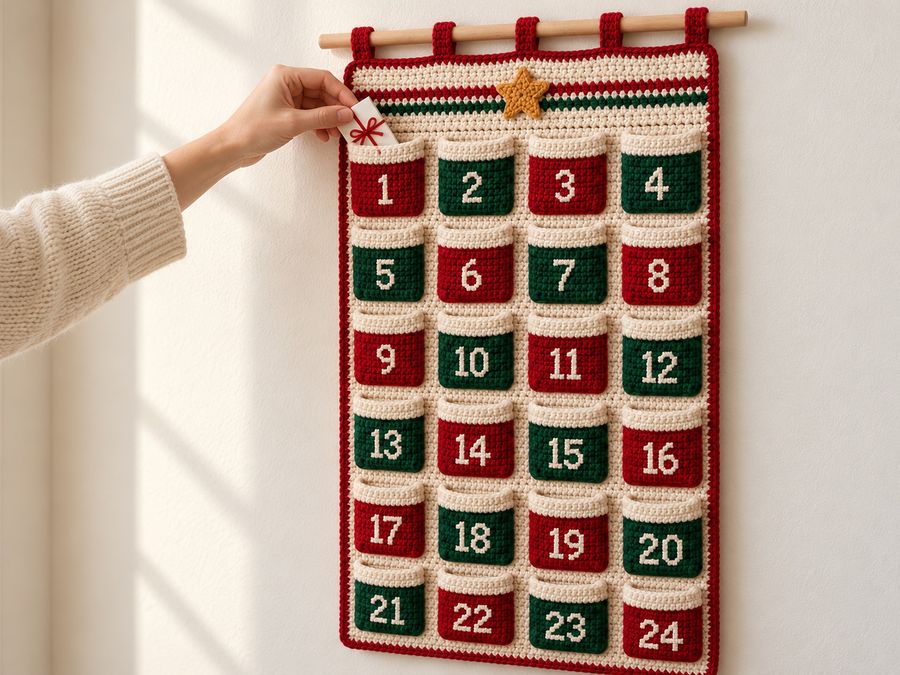
Pocket number 1 opens the countdown on the first day of December.
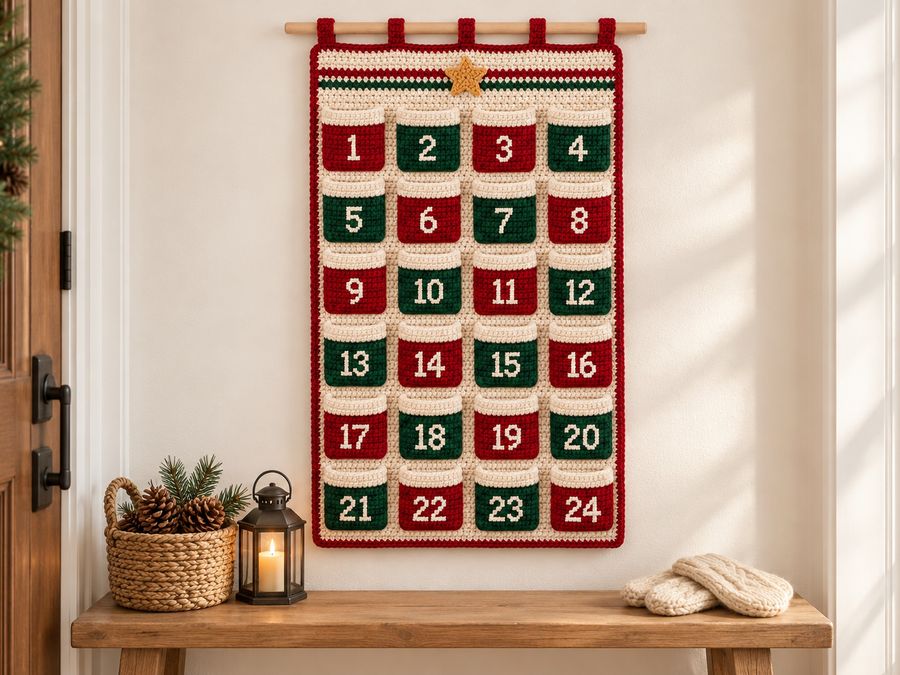
Hung in a hallway, the calendar shows its full 72 cm / 28.25 in drop with the tabs.
When a crochet advent calendar kit or another style suits you better
A crochet advent calendar kit is a boxed set of 24 small parcels of yarn and project instructions, opened one a day, and it suits you better if you want a new small project to crochet every day of December. A pattern is a set of instructions you make once into a calendar you fill yourself, every year, so our pattern suits you better if you want one countdown you keep.
| Kit | Pattern | |
|---|---|---|
| What you get | yarn and daily projects in boxes | instructions; you choose the yarn |
| When you crochet | during December | before December, from November |
| Used again | the boxes are opened once | the calendar comes out every year |
The table splits the two readings of “crochet advent calendar”: a kit is a December activity, and our pattern is a decoration you keep.
Other calendar styles hang small containers instead of pockets. Mini stocking calendars hang 24 little stockings, and two of our patterns include one: Candy Cane Covers, whose 12 candy cane holders include a mini stocking, and Mini Sweater and Mitten Ornaments, whose 15 patterns include a stocking. Bag calendars use tiny pouches, and the Gift Bag ornament above opens like one. Gnome calendars give each day a little gnome; ideas for those sit in Crochet Gnome Ideas: Christmas Gnomes, Beards and Snowmen. Tree and amigurumi calendars hang a small ornament or toy on a tree shaped or wall base each day. We have no pattern for the base or for amigurumi toys, but the tiny ornaments above can be the daily ornaments.
More Christmas patterns to make
Once your calendar is up, the mantel is next, so a matching stocking from Crochet Christmas Stocking Pattern: 4 Designs with a Name Panel makes a natural partner, and the whole family of seasonal projects sits in Christmas Crochet Patterns: Ornaments, Stockings and Decor. Every pattern we feature, Christmas decor and winter wear alike, is in Crochet Patterns to Make: Christmas Decor and Winter Wear. For a smaller first project, see Beginner Crochet Projects: Easy First Patterns to Make.
Questions makers ask
Is a crochet advent calendar hard to make?
No. Our pattern sits at the Craft Yarn Council's Easy level, because every piece is single crochet worked flat in rows. The new skills, colour changes, a magic ring, cross stitch and whip stitch, are each explained in the techniques section, and a stitch count at the end of every row lets you check your work as you go.
How much yarn does a crochet advent calendar take?
Our calendar takes about 450 m / 495 yd of Cream, 150 m / 165 yd of Red, 110 m / 125 yd of Green and about 5 m of Gold, all in 4, medium (worsted) yarn. Cream is close to two thirds of the total, because it makes the panel, every cuff and all 24 numbers.
How big are the pockets?
Each pocket is about 8.8 x 8.4 cm / 3.5 x 3.3 in, 15 single crochet wide and 16 rows tall. The opening is about 8.8 cm / 3.5 in wide, which is room for a wrapped sweet, a folded note or a tiny ornament. Keep each filling light, because heavy items stretch the pockets.
What can I put in a crochet advent calendar?
Light, small things: wrapped sweets, folded notes, little activities for each day or tiny ornaments of 3 to 5 cm / 1.25 to 2 in. Our pattern comes with 24 printable pocket cards, each with a family idea for one day. Keep small items out of reach of young children.
Is there a free crochet advent calendar pattern here?
One pocket is free. The full 24 pocket calendar is not written out on this site. One practice pocket is written out in full on this page, with its foundation chain, every row and the colour change. This page also gives the calendar's size, yarn, gauge, layout and assembly, so you can judge the whole project first.
When should I start a crochet advent calendar?
Start in November. Our pattern puts it plainly: "Start in November and the calendar is ready to fill for the 1st of December." The 24 pockets are small and all the same, so the pattern suggests making them in batches of six once the panel is done.