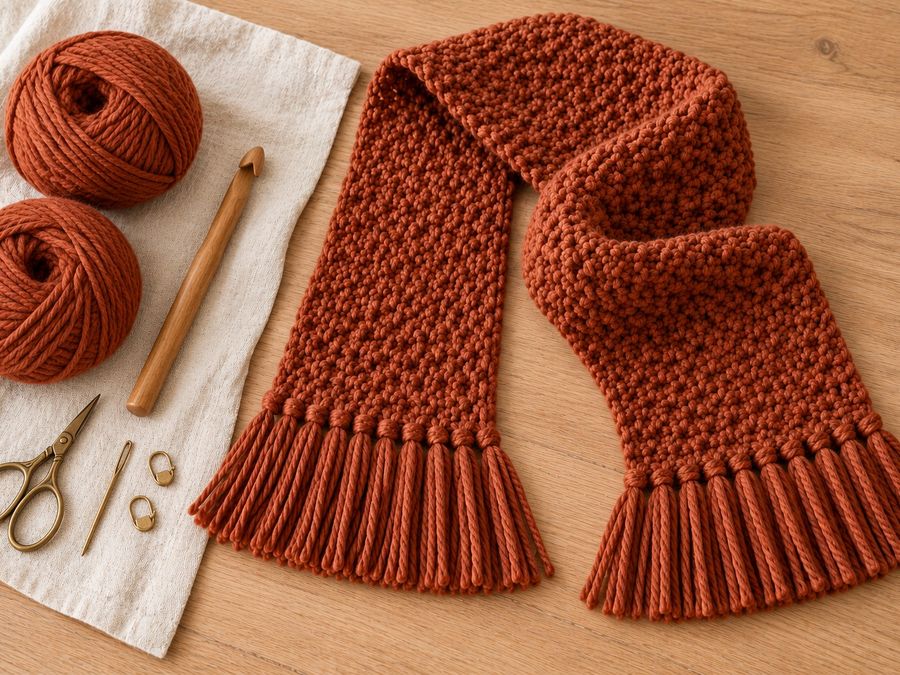
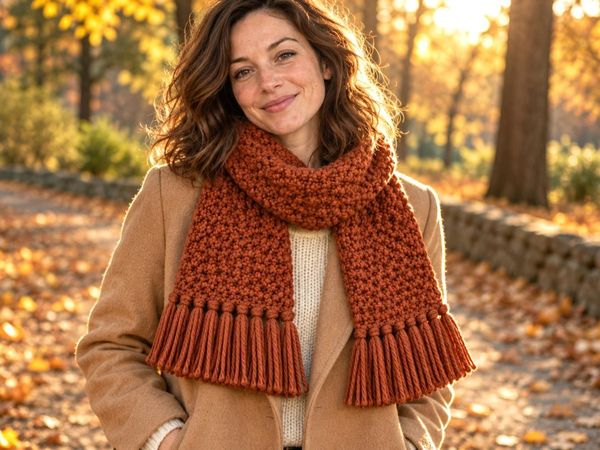
To crochet, choose a hook that suits your yarn weight, make a slip knot and a foundation chain, then work single crochet into the chain, one row at a time. Count your stitches at the end of every row, as How to Single Crochet: A Step by Step Guide for Beginners shows. Then learn the taller stitches, read a pattern and make a first project such as a coaster or a scarf. Six steps cover how to crochet for beginners, from the first loop to a first project, and the hook and yarn numbers are the Craft Yarn Council’s, so every range matches its tables.
 Choose a hook and yarn
Pick a yarn weight first, then a hook in the Craft Yarn Council range for it: 4, Medium yarn takes 5.5 mm (US I-9) to 6.5 mm (US K-10 1/2).
- Make a slip knot
Tie a loop that slides on the hook and tightens around it. It holds the yarn on the hook and does not count as a stitch.
- Chain the foundation row
Yarn over and pull through the loop on the hook. Repeat until the chain is as long as the pattern asks.
- Work single crochet
Insert the hook, yarn over and pull up a loop, then yarn over and pull through both loops on the hook.
 Read the pattern line
Decode the abbreviations, check the stitch count in brackets and confirm the pattern uses US or UK terms.
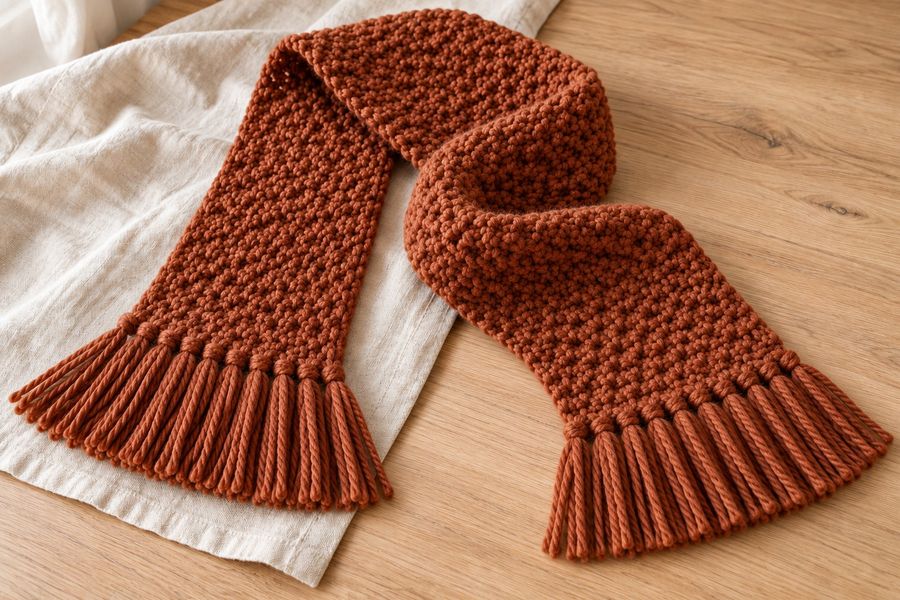 Make a first project
Start with a flat rectangle such as a scarf, then a small round piece such as a coaster.
What do you need to start crocheting?
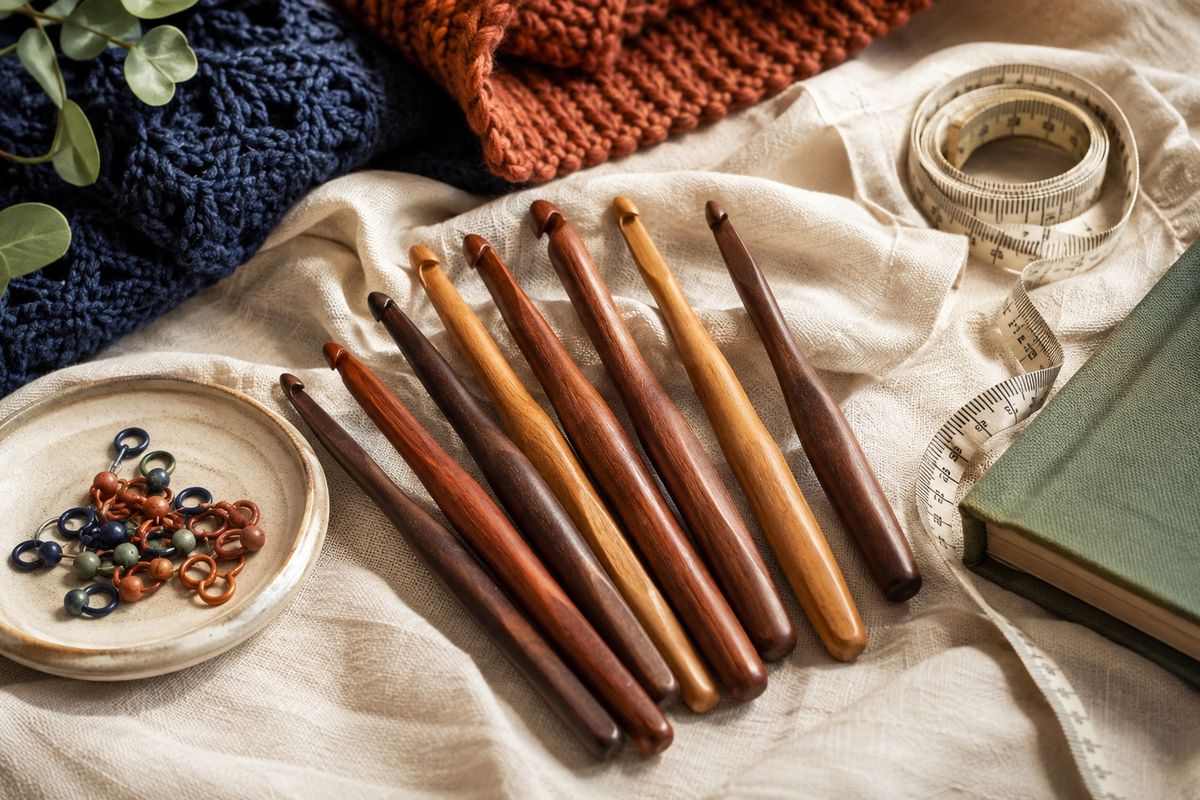
You need four things to start crocheting: a crochet hook, yarn, scissors and a yarn needle.
- A crochet hook, the tool that pulls each new loop through the last one.
- Yarn, one smooth ball in a weight the hook is sized for.
- Scissors, a small pair for cutting the yarn when a piece is done.
- A yarn needle, a blunt needle for weaving the tails into the stitches.
The hook and the yarn are chosen together, because the yarn weight sets the hook range. Pick your yarn first. Then read your hook size off its weight, as the next section shows. Yarn decides.
Which crochet hook size should a beginner use?
A beginner using 4, Medium (worsted) yarn should use a hook from 5.5 mm (US I-9) to 6.5 mm (US K-10 1/2), the range the Craft Yarn Council recommends for that weight in its “Standard Yarn Weight System”. The millimetre number is the actual diameter of the hook. The council treats it as the more accurate measure, because companies once numbered the US letter sizes differently. Trust the millimetres. Its ranges are guidelines only, so your pattern can still ask for a hook outside them. When it does, you follow the pattern.
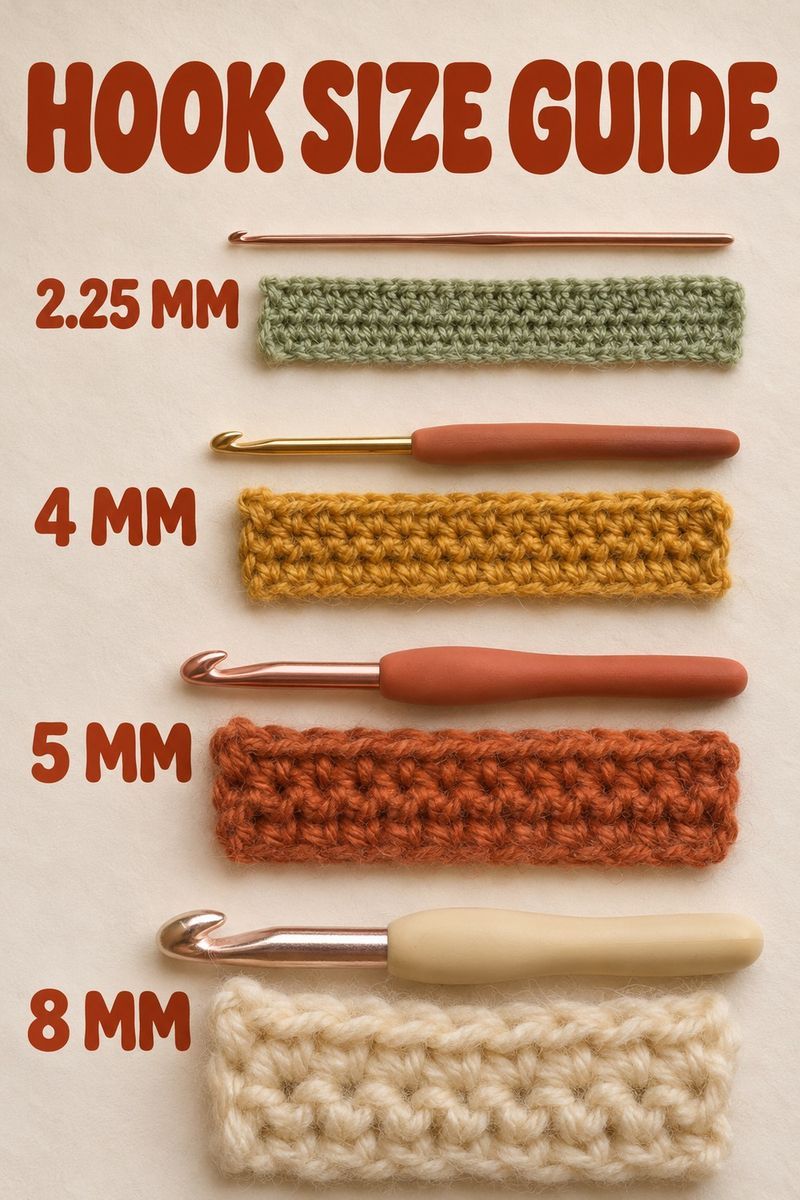
The hook size chart shows four crochet hooks, 2.25 mm (US B-1), 4 mm (US G-6), 5 mm (US H-8) and 8 mm (US L-11), each above a swatch, so you can see the stitch grow with the hook. Bigger hook, bigger stitch. The full list of crochet hooks for beginners, from the smallest steel hook to the jumbo sizes, belongs on Crochet Hooks for Beginners: Hook Sizes in mm and US Letters.
Which yarn weight should a beginner use?
A beginner should use a smooth, light-coloured yarn in 4, Medium (worsted) weight, so you can see each stitch and your hook range is the one given above. Dark and fuzzy yarns hide the top of each stitch. That is where your hook goes next.
Three CYC yarn weights cover most first projects:
| CYC number and name | Yarn types in the category | Crochet gauge (per 4 in.) | Recommended hook |
|---|---|---|---|
| 3, Light | DK, Light Worsted | 12-17 sts | 4.5-5.5 mm (US 7 to I-9) |
| 4, Medium | Worsted, Afghan, Aran | 11-14 sts | 5.5-6.5 mm (US I-9 to K-10 1/2) |
| 5, Bulky | Chunky, Craft, Rug | 8-11 sts | 6.5-9 mm (US K-10 1/2 to M-13) |
Yarn weights run from 0, the finest, to 7, the thickest, and the three rows above come from the Craft Yarn Council’s “Standard Yarn Weight System”. The council says the system is not an interchangeability chart. Two yarns with the same number can still crochet up differently, so work a swatch before you swap one for another.
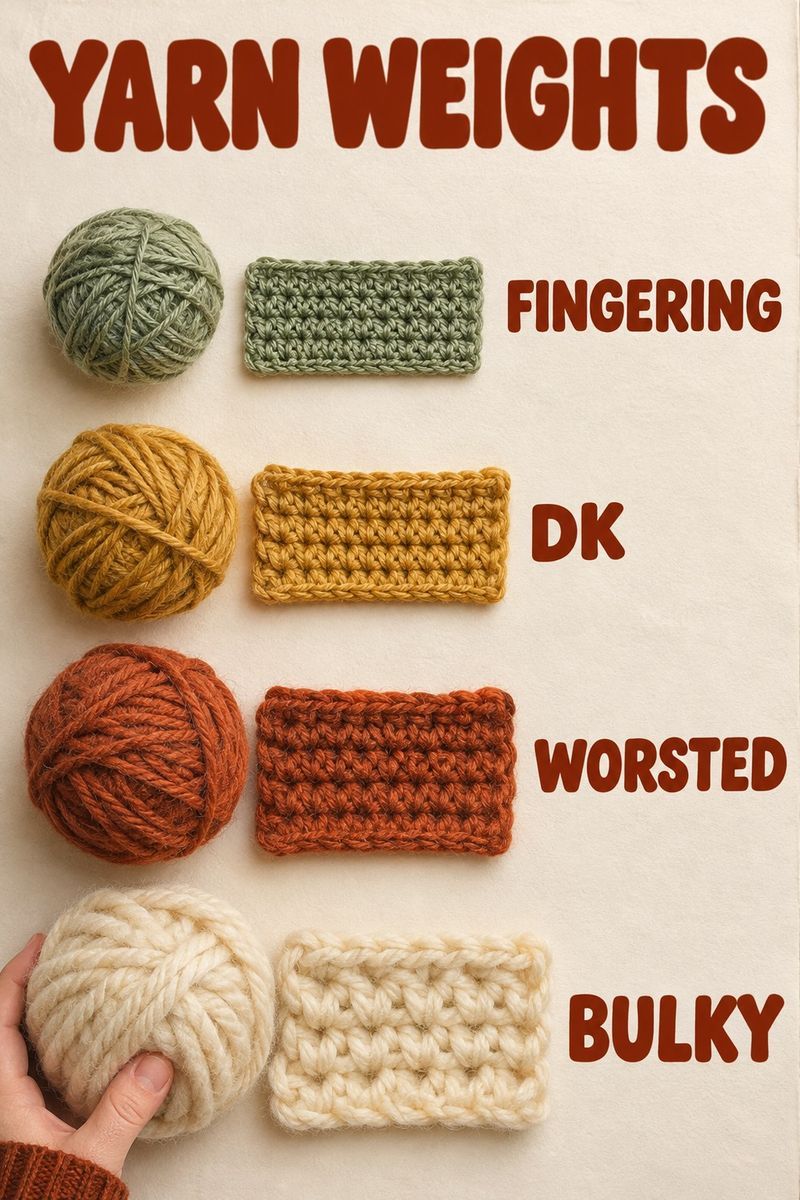
The yarn weights chart shows fingering, DK, worsted and bulky yarn beside their swatches, and you can see the jump in stitch size from one weight to the next. Crochet yarn for beginners, weight by weight, is covered in Crochet Yarn for Beginners: Yarn Weights, Hooks and Gauge. With your hook and yarn chosen, the next step is your hands.
How do you hold a crochet hook and yarn?
You hold a crochet hook in one of two grips, the pencil grip or the knife grip, and both work. In the pencil grip, the hook rests between your thumb and index finger the way a pencil does, with your thumb on the flat thumb rest. In the knife grip, your palm sits over the handle, the way you hold a table knife. Choose the one that feels natural. You can switch later.
Your other hand feeds the yarn and holds the work. A common way is to pass the yarn over your index finger, under your middle finger and around your little finger, so the yarn feeds at an even rate. Your thumb and middle finger pinch the work just below the hook. Tight fingers make tight stitches. Even tension comes from rows, not force.
How do left-handed crocheters hold the hook?
Left-handed crocheters hold the hook in the left hand and work from left to right, a mirror image of every step on this page. Your right hand feeds the yarn instead. Photos and diagrams are drawn for right hands, so you read them as their mirror image. The stitches do not change.
How do you make a slip knot and a foundation chain?
Every flat crochet piece starts the same way: a slip knot on the hook, then a chain of loops called the foundation chain. Patterns write a chain as “ch” and a yarn over as “yo”, the abbreviations in the Craft Yarn Council’s master list, so you will see both on the first line of almost any pattern.
Step 1: Make a slip knot
- Make a loop near your yarn end, with the working yarn (the strand from the ball) lying behind the loop.
- Insert the hook through the loop, catch the working yarn and pull it through.
- Pull the tail and the working yarn to close the knot around the hook.
Your knot should sit snug but still slide. A slip knot is adjustable, so it tightens on the hook and does not count as a stitch.
Step 2: Chain the foundation row
- Hold the tail and the base of the knot between your thumb and middle finger.
- Yarn over: wrap the yarn over the hook from back to front.
- Pull the yarn through the loop on the hook. That is one chain.
- Repeat until the chain is the length your pattern asks for.
Count the V shapes on the front of the chain. You do not count the loop on the hook, and you do not count the slip knot. Keep your chains loose, because your hook has to go back into each one on the first row. A tight chain makes that first row the hardest of the whole piece. Your first stitches go into this chain next.
What are the basic crochet stitches?
Four basic crochet stitches cover most beginner patterns: single crochet, half double crochet, double crochet and slip stitch. They differ in height. You will meet all four in your first patterns. Each extra yarn over makes a taller stitch, so the fabric grows faster and opens up.
| US name | US abbreviation | UK name | Height |
|---|---|---|---|
| Slip stitch | sl st | slip stitch (ss) | no height |
| Single crochet | sc | double crochet (dc) | short |
| Half double crochet | hdc | half treble (htr) | medium |
| Double crochet | dc | treble (tr) | tall |
| Treble crochet | tr | double treble (dtr) | tallest |
The table runs from the shortest stitch to the tallest, with each UK name as the Craft Yarn Council’s “Crochet Abbreviations Master List” gives it. Crochet stitches beyond these five, from textured stitches to post stitches, belong on Crochet Stitches: Types of Crochet Stitches with Pictures.
Single crochet (sc)
Single crochet is the shortest stitch that builds a solid fabric, and it is the first one you should learn. On a new chain, the first single crochet goes into the second chain from the hook.
- Insert the hook into the next chain or stitch.
- Yarn over and pull up a loop, so two loops sit on the hook.
- Yarn over and pull through both loops.
You now have one loop on your hook. That is one single crochet. Repeat it. The turning chain, the second row and the six common mistakes are in How to Single Crochet: A Step by Step Guide for Beginners.
Half double crochet (hdc)
Half double crochet sits between single and double crochet in height, because it starts with a yarn over but finishes in one pull. UK patterns call it half treble. Three loops, one pull.
- Yarn over, then insert the hook into the stitch.
- Yarn over and pull up a loop, so three loops sit on the hook.
- Yarn over and pull through all three loops.
Double crochet (dc)
Double crochet is the tallest of the four basic stitches, so a row of it grows quickly and leaves small gaps between the stitches. UK patterns call it treble.
- Yarn over, then insert the hook into the stitch.
- Yarn over and pull up a loop, so three loops sit on the hook.
- Yarn over and pull through two loops.
- Yarn over and pull through the last two loops.
Slip stitch (sl st)
A slip stitch is flat. It has no height, so you use it to travel and to join, not to build. Insert the hook, yarn over and pull the yarn through the stitch and the loop on the hook in one motion. It joins the end of a round to its start. It also moves your hook along a row without adding height.
How do you crochet in the round?
Crochet in the round works outward from a centre ring in rounds instead of rows, which is how circles, coasters and granny squares start. Patterns write a round as “rnd”. Each round ends where it began, so the piece grows wider instead of longer. How to crochet a circle comes down to adding stitches on each round so the piece stays flat. Your pattern gives the count. The Beginner Coasters pattern starts every coaster this way, from a magic ring worked outward in joined rounds.
What is a magic ring?
A magic ring is an adjustable starting ring: you work the first round into it, then pull the tail to close it, so the centre draws up tight. Its steps belong on How to Make a Magic Ring in Crochet for Beginners.
What is a granny square?
A granny square is a square motif worked in rounds from the centre, built from groups of double crochet with chain spaces at the corners, so each round turns four corners and stays square. How to crochet a simple granny square, round by round, is the subject of How to Crochet a Granny Square for Beginners.
How do you read a crochet pattern?
A crochet pattern is written in abbreviations, one row or round per line, with the stitch count at the end of the line. Your first row will often read like this:
Ch 16. Sc in 2nd ch from hook and in each ch across (15 sc). Ch 1, turn.
In plain words, you chain 16, work one single crochet into the second chain from the hook and into every chain after it, and check that the row holds 15 stitches. Then chain 1 and turn. The number in brackets is the stitch count, so you know straight away if a stitch went missing. Count before you turn.
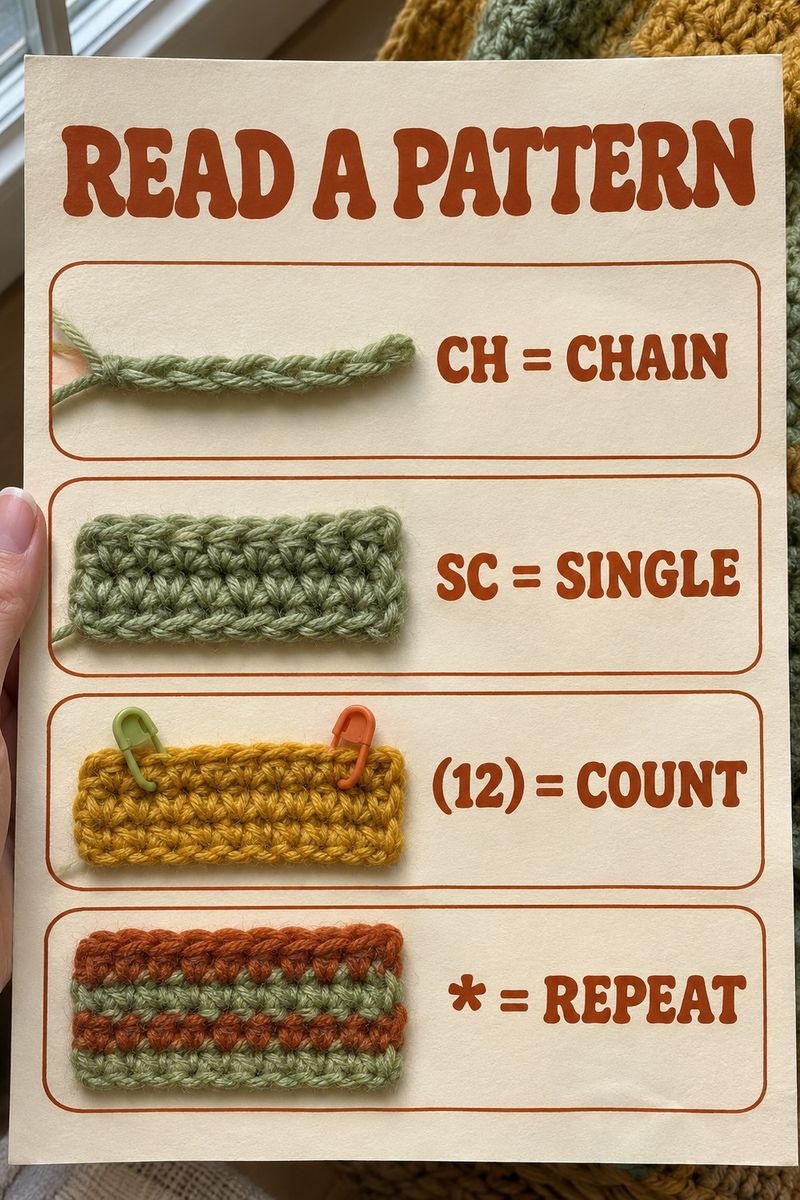
The pattern card shows four of those marks on real swatches: ch for chain, sc for single crochet, a number in brackets for the stitch count and an asterisk for a repeat. Longer patterns, with repeats and charts, are taught in How to Read a Crochet Pattern: Abbreviations and US vs UK Terms.
What do crochet abbreviations mean?
Crochet abbreviations are short forms for stitches and actions, so a whole row fits on one line. Fifteen of them cover a first pattern:
| Abbreviation | Meaning |
|---|---|
| ch | chain stitch |
| sl st | slip stitch |
| sc | single crochet |
| hdc | half double crochet |
| dc | double crochet |
| st | stitch |
| sk | skip |
| sp | space |
| ch-sp | chain space |
| rep | repeat |
| rnd | round |
| tch | turning chain |
| inc | increase |
| dec | decrease |
| yo | yarn over |
Each meaning matches the Craft Yarn Council’s “Crochet Abbreviations Master List”. Most patterns list the ones they use at the start, so you can check a short form before your first stitch.
What is the difference between US and UK crochet terms?
US and UK patterns use the same stitch names for different stitches: US single crochet is UK double crochet. The shift runs up the whole table. US half double crochet is UK half treble, US double crochet is UK treble and US treble is UK double treble. Gauge is called tension in UK patterns, and a yarn over is a yarn over hook (yoh). The two systems name stitches differently, so a UK “dc” worked as a US dc comes out a full stitch taller. Check your pattern’s notes for US or UK terms before you chain. Every pattern in the catalogue gives both in the same file.
What is gauge in crochet?
By the usual definition, gauge is the number of stitches and rows per inch (or centimetre) of crochet fabric. You measure it on a swatch, a small sample of the pattern worked before the main piece, usually a 4 in. (10 cm) square. The Craft Yarn Council says to always work a gauge swatch and compare it to the pattern gauge, whatever the hook’s number or millimetre size. Gauge sets the finished size, so if your swatch runs large, your piece runs large too.
What do the skill levels Basic, Easy, Intermediate and Complex mean?
The Craft Yarn Council’s “Project Levels” name four skill levels, and each one adds to the last:
- Basic: “Projects using basic stitches. May include basic increases and decreases.”
- Easy: “Projects may include simple stitch patterns, color work, and/or shaping.”
- Intermediate: “Projects may include involved stitch patterns, color work, and/or shaping.”
- Complex: “Projects may include complex stitch patterns, color work, and/or shaping using a variety of techniques.”
The council does not use the labels “beginner” or “experienced”. Read against its definitions, your first pattern sits at Basic or Easy, because both stay within basic stitches and simple shaping.
What should you crochet first?
The best first project is flat, worked in one stitch and one colour, with a stitch count on every row, so you see a mistake within a row of making it. Three projects follow in order:
- A flat rectangle, such as a dishcloth or a scarf.
- A small round piece, such as a coaster.
- A first written pattern with a stitch count on each line.
The Moss Stitch Chunky Scarf is written for beginners and asks for three skills: a chain, a single crochet and turning the work. It uses 6, Super Bulky yarn and a 10 mm (US N/P-15) hook, so each stitch is large enough for you to see and count. The Beginner Coasters come next, because they move from rows to rounds. Rounds come second. Every coaster starts from a magic ring and builds in joined rounds of double crochet on a 4 mm (US G-6) hook.
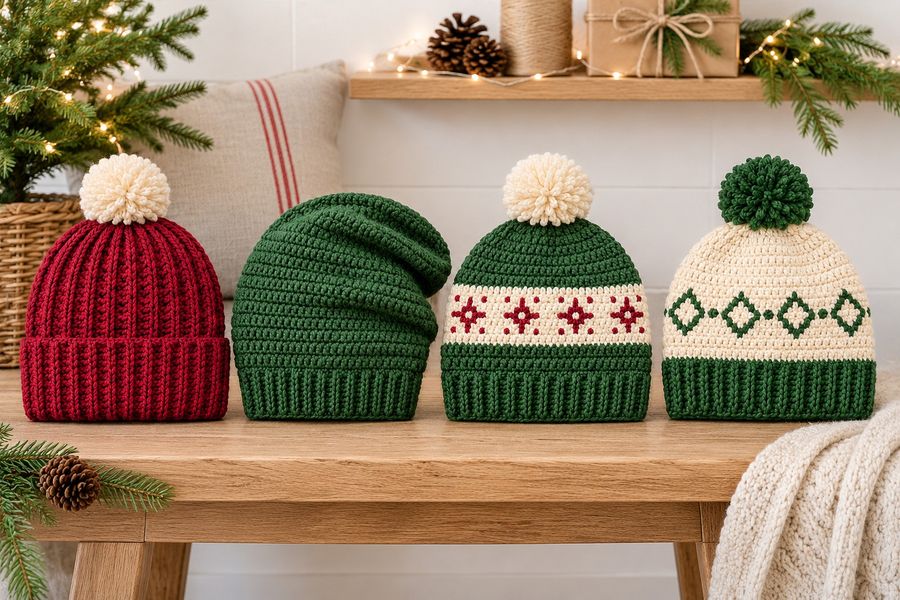
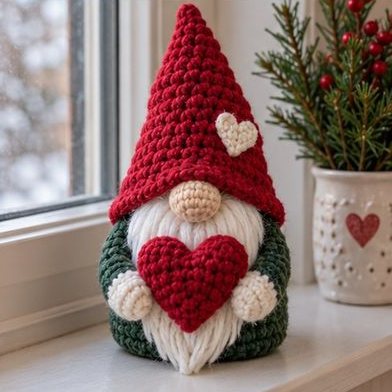
The moss stitch scarf is one straight rectangle of single crochet and chain one, finished with a fringe. More first projects at this level are gathered in Beginner Crochet Projects: Easy First Patterns to Make. For crochet patterns for beginners and the seasons after them, see Crochet Patterns to Make: Christmas Decor and Winter Wear.
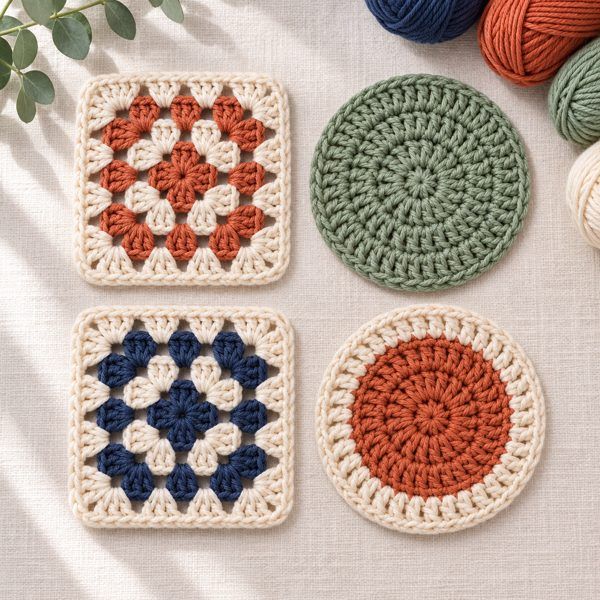
The coaster set shows the round step: granny square and round coasters, each grown from one centre ring.
Which crochet techniques come after the basics?
Six techniques build on the basic stitches: filet crochet, mosaic crochet, tapestry crochet, blocking, crochet hearts and amigurumi. Each one uses stitches you already know in a new arrangement, so none of them starts from zero.
Filet crochet
Filet crochet draws a picture with a grid of open mesh and filled blocks, read from a chart. Its method is taught in How to Filet Crochet: Open Mesh, Filled Blocks and Charts. Five patterns in the catalogue use it. Because both read from charts, mosaic is the natural next step.
Mosaic crochet
Mosaic crochet draws a pattern in two colours, with stitches dropped down over the rows below. How overlay mosaic works is set out in Mosaic Crochet: How Overlay Mosaic Works and How to Read Charts. Two patterns in the catalogue use overlay mosaic, so you can see the finished effect before you start. Tapestry crochet changes colour in a different way.
Tapestry crochet
Tapestry crochet changes colour inside a row and carries the unused yarn inside the stitches, following a chart. Color changes and carried yarn are covered in Tapestry Crochet: Color Changes, Carried Yarn and Charts. Two patterns in the catalogue use tapestry crochet. The chart does the drawing, so you change colour where the chart tells you.
Blocking
Blocking sets the final shape of a finished piece by pinning it out to size. How to Block Crochet Lace: Snowflakes, Shawls and Panels covers three shaped pieces. Small shaped pieces come next.
Crochet hearts
A crochet heart is a small shaped motif, so it is a quick first make for Valentine’s Day. The shapes are taught in How to Crochet a Heart: Small Hearts for Valentine’s Day. Stuffed figures are the step after.
Amigurumi
Amigurumi is small stuffed figures worked in tight rounds of single crochet, so the stuffing stays inside. Low sew shapes keep your sewing short, as Amigurumi for Beginners: Low Sew Shapes and First Patterns explains.
How is crochet different from knitting?
Crochet uses one hook and keeps one active loop on it, while knitting holds a row of live stitches on two needles. That one difference changes how mistakes behave. A dropped crochet loop does not run down the fabric the way a dropped knit stitch can, because every crochet stitch is finished before the next begins. Pull your hook out and the work simply waits for you. Both crafts share the Craft Yarn Council’s project levels, so Basic, Easy, Intermediate and Complex mean the same thing on a knitting pattern. A crochet pattern and a knitting pattern still use different abbreviations and different tools, so a pattern written for one craft cannot be worked in the other without rewriting every line.
Questions makers ask
Do you need a kit to learn to crochet?
No. A crochet hook, one ball of yarn, scissors and a yarn needle are enough to learn every step on this page. A kit only bundles those four things together. Buy the yarn first, then the one hook its weight calls for, so the two match from the first chain.
Can you learn to crochet with any yarn?
Yes, but a smooth, light-coloured yarn in 4, Medium weight shows the stitches best. Fuzzy, dark and novelty yarns hide where each stitch begins, so the hook keeps missing its place. Save them for the second or third project, once the stitches are easy to count.
What is the easiest crochet stitch to learn first?
Single crochet. It is the shortest of the basic stitches that builds a fabric: one loop pulled up, then one yarn over to finish. That short sequence is easy to repeat and easy to count, so it is a stitch many first patterns use.
Is crochet harder for left-handed people?
No. A left-handed crocheter follows the same steps in reverse, with the hook in the left hand and the yarn in the right. Stitch names, abbreviations and stitch counts stay the same, so any written pattern works without changes. Only photos need to be read as their mirror image.
What do the numbers on a crochet hook mean?
The millimetre number is the diameter of the hook's shaft. The US letter is an older label, and the Craft Yarn Council moved to metric sizing because companies numbered the letters differently. When a pattern and a hook disagree, trust the millimetre size over the letter.