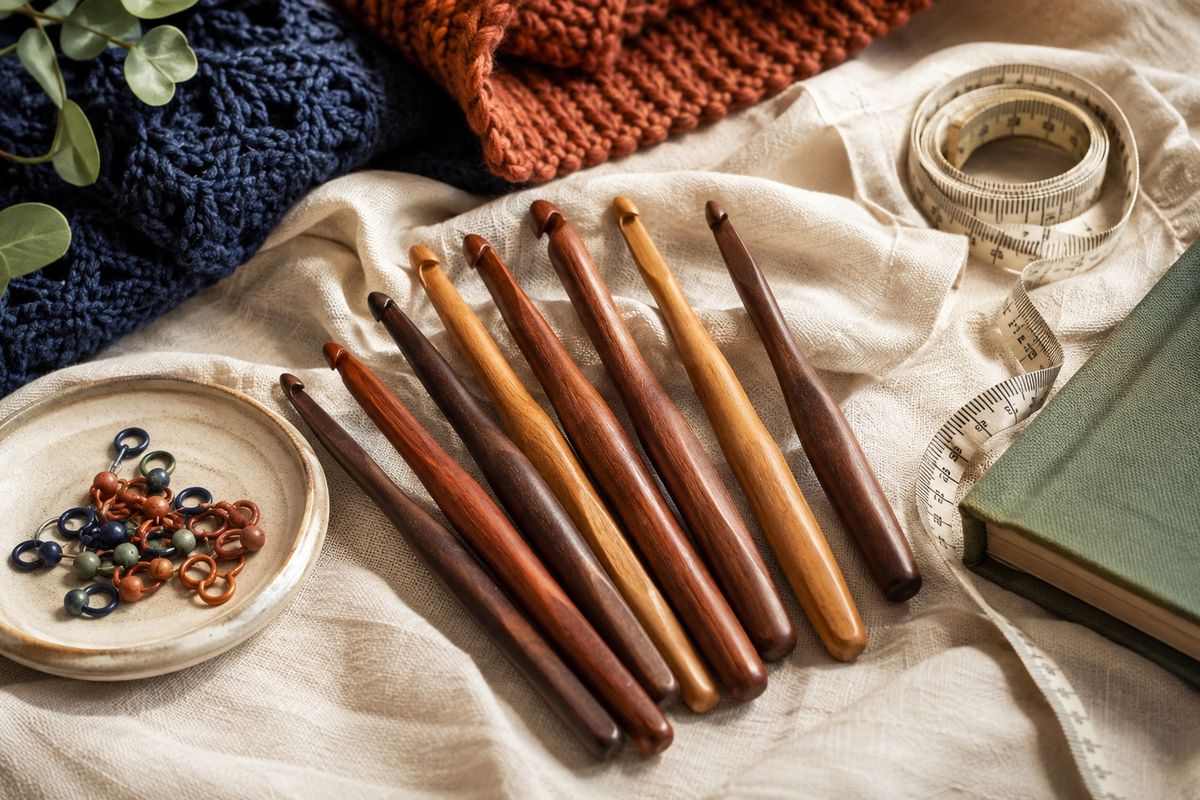
To single crochet, insert the hook into the next stitch, yarn over and pull up a loop (two loops on the hook), then yarn over and pull through both loops. On a new chain, your first sc goes into the second chain from the hook, one goes into each chain, and then you chain 1 and turn. UK patterns call the same single crochet stitch double crochet. The eight steps below show how to single crochet from a loose yarn end to a second row, so you end with a swatch to count, fix and vary.
- Make a slip knot
Loop the yarn, pull the working yarn through with the hook and tighten the knot until it is snug but still slides.
- Chain the foundation row
Yarn over and pull through the loop on the hook. Repeat until you have 16 chains for a practice row.
- Insert the hook into the second chain
Skip the first chain from the hook and go under the top two strands of the second chain's V.
- Yarn over and pull up a loop
Wrap the yarn over the hook and draw it back through the chain. Two loops now sit on the hook.
- Yarn over and pull through both loops
Wrap the yarn again and pull it through both loops. One loop is left: that is one single crochet.
- Work one single crochet in each chain
Repeat the stitch in every chain to the end. Sixteen chains give a first row of 15 single crochet.
- Chain 1 and turn
Make one chain, then turn the work like a page. In single crochet this turning chain is not a stitch.
- Work the next row
Put the first stitch into the first stitch of the row, not the chain, and the last into the last stitch.
What do you need to single crochet?
You need a crochet hook, a smooth yarn, scissors and a yarn needle.
- A crochet hook sized for your yarn.
- A smooth yarn in a light colour.
- Scissors for cutting the yarn.
- A yarn needle for weaving in the tails.
For 4, Medium (worsted) yarn, use a 5.5 mm (US I-9) to 6.5 mm (US K-10 1/2) hook, the Craft Yarn Council range for that weight. The council calls its ranges guidelines only, so your pattern may name a different hook. Pick a light, smooth yarn, so each V along the top of your row shows clearly. Hold the hook in a pencil grip or a knife grip, whichever feels natural. The full beginner path, from holding the hook to a first project, is on How to Crochet for Beginners: Hooks, Yarn, Stitches, Projects.
How do you single crochet step by step?
Single crochet takes eight steps from a loose yarn end to a second row. Each step ends with a check, so you know what your work should look like before you move on. Go slowly. Speed comes later, from repetition, because your hands learn the order of insert, yarn over, pull up and pull through long before they learn to do it fast, and a slow row you can count teaches more than a quick row you have to unravel.
Step 1: Make a slip knot
- Make a loop near your yarn end, with the working yarn (the strand from the ball) lying behind the loop.
- Insert your hook through the loop, catch the working yarn and pull it through.
- Pull the tail and the working yarn to close the knot around the hook.
Check: your knot sits snug on the hook but still slides. A slip knot is adjustable, so it does not count as a stitch.
Step 2: Chain the foundation row
- Hold the tail and the base of the knot between your thumb and middle finger.
- Yarn over: wrap the yarn over the hook from back to front.
- Pull the yarn through the loop on the hook. That is one chain.
- Repeat until you have 16 chains for a practice row.
Count the V shapes on the front of the chain. You do not count the loop on your hook, and you do not count the slip knot. Keep your chains loose, because your hook has to go back into each one in Step 3. If your chains come out tight, make them with a hook one size larger, then switch back for the stitches.
Check: 16 even Vs, none pulled small.
Step 3: Insert the hook into the second chain
Skip the first chain from your hook and insert the hook into the second chain. The skipped chain gives the edge its height, so your first stitch stands as tall as the rest of the row. Look at the front of the chain: each chain is a V. Insert your hook from front to back under the top two strands of that V.
The back of the chain has a row of small bumps. Some patterns ask you to work into those bumps instead. When a pattern just says “sc”, you work under the V.
Check: two strands of the chain lie across the top of your hook.
Step 4: Yarn over and pull up a loop
- Yarn over, wrapping the yarn over the hook from back to front.
- Draw the hook back through the chain, bringing the yarn with it.
Check: two loops sit on your hook, not one. If you see one, the yarn slipped off the hook, so yarn over and pull through again.
Step 5: Yarn over and pull through both loops
Yarn over again and pull the yarn through both loops on your hook in one motion.
Check: one loop is left on your hook. That is the whole stitch. It looks like a small V on top with a short post below it.
Step 6: Work one single crochet in each chain
Insert your hook into the next chain and repeat Steps 4 and 5. Keep going in every chain to the end, including the very last one. From 16 chains, your practice row gives 15 single crochet, because you skipped the first chain from the hook.
Check: the loop on your hook sits right at the end of the row, beside the last stitch.
Step 7: Chain 1 and turn
- Chain 1.
- Turn the work like a page in a book, so the back of the row faces you.
In single crochet the turning chain does not count as a stitch. Patterns abbreviate it “tch”, and “ch 1, turn” is the instruction you see at the end of a sc row. The chain lifts your yarn to the height of the next row, so the edge stays square.
Check: one chain stands beside the first stitch of the row below.
Step 8: Work the next row
Insert your hook under both loops of the first V, the stitch right beside the turning chain, not into the chain itself. Work a single crochet. Then work one in each stitch across. Skip none.
Your last single crochet goes into the last stitch of the row below. It sits tight against the edge, so it is the easiest stitch on the row to miss. Look for it. Then chain 1, turn and repeat.
Check: you count 15 stitches again.
How do you count single crochet stitches?
You count single crochet stitches by the V tops along the row: each V is one stitch, and the turning chain is not counted. Your count stays the same on every row of a straight piece, so a changed number tells you the row holds a mistake. Count before you turn. Put a stitch marker in the first stitch of each row; patterns write a marker as “m” and place marker as “pm”. A scrap of contrast yarn works as a marker too. Every pattern in our catalogue gives the stitch count at the end of each row, so you can check as you go.
How do you keep single crochet edges straight?
You keep single crochet edges straight by placing the first and last stitch of every row correctly:
- Count your stitches at the end of every row.
- Start each row in the first stitch, not the turning chain.
- Finish each row in the last stitch of the row below.
- Keep your tension even as you turn.
Most slanted edges start at the two ends of a row, because that is where a stitch is easiest to add or to miss. The middle of the row has a stitch below every stitch you make, so there is nothing there to skip or double, and once your first and last stitches land in the right place every time, the edges straighten on their own. Watch the ends.
What are the most common single crochet mistakes?
Six mistakes cause most single crochet problems, and each one has a cause you can see in the work:
| Mistake | What causes it | How to fix it |
|---|---|---|
| Work gets narrower | The last stitch of a row is missed, so each row loses a stitch | Count, and work into the very last stitch of the row below |
| Work gets wider | A stitch goes into the turning chain or twice into one stitch, so each row gains | Start in the first stitch, not the chain, and count every row |
| Stitches too tight | The yarn hand pulls hard, so the loops close around the hook | Loosen your grip, or try a hook one size larger |
| Stitches too loose | The yarn feeds without tension, so each loop grows | Wrap the yarn round one more finger, or try a hook one size smaller |
| Hook sticks | The loops sit on the narrow throat of the hook, so they cannot slide | Keep the loops loose on the hook before each pull |
| Yarn splits | The hook tip goes between the plies, so it catches part of the strand | Angle the tip slightly down as you insert, or choose a smoother yarn |
The table reads across, from what your fabric shows to its fix. To undo a mistake, slide your hook out, pull the yarn to unravel back to the error, and put the loop back on your hook. Crocheters call this frogging.
What is single crochet called in UK terms?
In UK terms, single crochet is called double crochet. The other stitch names shift the same way:
| US term (abbreviation) | UK term (abbreviation) |
|---|---|
| Slip stitch (sl st) | Slip stitch (ss) |
| Single crochet (sc) | Double crochet (dc) |
| Half double crochet (hdc) | Half treble (htr) |
| Double crochet (dc) | Treble (tr) |
| Treble (tr) | Double treble (dtr) |
| Double treble (dtr) | Triple treble (trtr) |
The pairs come from the Craft Yarn Council’s “Crochet Abbreviations Master List”. UK patterns also say tension for gauge, and yarn over hook (yoh) for yarn over. The two systems name stitches differently, so a UK “dc” row worked as a US dc comes out taller than the pattern intends. Every pattern in our catalogue gives US and UK terms in the same file.
How is single crochet written in a pattern?
In a written pattern, single crochet is “sc”, the Craft Yarn Council abbreviation. Your practice row from the steps above reads like this:
Ch 16. Sc in 2nd ch from hook and in each ch across (15 sc). Ch 1, turn.
In plain words: chain 16, work one single crochet into the second chain from the hook and into every chain after it, and check that the row holds 15 stitches. Then chain 1 and turn. The number in brackets is the stitch count, so you know before you turn whether a stitch went missing.
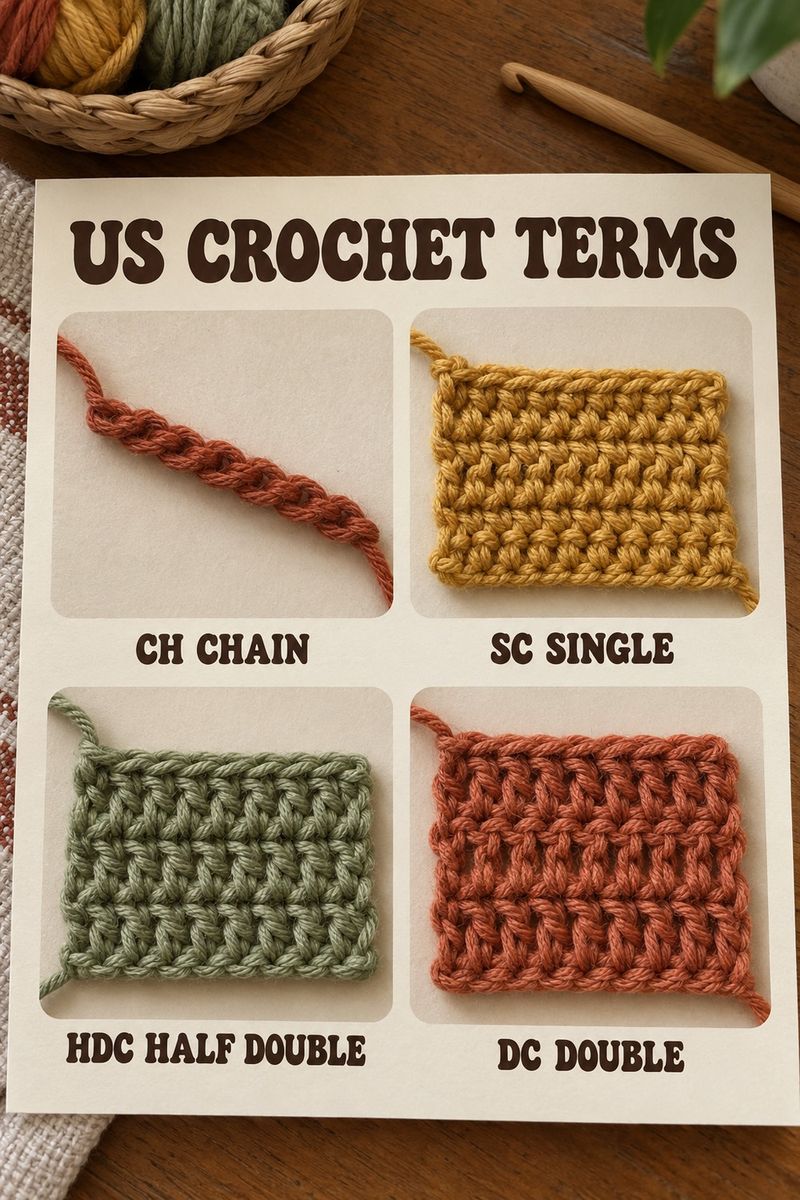
The US terms card shows a chain and three swatches labelled ch for chain, sc for single crochet, hdc for half double and dc for double crochet, so you can compare the single crochet height with the taller stitches.
What are the variations of single crochet?
Four single crochet variations appear in beginner and blanket patterns: sc2tog, back loop only, front and back post, and extended single crochet. Each one changes where your hook goes or adds one step, so the fabric changes while the stitch stays familiar.
Single crochet two together (sc2tog)
Single crochet two together (sc2tog) turns two stitches into one, so it is the usual single crochet decrease (dec).
- Insert your hook into the next stitch, yarn over and pull up a loop.
- Insert your hook into the following stitch, yarn over and pull up a loop. Three loops sit on the hook.
- Yarn over and pull through all three loops.
Your row loses one stitch at each sc2tog. Count it. That is how a shaped piece narrows.
Back loop only single crochet
Back loop only single crochet (BLO) is a single crochet worked under the back loop of the V alone.
- Find the two loops along the top of the stitch.
- Insert your hook under the back loop only.
- Yarn over and pull up a loop, then yarn over and pull through both loops.
The unused front loops form a horizontal ridge, so rows of BLO single crochet make a ribbed texture. Front loop only (FLO) works the other loop.
Front post and back post single crochet
Front post single crochet (FPsc) and back post single crochet (BPsc) are worked around the post of the stitch below, not into its top.
- Insert your hook around the post, from front to back to front for FPsc, or from back to front to back for BPsc.
- Yarn over and pull up a loop.
- Yarn over and pull through both loops.
The stitch sits raised on one side of the fabric, so post stitches build ridges you can feel.
Extended single crochet (esc)
Extended single crochet (esc) adds one pull to single crochet, so the stitch stands slightly taller and softer.
- Insert your hook into the stitch, yarn over and pull up a loop.
- Yarn over and pull through one loop only.
- Yarn over and pull through the last two loops.
Can you single crochet in the round?
Yes, you can single crochet in the round: the rounds work outward from a centre ring instead of back and forth, and patterns write a round as “rnd”. The magic ring is the usual adjustable starting ring, and its steps belong on How to Make a Magic Ring in Crochet for Beginners. Each round ends where it began, so you join it or keep spiralling instead of turning. Our Beginner Coasters start every coaster with a magic ring.
What can you make with single crochet?
Single crochet makes a dense, even fabric, so it suits flat pieces that hold their shape. Three projects show the range, from rows to rounds.
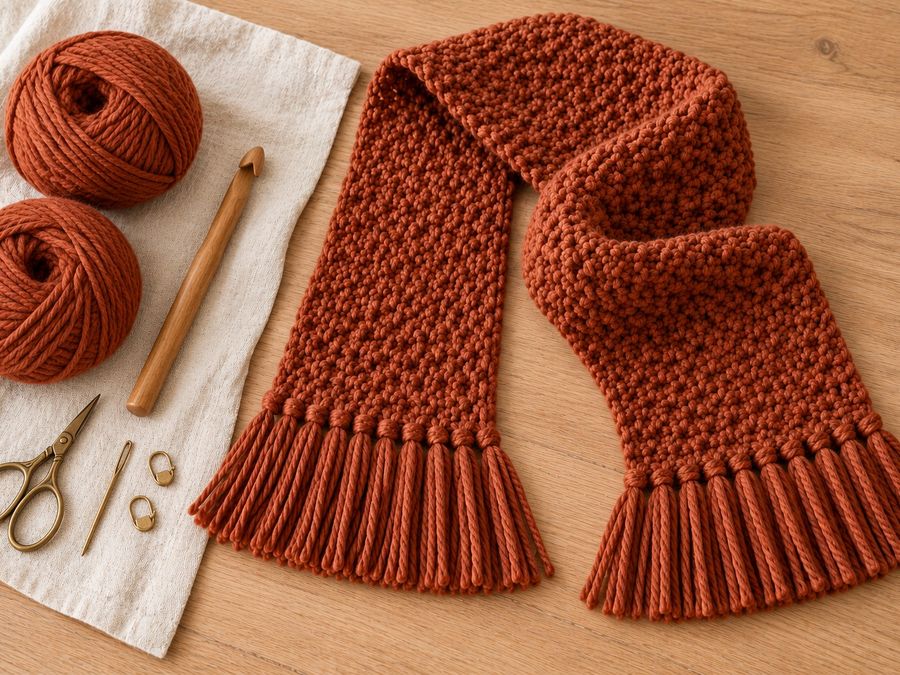
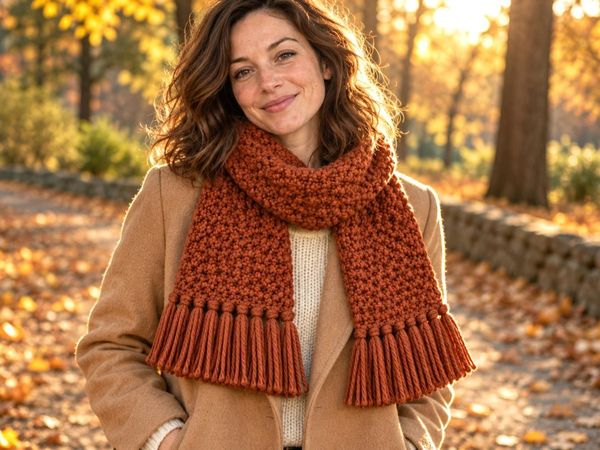
A scarf is the classic first piece. The Moss Stitch Chunky Scarf uses only chain, single crochet and turning: moss stitch is a single crochet and a chain one that skips a stitch, with each single crochet placed into the chain space below. It calls for 6, Super Bulky yarn and a 10 mm (US N/P-15) hook, so your stitches stay large enough to count. Moss stitch is one of the crochet stitches for scarves that looks the same on both sides, and Crochet Scarf Patterns: 9 Styles from Moss Stitch to Hooded shows the other styles.
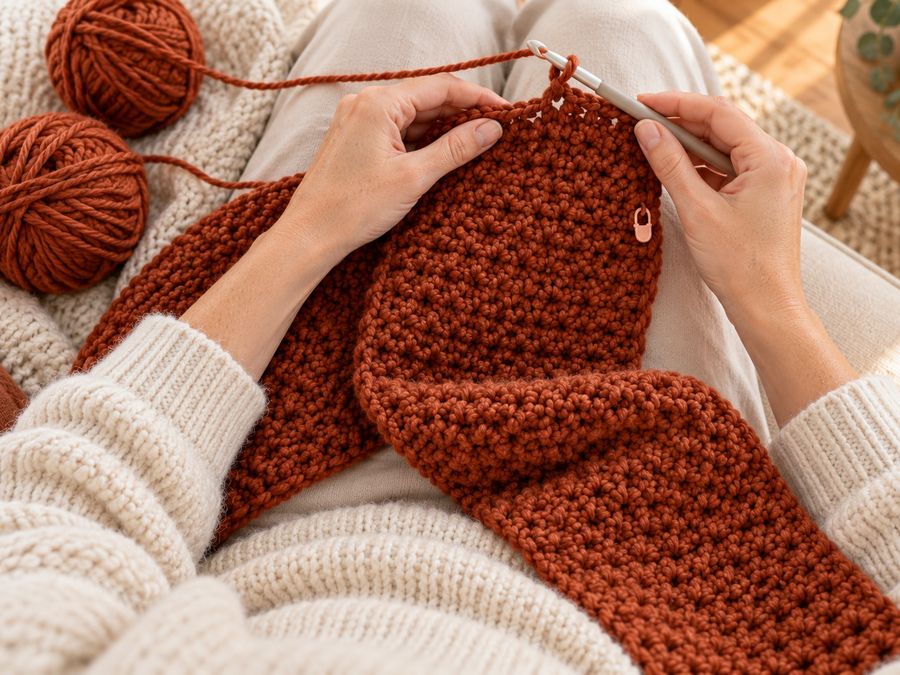
The scarf in progress shows moss stitch: single crochet and chain one, alternating, row after row.
Coasters are the step after single crochet rows. The Beginner Coasters pattern works rounds of double crochet from a magic ring, so it teaches a taller stitch and the round at the same time. A beginner crochet coaster in round and square shapes is the subject of Crochet Coaster Patterns: Round, Square and Christmas Coasters.
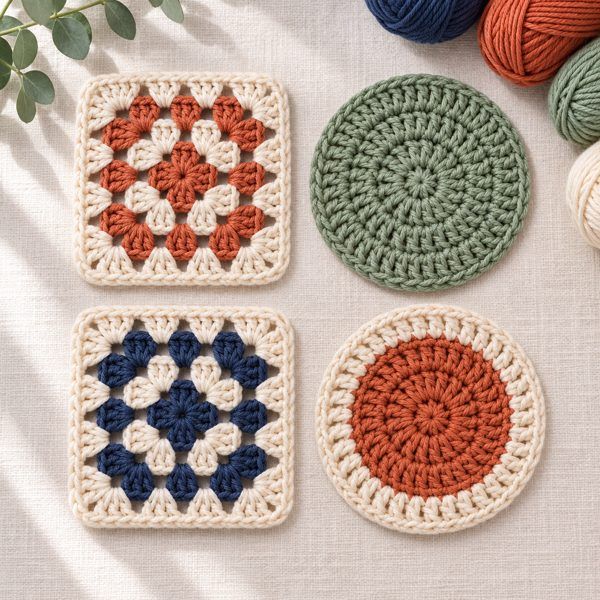
The coaster set shows granny square and round coasters, the round work that follows your first single crochet rows.
A single crochet blanket is the same rows made wider and longer, so it builds a dense, warm fabric. Plan for many rows.
Which stitch should you learn after single crochet?
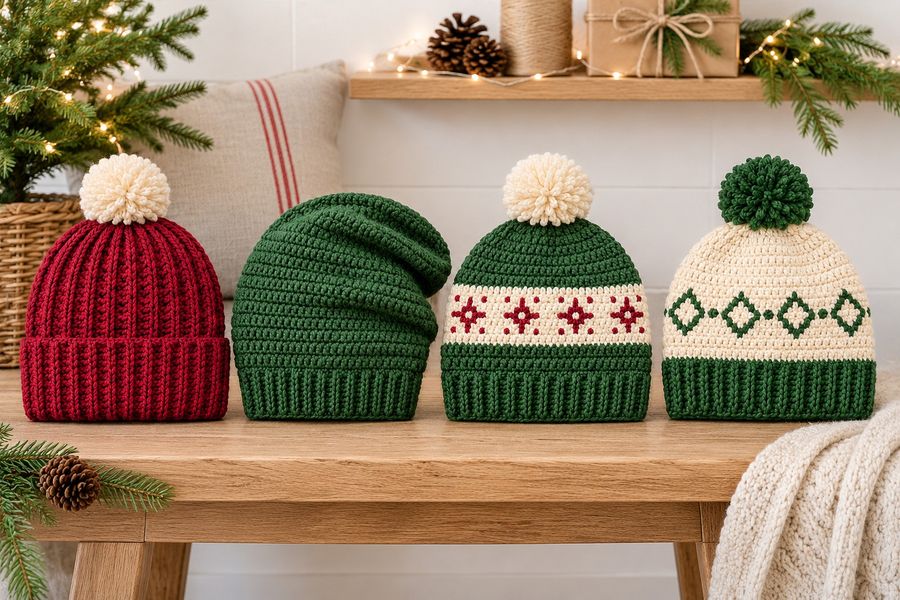
Learn half double crochet after single crochet, then double crochet, because each adds one yarn over and one step of height. Half double crochet (hdc, UK half treble) starts with a yarn over and finishes by pulling through three loops at once. Double crochet (dc, UK treble) starts the same way but finishes in two pulls of two loops, so it stands taller again. Both reuse the insert, yarn over and pull up a loop you have just learned. Work a swatch of each beside your single crochet. The jump shows at once. When all three feel even, choose a first piece from Crochet Patterns to Make: Christmas Decor and Winter Wear.
Questions makers ask
Is single crochet good for a blanket?
Yes, for a dense, warm blanket with no gaps between the stitches. The condition is time: single crochet is the shortest basic stitch, so a blanket in it needs more rows than one in a taller stitch. Choose it when you want a firm fabric, and expect a longer make.
Can left-handed crocheters follow these steps?
Yes. Hold the hook in your left hand, feed the yarn with your right and work from left to right. Every step stays the same in mirror image: the second chain from the hook, the two loops, the chain 1 and turn. Stitch counts and abbreviations do not change at all.
What is the difference between a slip stitch and a single crochet?
A slip stitch has no height, and a single crochet does. For a slip stitch you insert the hook, yarn over and pull through the stitch and the loop on the hook in one motion. For a single crochet you pull up a loop first, then yarn over and pull through two loops.
Is single crochet the same as double crochet?
Not in US terms. US double crochet is a taller stitch that starts with an extra yarn over. The mix-up comes from UK patterns, where the stitch you know as single crochet is named double crochet. Check whether your pattern uses US or UK terms before you make the first chain.