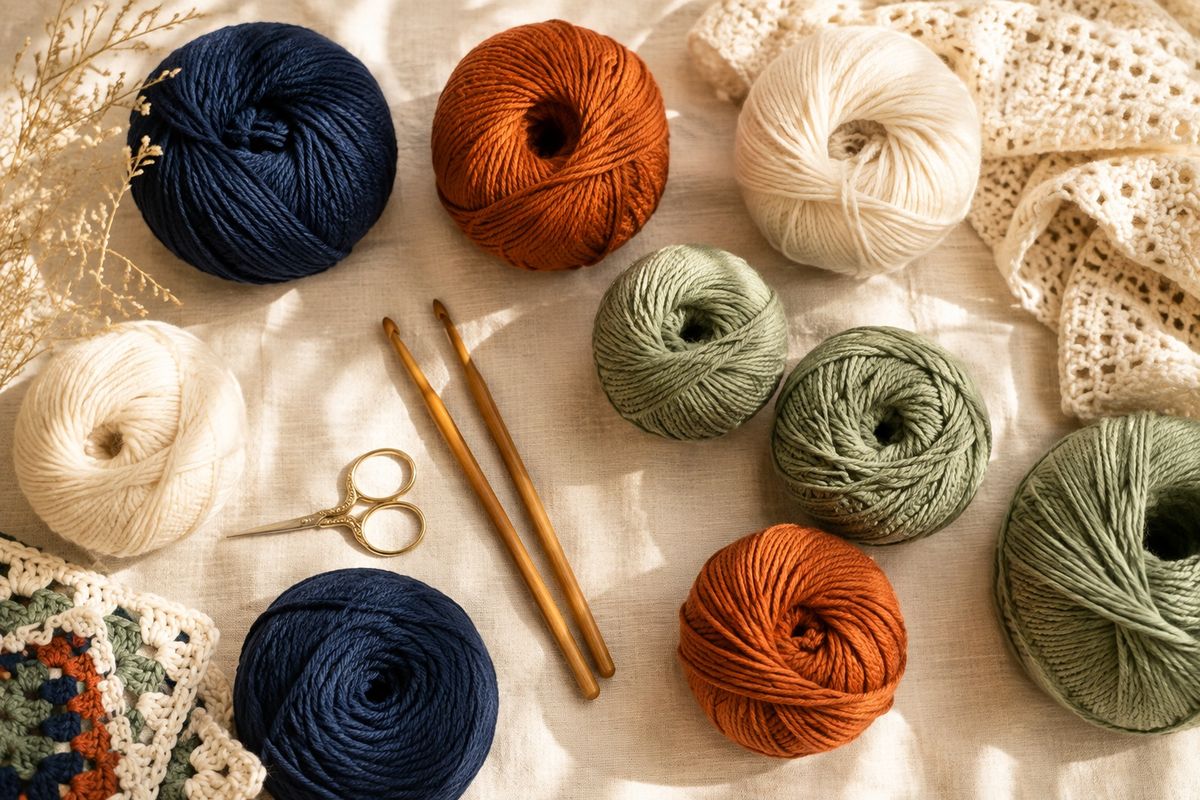
The Craft Yarn Council yarn weight chart numbers yarn from 0 (Lace) to 7 (Jumbo), and weight 4 is Medium: worsted, afghan and aran. Pick any weight from 0 to 7 in the finder above and it shows the Craft Yarn Council name, the yarn types in that weight, the recommended crochet hook and the crochet gauge range. Weight 0 is the finest and weight 7 is the thickest, so a bigger number means a thicker yarn.
How do you use the yarn weight finder?
Choose a number from 0 to 7, or use the arrow keys to move between them. The finder shows one row of the Craft Yarn Council Standard Yarn Weight System for that number. That is all it does.
Look at your yarn label first, because many labels carry a number from 0 to 7, and that is the number to choose. If the label names only a type, such as DK or chunky, find that type in the chart below to get the number.
How do you read the result?
The result has four parts. The name is the council’s category name, for example Light or Bulky. The yarn types are the everyday terms that fall inside that category, such as sport, worsted or chunky. The hook is the recommended range in millimetres with US sizes. The gauge is how many stitches fit across 4 in.
Treat all of it as a guide for your project, because the council states that the ranges are guidelines only and show the most commonly used gauges and hooks for each category. It also states that the system is not an interchangeability chart. Two yarns in the same weight can still work up differently, so swap one for another only after you make a gauge swatch.
What is the yarn weight chart?
The chart lists the eight Craft Yarn Council weights with their types, recommended hooks and crochet gauge per 4 in.
| Weight | Name | Yarn types | Recommended hook | Gauge |
|---|---|---|---|---|
| 0 | Lace | Fingering, 10-count crochet thread | 2.25 mm (US B-1) | 32 to 42 double crochets per 4 in. |
| 1 | Super Fine | Sock, Fingering, Baby | 2.25 to 3.5 mm (US B-1 to E-4) | 21 to 32 sts (sc) per 4 in. |
| 2 | Fine | Sport, Baby | 3.5 to 4.5 mm (US E-4 to 7) | 16 to 20 sts per 4 in. |
| 3 | Light | DK, Light Worsted | 4.5 to 5.5 mm (US 7 to I-9) | 12 to 17 sts per 4 in. |
| 4 | Medium | Worsted, Afghan, Aran | 5.5 to 6.5 mm (US I-9 to K-10 1/2) | 11 to 14 sts per 4 in. |
| 5 | Bulky | Chunky, Craft, Rug | 6.5 to 9 mm (US K-10 1/2 to M-13) | 8 to 11 sts per 4 in. |
| 6 | Super Bulky | Super Bulky, Roving | 9 to 15 mm (US M-13 to Q) | 7 to 9 sts per 4 in. |
| 7 | Jumbo | Jumbo, Roving | 15 mm and larger (US Q and larger) | 6 sts and fewer per 4 in. |
For weight 0, the gauge is counted in double crochet. For weight 1, it is counted in single crochet. The council notes that lace weight yarn is usually worked on larger hooks to make openwork, so a gauge range is hard to set for it, and the safest guide is the gauge printed in your pattern.
What yarn weight mistakes should you avoid?
Most mix-ups come from names. DK and light worsted are not two weights, because both sit inside weight 3 Light, while chunky belongs to weight 5 Bulky and worsted, afghan and aran share weight 4 Medium.
- Swapping yarn by name alone. Check the number, then your gauge.
- Matching the hook but not the gauge. A hook inside the range can still give a looser or tighter fabric in your hands, which is why your own swatch decides.
- Reading gauge as a promise. The figure is a range, so your swatch is the only number that counts for your project.
Once you know the weight, the hook size chart converts the recommended millimetres into US sizes. The yarn calculator then works out how much of that yarn a project needs. Beginners can try the yarn on a first row with the guide to how to single crochet.
Questions makers ask
Which yarn names appear in more than one weight?
Several names sit in two categories on the council chart. Fingering is in weights 0 and 1, Baby is in weights 1 and 2, and Roving is in weights 6 and 7. When a label gives only one of those names, look for its number or use the gauge in your pattern.
What should I do once I know my yarn weight?
Check the recommended hook range for that weight, then work a gauge swatch with your yarn and compare it with your pattern. The council calls its ranges guidelines only, so the swatch decides whether the hook is right. The hook size chart converts the millimetres into US sizes.
Does a higher yarn weight number always mean a bigger hook?
On the chart, yes: the recommended hook grows from 2.25 mm at weight 0 to 15 mm and larger at weight 7. Lace weight is the one to read with care, because the council says it is usually worked on larger hooks to make openwork. Follow the hook your pattern names.
What do the open-ended figures for Jumbo mean?
Both Jumbo figures are open-ended. The hook is 15 mm and larger (US Q and larger), and the gauge is 6 stitches and fewer per 4 in. Because the chart gives no exact gauge for the weight, use the gauge printed in your pattern.