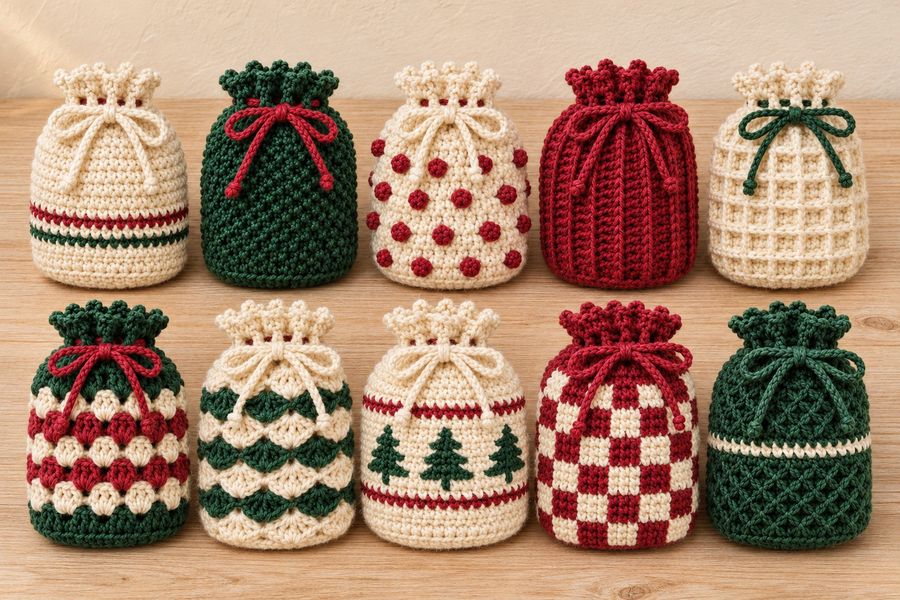
A crochet drawstring bag is a small pouch worked in joined rounds from a flat round base, with an eyelet round near the top and a cord threaded through it to close. This guide sets out 10 Christmas drawstring pouches that share one base and one top: each is 4.25 in (10.5 cm) wide, takes 38 to 59 yd (34 to 55 m) of worsted yarn and a 4 mm hook, and holds a gift card, jewellery or sweets.
Every pouch starts on the same round base and ends with the same eyelet round, picot edge and slip stitch cord, so only the middle changes. You learn the base and top once. The ten middles are sorted below by technique: basic stitches, raised texture and colourwork.
Which crochet drawstring bag pattern should you make?
The crochet drawstring bag pattern to make depends on the stitches you know: four of the ten pouches use only basic stitches (single, half double and double crochet), four have a raised texture, and two use tapestry colourwork. By skill level, one pouch is Beginner, seven are Easy and two are Intermediate. Pick by what your hands already do.
| Pouch | Texture | Stitches | Skill | Rounds | Yarn | Sides |
|---|---|---|---|---|---|---|
| Cabin Stripe | Stripes | sc | Beginner | 28 | 44 yd (41 m) | 4.8 in (12.3 cm) |
| Evergreen Seed | Seed stitch | sc + dc | Easy | 22 | 41 yd (37 m) | 5.0 in (12.6 cm) |
| Granny Stripe | Granny clusters | dc groups | Easy | 19 | 39 yd (36 m) | 4.5 in (11.5 cm) |
| Pine and Snow Shells | Shells | dc shells, hdc and sc in the levelling round | Easy | 18 | 38 yd (34 m) | 4.8 in (12.1 cm) |
| Snowberry Popcorn | Popcorns | sc + popcorn | Easy | 28 | 59 yd (55 m) | 4.8 in (12.3 cm) |
| Cranberry Rib | Post stitch rib | FPdc + BPdc | Easy | 19 | 41 yd (38 m) | 5.0 in (12.7 cm) |
| Snowy Waffle | Waffle | FPdc waffle | Easy | 19 | 40 yd (36 m) | 5.0 in (12.7 cm) |
| Crossed Pine | Crossed dc | crossed dc | Easy | 19 | 40 yd (36 m) | 5.0 in (12.7 cm) |
| Little Fir Forest | Tapestry trees | tapestry sc | Intermediate | 28 | 48 yd (42 m) | 4.8 in (12.3 cm) |
| Cabin Check | Tapestry checks | tapestry sc | Intermediate | 28 | 49 yd (45 m) | 4.8 in (12.3 cm) |
The table sets all ten pouches on the same seven fields, so you can see that the real differences are the stitch, the skill level, the round count and 21 yards of yarn between the lightest pouch and the heaviest. Sides are measured above the 2.5 in (6.5 cm) base.
Start with the Cabin Stripe. It teaches the base and top every other pouch reuses. If you already know double crochet, the seed stitch or shells come next.
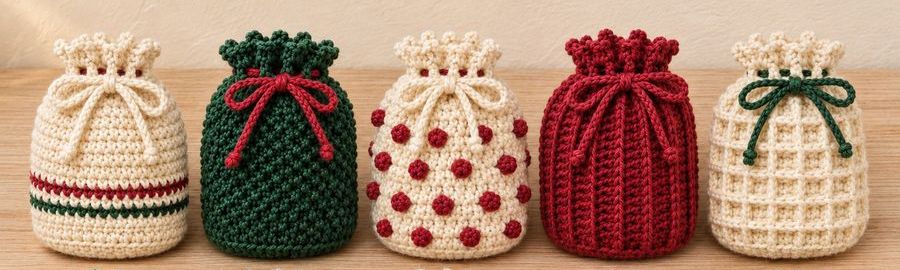
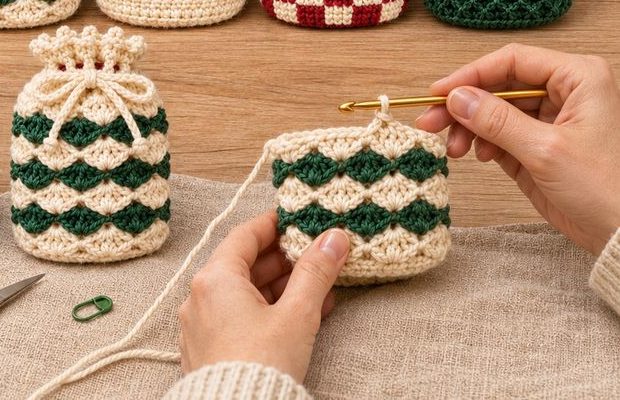
The photo shows the first five pouches of the set side by side, each in the same three colours.
Which drawstring pouches use only basic stitches?
Four drawstring pouches use only basic stitches, single, half double and double crochet: the Cabin Stripe in single crochet, the Evergreen Seed in seed stitch, the Granny Stripe in granny groups and the Pine and Snow Shells in shells. Every pouch in this guide uses one yarn, 4, medium (worsted), and one 4 mm (US G-6) hook, so the ten pouches match as a set. You never switch hooks.
Cabin Stripe pouch
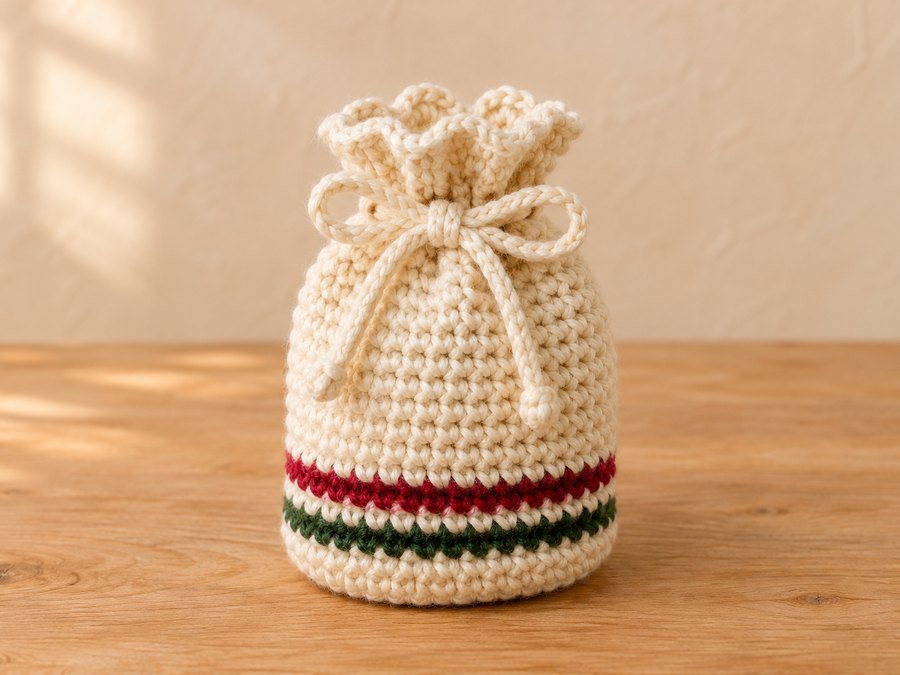
Cabin Stripe pouch
- Yarn
- 4, medium (worsted)
- Hook
- 4 mm (US G-6)
- Skill level
- Beginner
- Time
- one evening
- Best for
- your first pouch: it teaches the base and top every other pouch shares
The Cabin Stripe is a cream drawstring pouch in single crochet, with a cranberry stripe and a pine stripe near the base. It takes 28 rounds and 44 yd (41 m) in all: 38 yd (35 m) of cream and 3 yd (3 m) each of cranberry and pine. The sides stand 4.8 in (12.3 cm) tall.
Single crochet is the only body stitch, so you practise the base and top the other nine use with nothing else to think about. The full pattern is in the how-to section below. Every count is there.
Tip: carry the cream up the inside of the pouch instead of cutting it. It comes back after every stripe.
Evergreen Seed pouch
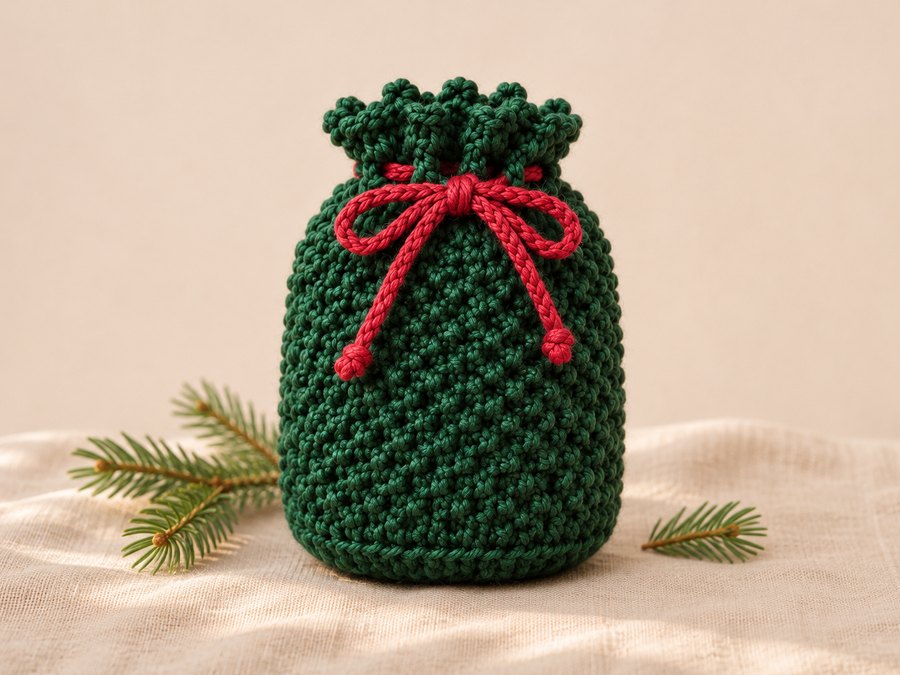
Evergreen Seed pouch
- Yarn
- 4, medium (worsted)
- Hook
- 4 mm (US G-6)
- Skill level
- Easy
- Time
- one evening
- Best for
- a one-colour pouch with a soft, pebbly surface
The Evergreen Seed is a solid pine drawstring pouch in seed stitch: a single crochet goes into every double crochet and a double crochet into every single crochet. It takes 22 rounds and 41 yd (37 m), with a cranberry cord. The sides are 5.0 in (12.6 cm) tall.
How it is built: work the shared base and the back loop round, then alternate single and double crochet in every round, starting each round with the stitch the last one ended on. Finish with the shared top. The stitches never stack on their twin, so the surface turns pebbly. The body is one colour. You carry nothing.
Tip: if you lose your place, look down. A double crochet always sits on a single crochet.
Granny Stripe pouch
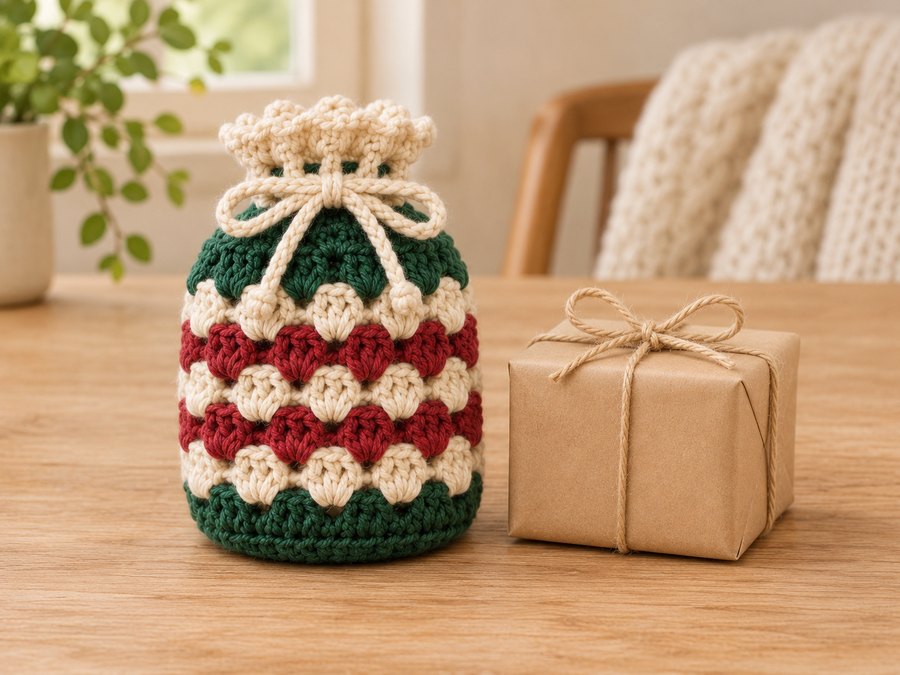
Granny Stripe pouch
- Yarn
- 4, medium (worsted)
- Hook
- 4 mm (US G-6)
- Skill level
- Easy
- Time
- one evening
- Best for
- using three colours in a classic granny look
The Granny Stripe is for you if granny squares already feel familiar: a drawstring pouch of double crochet groups in cream and cranberry over a pine base, with a pine top. It takes 19 rounds and 39 yd (36 m), and at 4.5 in (11.5 cm) its sides are the shortest of the ten.
How it is built: after the shared base and back loop round, work one round of groups into the stitches, then rounds of groups into the spaces between the groups below, swapping cream and cranberry each round. Two pine rounds of single crochet lead into the shared top. The groups sit in spaces, not stitches, so the stripes open into the classic granny lattice. The colours swap every round.
Tip: join each new colour in a different space so the joins do not stack. If you work over the tails as you go, the finishing takes minutes.
Pine and Snow Shells pouch
Pine and Snow Shells pouch
- Yarn
- 4, medium (worsted)
- Hook
- 4 mm (US G-6)
- Skill level
- Easy
- Time
- one evening
- Best for
- a scalloped pouch in two colours
The Pine and Snow Shells is a scalloped drawstring pouch with shells in pine and cream rounds over a cream base. It takes the fewest rounds, 18, and the least yarn, 38 yd (34 m). The sides are 4.8 in (12.1 cm) tall.
How it is built: after the shared base and back loop round, work shell rounds, each one joined in the centre of a shell below and swapping pine and cream. A levelling round of mixed stitch heights fills the dips, so the eyelets of the shared top sit level. It is the only body round without shells.
Tip: each shell sits in the single crochet between two shells below, so the scallops interlock. Start every shell round with the single crochet in the centre of a shell below.
Which drawstring pouches have a raised texture?
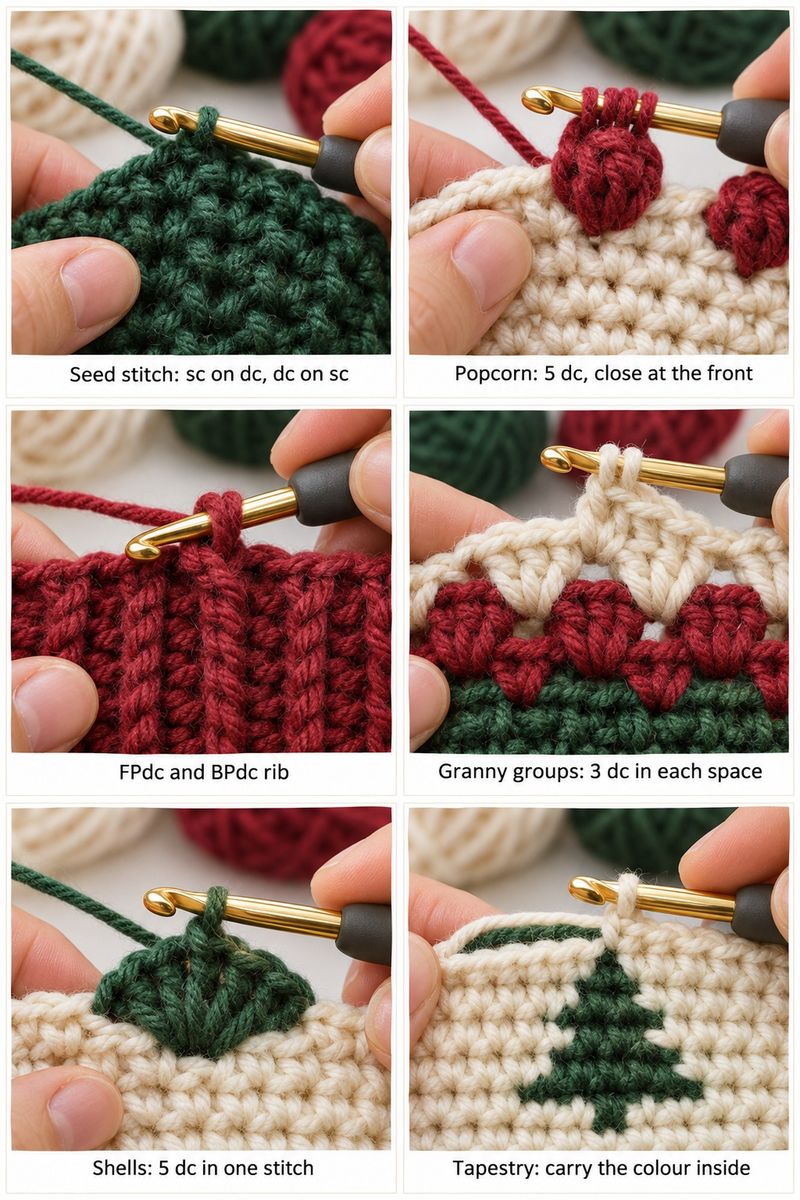
Four drawstring pouches have a raised texture: the Snowberry Popcorn, the Cranberry Rib, the Snowy Waffle and the Crossed Pine. Popcorns and post stitches stand off the surface, so these pouches are thicker than the basic four. A front post double crochet (FPdc) is worked around the post of the stitch below from the front; a back post double crochet (BPdc) is worked around it from the back. A popcorn is a group of complete double crochet closed into one raised stitch. If you have never worked into a post, the Cranberry Rib teaches it in two stitches.
Snowberry Popcorn pouch
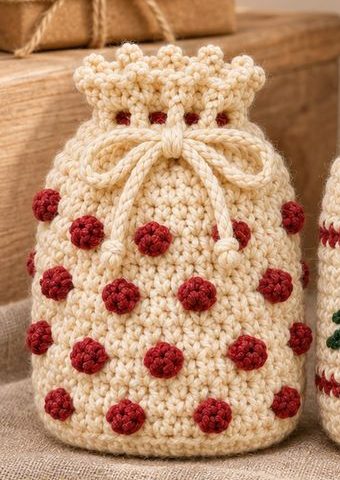
Snowberry Popcorn pouch
- Yarn
- 4, medium (worsted)
- Hook
- 4 mm (US G-6)
- Skill level
- Easy
- Time
- one evening
- Best for
- raised berries that sit on the outside
The Snowberry Popcorn is the pouch to make if you want raised texture in two colours: a cream drawstring pouch in single crochet with five rounds of raised cranberry popcorns, moved along each time so the berries stagger. It takes 28 rounds and the most yarn of the set, 59 yd (55 m). The sides are 4.8 in (12.3 cm) tall.
How it is built: after the shared base and back loop round, work cream rounds of single crochet with a popcorn round every third round, moving the popcorns along each time. You carry the cranberry inside the cream stitches on popcorn rounds and cut it at the end of the round.
Tip: popcorns pop toward you, so they always land on the outside of the pouch. Pull each one closed firmly before the next cream stitch. It stays round.
Cranberry Rib pouch
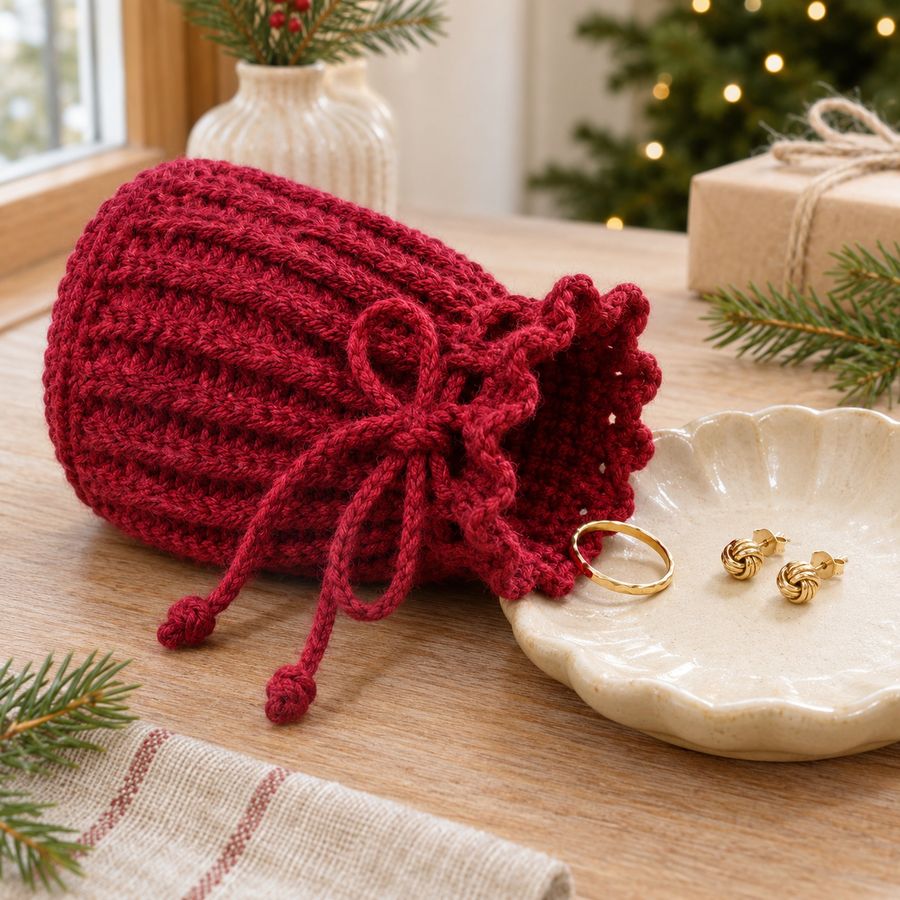
Cranberry Rib pouch
- Yarn
- 4, medium (worsted)
- Hook
- 4 mm (US G-6)
- Skill level
- Easy
- Time
- one evening
- Best for
- a stretchy pouch that hugs a small box
The Cranberry Rib is a solid cranberry drawstring pouch in front and back post double crochet, a stretchy rib that hugs whatever is inside. It takes 19 rounds and 41 yd (38 m). The sides are 5.0 in (12.7 cm) tall.
How it is built: after the shared base and back loop round, work one round of double crochet, then rib rounds that alternate FPdc and BPdc. A FPdc always goes around a FPdc, so the ribs run straight up the pouch into the shared top.
Tip: post stitches use more yarn and pull in, so keep your tension relaxed. The ch 2 at the start never counts. Your first FPdc goes around the first stitch.
Snowy Waffle pouch
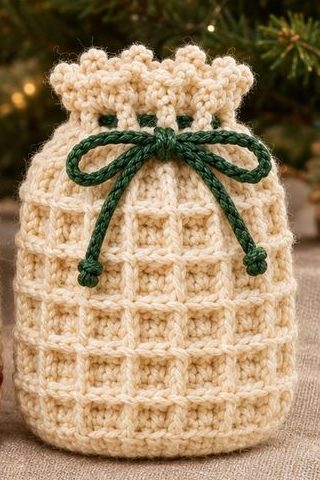
Snowy Waffle pouch
- Yarn
- 4, medium (worsted)
- Hook
- 4 mm (US G-6)
- Skill level
- Easy
- Time
- one evening
- Best for
- jewellery: waffle is thick, so the pouch stands up on its own
The Snowy Waffle is a solid cream drawstring pouch in waffle stitch: front post doubles that change place each round to build a raised, squared grid. It takes 19 rounds and 40 yd (36 m), with a pine cord. The sides are 5.0 in (12.7 cm) tall.
How it is built: after the shared base and back loop round, work one round of double crochet, then alternate two kinds of round. Odd rounds start with a FPdc and even rounds with a dc, then the shared top closes it. The dc of each even round sits on the FPdc below, so the squares build up as you go.
Tip: say the repeat out loud for the first two rounds. Waffle is thick, so this pouch stands up on its own.
Crossed Pine pouch
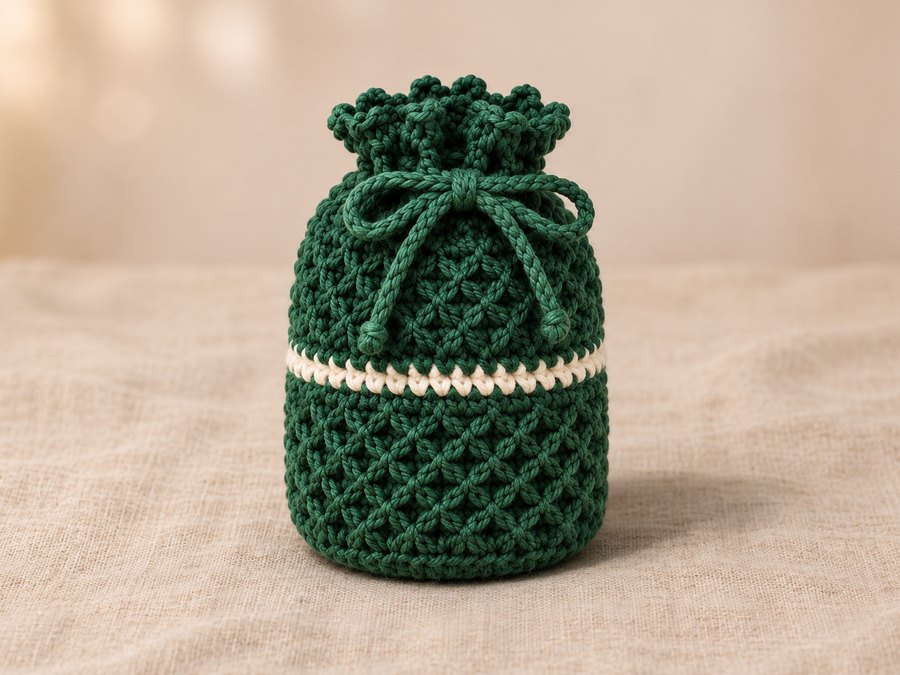
Crossed Pine pouch
- Yarn
- 4, medium (worsted)
- Hook
- 4 mm (US G-6)
- Skill level
- Easy
- Time
- one evening
- Best for
- a woven, basket-like look in few rounds
The Crossed Pine is a deep pine drawstring pouch in crossed double crochet, with one cream stripe in the lower third. It takes 19 rounds and 40 yd (36 m). The sides are 5.0 in (12.7 cm) tall.
How it is built: after the shared base and back loop round, work rounds of crossed pairs. Each pair skips a stitch, works the next one, then works the skipped stitch in front of it. One cream round sits low on the body, and the shared top finishes it. You work the second dc of each cross in front of the first, so every X leans the same way.
Tip: crossed rounds are tall, so 9 of them make the whole body. It is quicker than it looks.
Which drawstring pouches use colourwork?
Two drawstring pouches use colourwork: the Little Fir Forest and the Cabin Check, both in tapestry crochet. Tapestry crochet carries the unused colour along the top of the round below and works over it, so the carried strand hides inside the stitches. You work two strands at once. Start with the fir trees if you want the colourwork in one band only.
Little Fir Forest pouch
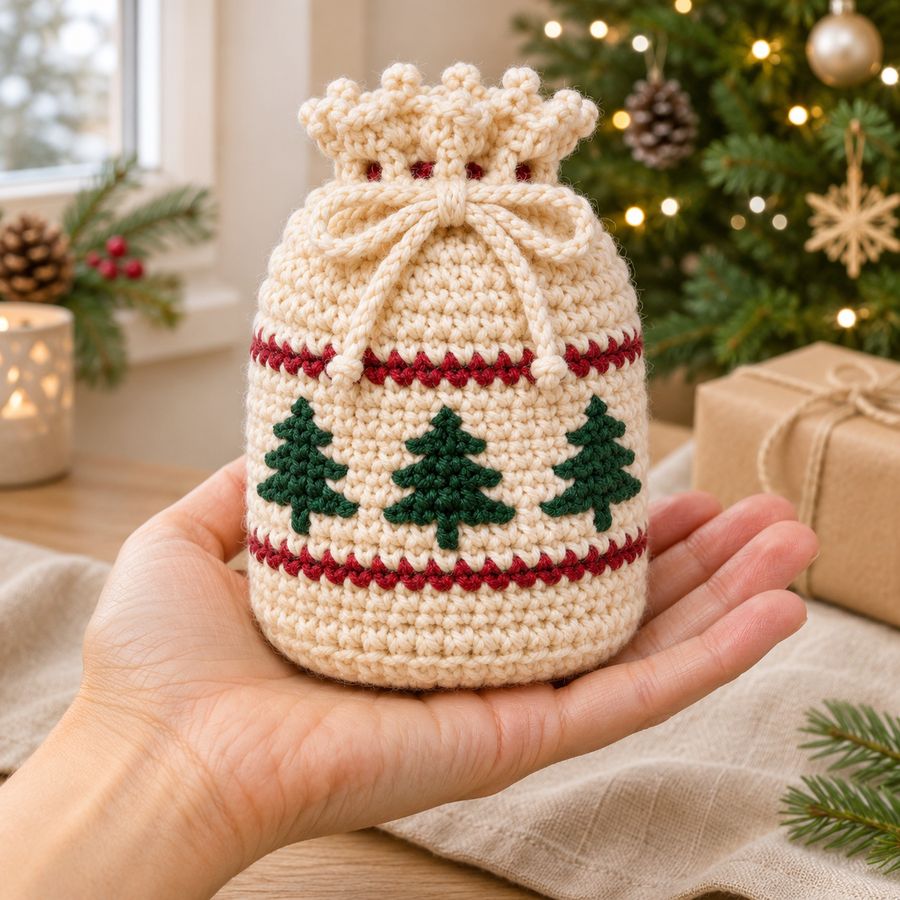
Little Fir Forest pouch
- Yarn
- 4, medium (worsted)
- Hook
- 4 mm (US G-6)
- Skill level
- Intermediate
- Time
- one evening
- Best for
- makers ready for tapestry colourwork
The Little Fir Forest is a cream drawstring pouch with a band of six layered fir trees in pine, between two thin cranberry stripes. You follow either the chart or the written rounds. It takes 28 rounds and 48 yd (42 m). The sides are 4.8 in (12.3 cm) tall.
How it is built: after the shared base and back loop round, work cream single crochet, one cranberry stripe, the tree band in pine and cream, a second cranberry stripe, then cream up to the shared top. Only the tree band carries two colours, so the colourwork is a short stretch of the pouch. The rest is one colour at a time.
Tip: hold the pine across the top of the round below and work the cream over it. It never shows. Change colour on the last yarn over of the stitch before the new colour.
Cabin Check pouch
Cabin Check pouch
- Yarn
- 4, medium (worsted)
- Hook
- 4 mm (US G-6)
- Skill level
- Intermediate
- Time
- one evening
- Best for
- a checkerboard in two colours
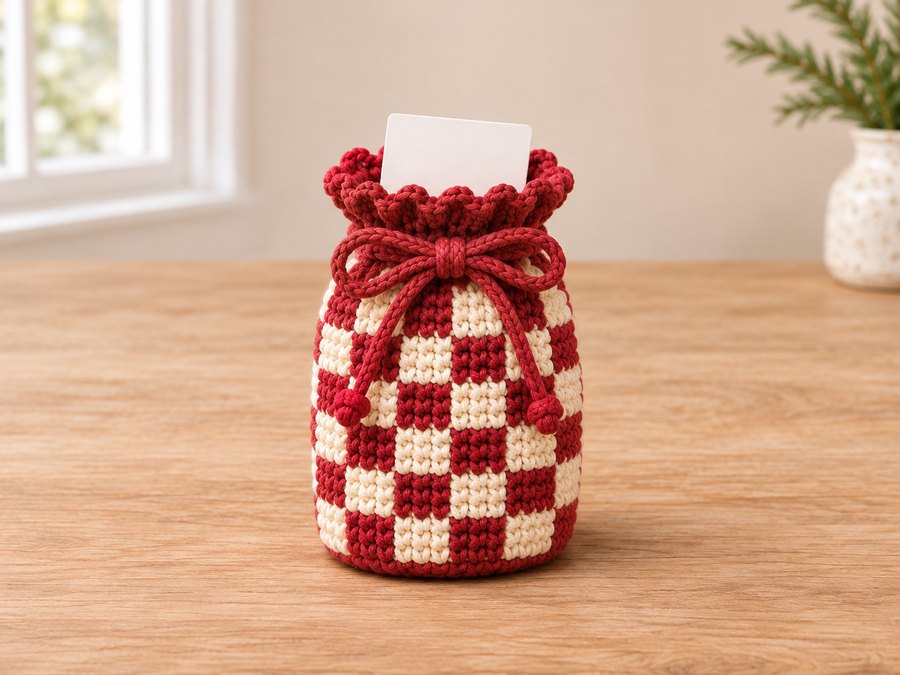
The Cabin Check is a cranberry and cream checkerboard drawstring pouch in tapestry crochet, six checks around and six checks high. You carry two colours the whole way up. It takes 28 rounds and 49 yd (45 m). The sides are 4.8 in (12.3 cm) tall.
How it is built: after the shared base and back loop round, work blocks of the two colours with both strands carried on every round, and swap the order at each new band of checks so cream sits on cranberry. The shared top starts in cranberry. Keep both strands loose, because a tight carry puckers the pouch.
Tip: the joins fall between two checks, so the jog hides in the pattern. Swap the colour order every three rounds.
How do you crochet a drawstring bag?
You crochet a drawstring bag as a round base, straight sides, an eyelet round and a cord, worked from the bottom up in joined rounds with the right side facing and never turned. The Cabin Stripe pouch is written out in full below, every round and stitch count from its pattern, so you can make this crochet drawstring bag from this page. It is free.
You need 38 yd (35 m) of cream, 3 yd (3 m) of cranberry and 3 yd (3 m) of pine in 4, medium (worsted) yarn, a 4 mm (US G-6) hook, a yarn needle, scissors and 1 stitch marker. The pattern uses US terms: single crochet (sc) is UK double crochet, and double crochet (dc) is UK treble. Join every round with a slip stitch to the first stitch. You never turn. The ch 1 or ch 2 at the start of a round never counts as a stitch.
 Make the round base
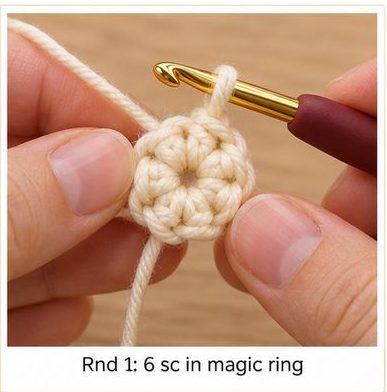
Work 6 sc in a magic ring, then add 6 stitches every round until you reach 36. The base measures about 2.5 in (6.5 cm) across.
 Turn the base into sides
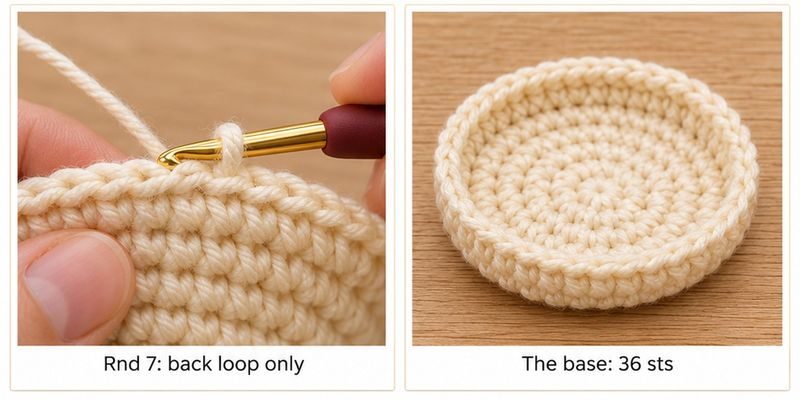
Work one round of sc in the back loop only. It leaves a ridge and turns the work upward.
 Work the body
Keep 36 stitches in every round. Only this part changes from pouch to pouch.
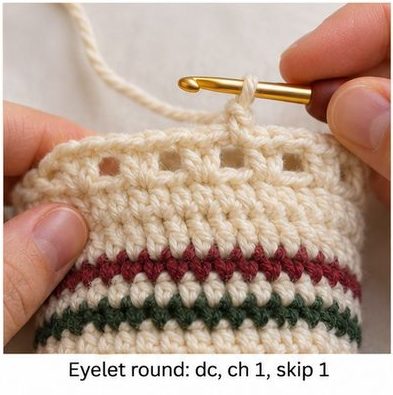 Make the eyelet round
Work (dc, ch 1, skip 1) 18 times for 18 eyelets. The next round puts 1 sc in each dc and each ch-1 space.
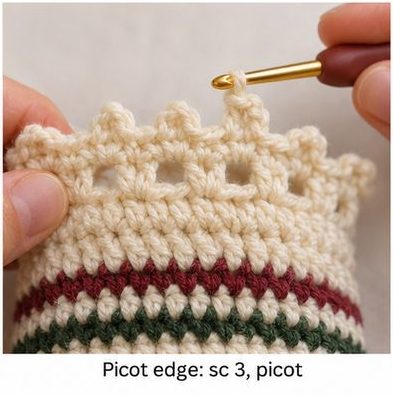 Add the picot edge
Work (sc 3, picot) 12 times. Picots are not counted, so the round still has 36 stitches.
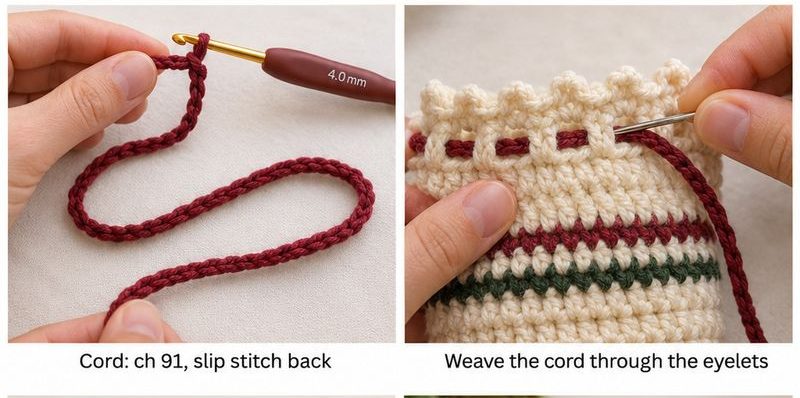 Make and thread the cord
Chain 91 and slip stitch back along the chain for 90 stitches. Weave it through the 18 eyelets from the front, knot each end, pull and tie a bow.
The six steps are the same on every pouch in the set; the Cabin Stripe fills step 3 with single crochet stripes.
The round base
The round base is a flat circle of 36 single crochet made in 6 rounds, with 6 increases in every round after the magic ring. Put a marker in the first stitch of each round so your join always goes to the right place. Keep the joins in one line, because that line becomes the back of the pouch. Count at the end of every round.
| Round | Colour | Instructions | Stitch count |
|---|---|---|---|
| 1 | Cream | Make a magic ring, 6 sc into the ring, pull the tail to close it, join | 6 sc |
| 2 | Cream | Ch 1, 2 sc in each st around, join | 12 sc |
| 3 | Cream | Ch 1, (sc in next st, 2 sc in next st) 6 times, join | 18 sc |
| 4 | Cream | Ch 1, (sc in each of next 2 sts, 2 sc in next st) 6 times, join | 24 sc |
| 5 | Cream | Ch 1, (sc in each of next 3 sts, 2 sc in next st) 6 times, join | 30 sc |
| 6 | Cream | Ch 1, (sc in each of next 4 sts, 2 sc in next st) 6 times, join | 36 sc |
Each round of the table ends 6 stitches higher than the round before, from 6 to 36. After Round 6 your base is a flat circle of 36 stitches about 2.5 in (6.5 cm) across.
The sides
The sides start at Round 7, a round of single crochet in the back loop only that leaves a ridge and turns the flat base upward. From there the body is 36 stitches in every round, so the sides go straight up like a tube. No more increases. The Cabin Stripe sides are 22 rounds without shaping, counting the three top rounds.
| Round | Colour | Instructions | Stitch count |
|---|---|---|---|
| 7 | Cream | Ch 1, sc in the back loop only of each st around, join | 36 sc |
| 8 to 10 | Cream | Ch 1, sc in each st around, join (3 rounds) | 36 sc |
| 11 to 12 | Cranberry | Change to Cranberry, ch 1, sc in each st around, join (2 rounds) | 36 sc |
| 13 | Cream | Change to Cream, ch 1, sc in each st around, join | 36 sc |
| 14 to 15 | Pine | Change to Pine, ch 1, sc in each st around, join (2 rounds) | 36 sc |
| 16 to 25 | Cream | Change to Cream, ch 1, sc in each st around, join (10 rounds) | 36 sc |
The table shows the two stripes near the base, cranberry on Rounds 11 and 12 and pine on Rounds 14 and 15, with cream below, between and above them.
Change colour on the last yarn over of the join, so each stripe starts clean. Carry the cream up the inside instead of cutting it, because you use it again after each stripe. Weave in each end as soon as you finish a part. The ends do not pile up.
The eyelet round and picot edge
The eyelet round is Round 26: double crochet and chain 1 spaces that make 18 eyelets for the cord, with each ch 1 counted as a stitch. Round 27 fills it back to 36 single crochet. Round 28 finishes the top with a picot edge.
| Round | Colour | Instructions | Stitch count |
|---|---|---|---|
| 26 | Cream | Ch 2, (dc in next st, ch 1, skip next st) 18 times, join | 36 sts |
| 27 | Cream | Ch 1, (sc in next st, sc in next ch-1 space) 18 times, join | 36 sc |
| 28 | Cream | Ch 1, (sc in each of next 3 sts, picot) 12 times, join | 36 sc |
A picot is ch 3, then a slip stitch in the 3rd chain from the hook. Picots are not counted in the stitch count, so your round still ends on 36. Do not count them.
The table closes the pouch in three rounds: the eyelets, a round that fills them, and the picot edge.
The slip stitch drawstring
The slip stitch drawstring is a cream chain of 91 with a slip stitch worked back along it, 90 stitches in all. With Cream, ch 91, slip stitch in the 2nd chain from the hook and in each chain across. A slip stitch worked along a chain makes a firm, round cord that does not stretch, according to the pattern.
Fasten off and weave in all ends on the inside. Then thread it. Starting at the front, weave the cord in and out of the 18 eyelets so both ends come out of neighbouring eyelets at the front. Tie an overhand knot 3/8 in (1 cm) from each end, trim, pull the cord to gather the top and tie a bow. You should have both knots at the front.
To block, turn the pouch right side out, press the base flat on a table and let the sides stand up. If the sides lean, mist lightly with water, shape and let it dry. Never press an iron onto it. Your first pouch is done.
What yarn, hook and size does a small crochet pouch need?
A small crochet pouch needs 38 to 59 yd (34 to 55 m) of 4, medium (worsted) yarn and a 4 mm (US G-6) hook, and it comes out 4.25 in (10.5 cm) wide. The four parts below give the yardage, the gauge, what fits inside and how you change the size.
Yarn weight and yardage
The yarn for these pouches is category 4, medium (worsted), in cotton, acrylic or a wool blend, about 38 to 59 yd (34 to 55 m) per pouch with the cord included. All ten pouches take three colours. Check your yarn label for category 4.
| Colour | Pouches it is used in | For all ten |
|---|---|---|
| Cream | Cabin Stripe, Snowberry Popcorn, Snowy Waffle, Granny Stripe, Pine and Snow Shells, Little Fir Forest, Cabin Check, Crossed Pine | 219 yd (200 m) |
| Pine | Cabin Stripe, Evergreen Seed, Snowy Waffle, Granny Stripe, Pine and Snow Shells, Little Fir Forest, Crossed Pine | 113 yd (103 m) |
| Cranberry | Cabin Stripe, Evergreen Seed, Snowberry Popcorn, Cranberry Rib, Granny Stripe, Little Fir Forest, Cabin Check | 107 yd (98 m) |
The table adds up to about 439 yd (401 m) for the whole set, and cream carries the most because it is used in eight of the ten pouches.
The pattern’s own advice is that one 100 g ball of each colour makes the whole set with yarn to spare. It also notes that cotton gives crisp stitch definition and a firm pouch, while acrylic is softer. If you swap colours, keep one darker than the others so the texture still shows.
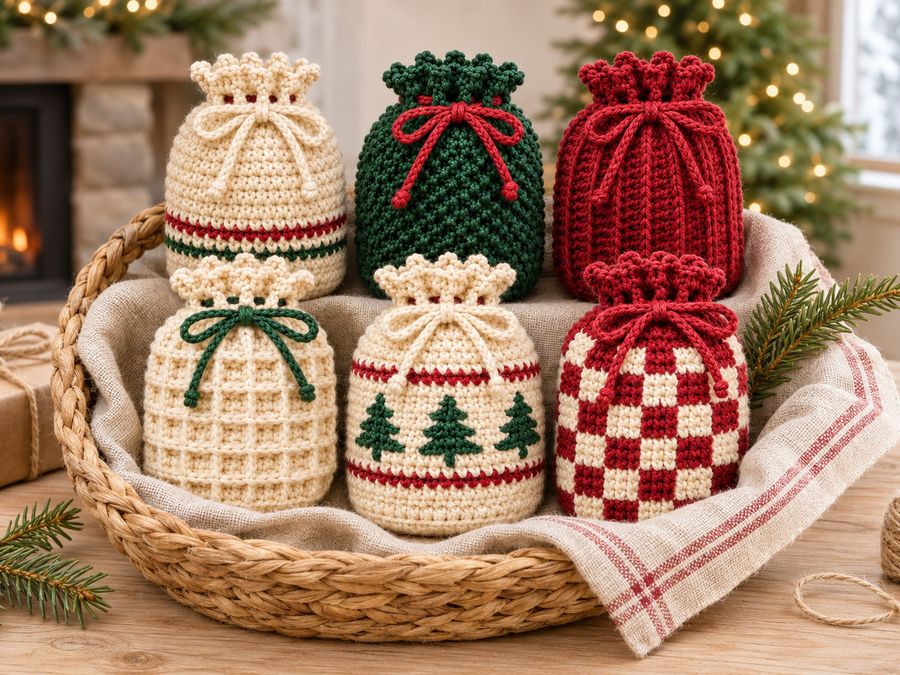
Six of the pouches sit together in one basket, and the shared yarn and hook are why they read as one set.
Hook size and gauge
These pouches are worked in worsted yarn on a 4 mm (US G-6) hook to a gauge of 17 sc and 19 rounds to 4 in (10 cm). The Craft Yarn Council “Standard Yarn Weight System” gives 11 to 14 single crochet per 4 in on a 5.5 to 6.5 mm (US I-9 to K-10 1/2) hook for category 4, and calls its ranges guidelines only. The pouch is worked tighter on purpose, because a tight, even fabric keeps small gifts inside.
That is not a mistake in the hook. It is the point.
You can check your gauge on the base itself. After Round 6 your base should measure about 2.5 in (6.5 cm) across. If it is larger, use a smaller hook. If it is smaller, use a larger one. Gauge is the US word; UK patterns call it tension.
What fits inside
A flat gift card, a pair of earrings, a jewellery box, a handful of sweets or a small candle fits inside each pouch. Every pouch is 4.25 in (10.5 cm) wide on a 2.5 in (6.5 cm) base, with sides 4.5 to 5.0 in (11.5 to 12.7 cm) tall. A gift card of 3.4 x 2.1 in (8.6 x 5.4 cm) slides in flat.
| Item | Fits? |
|---|---|
| Gift card, 3.4 x 2.1 in (8.6 x 5.4 cm) | Yes, flat |
| Pair of earrings | Yes |
| Jewellery box | Yes |
| Handful of sweets | Yes |
| Small candle | Yes |
Every item in the table comes from the pattern’s own list of what fits, so you can match your gift to a size the pattern states.
Making a pouch bigger or smaller
A pouch gets taller when you add body rounds and grows or shrinks all over when you change the yarn and hook. Makers often resize a drawstring pouch by adding rows, and a common question from makers is how to make one smaller, for a pouch that carries wedding rings. Each added single crochet round adds about 3/16 in (0.5 cm) of height, and each double crochet round about 3/8 in (1 cm).
If you want a whole-pouch change, keep every stitch count and swap to a thicker or thinner yarn with a hook to match. Crochet the gauge swatch in the new yarn first, because the pouch grows or shrinks by the same factor as your 17-stitch measure.
| Your 17 sc measure | Size factor | Pouch width |
|---|---|---|
| 3.6 in (9 cm) | x 0.9 | about 3.7 in (9.5 cm) |
| 4 in (10 cm), as written | x 1 | 4.25 in (10.5 cm) |
| 4.8 in (12 cm) | x 1.2 | about 5.0 in (12.6 cm) |
| 6 in (15 cm) | x 1.5 | about 6.2 in (15.8 cm) |
The table scales the 4.25 in (10.5 cm) width by the factor in each row, from about 3.7 in (9.5 cm) to about 6.2 in (15.8 cm), each converted from the centimetre figure.
A wider base works only for some pouches. You add 6 stitches per base round, to 42 at Round 7, and only where the body repeat divides the new count. Bigger pouches use more yarn, so allow extra. If you add or remove rounds yourself, the count tables no longer apply to those rounds.
What can you give in a crochet gift bag?
A crochet gift bag is wrapping the recipient keeps: a gift card, jewellery, sweets or a small candle goes inside, and the bag stays after the gift is opened. Nothing gets torn open. The pattern lists four uses, so you can match a pouch to the person you give it to.
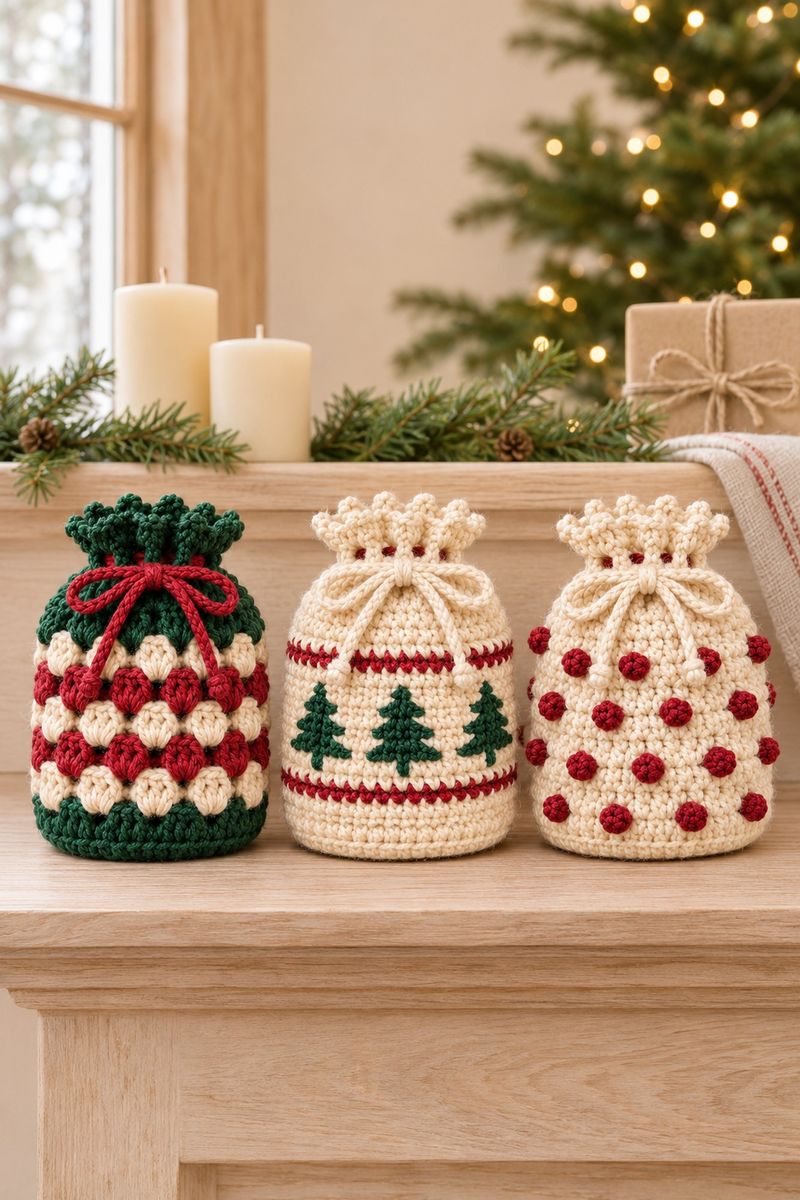
Three of the pouches stand on a mantel, which is how a filled gift bag waits for its day.
Gift card holder
A crochet gift card holder is a drawstring pouch with the card slid in flat and the bow pulled tight. The gift card of 3.4 x 2.1 in (8.6 x 5.4 cm) fits inside the 4.25 in (10.5 cm) width with room to spare, so the card lies flat instead of bending. You pull the cord and it is wrapped.
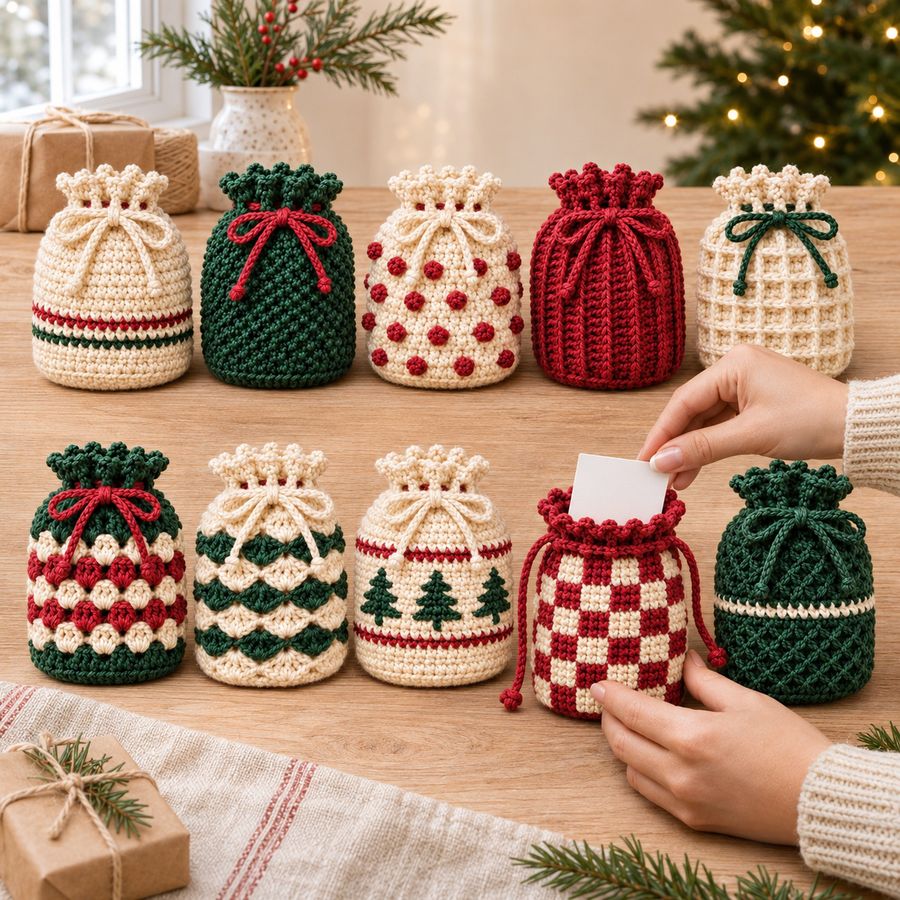
The photo shows a card going into the Cabin Check pouch, the gift card holder of the set.
More gifts sorted by who they are for and how long they take are on Crochet Gift Ideas: Easy Gifts to Make by Person and Time.
Treat bags and table favours
Crochet treat bags hold sweets, and a pouch at each place makes a Christmas table favour your guests take home. For an advent run, the pattern suggests making all ten in different textures and filling them with sweets. Each pouch takes you one evening, so a set of ten is ten evenings.
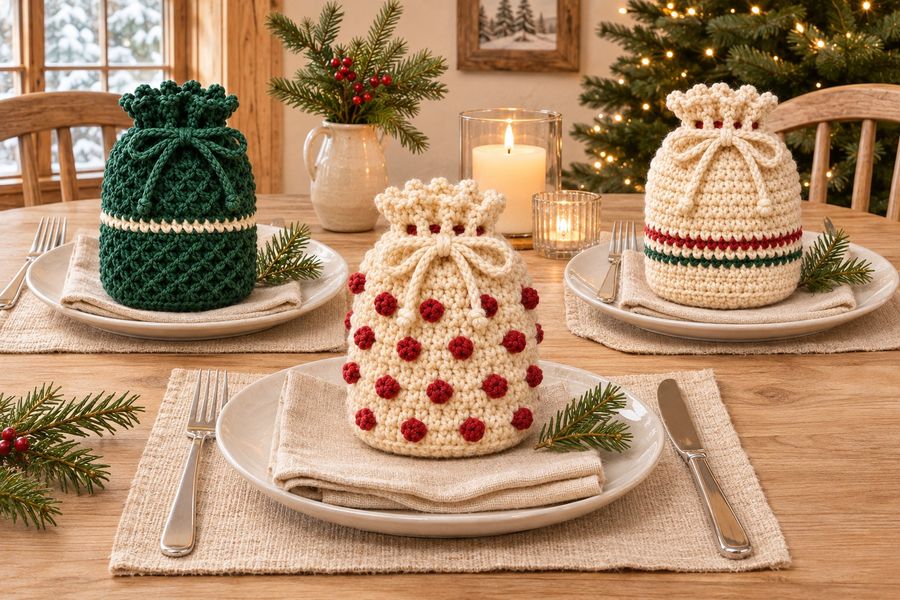
Three pouches sit on the plates of a set table, one at each place.
Reusable gift wrap under the tree
A crochet pouch under the tree is reusable gift wrap: jewellery or a small candle for a teacher, a neighbour or a gift exchange goes inside, and the pouch works as a stocking stuffer too. The bow opens and ties again, so the same bag carries the next gift. The recipient keeps both.
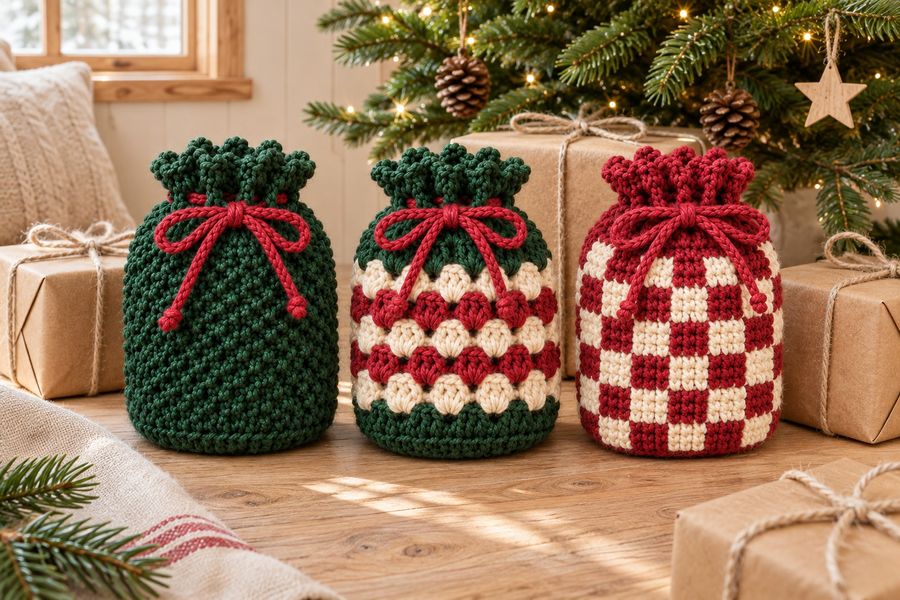
The seed stitch, granny stripe and checkerboard pouches wait under the tree beside wrapped parcels.
The same ten pouches are part of the 62-pattern Christmas collection, beside ornaments, mug cozies, coasters and mini wreaths.
Why does a crochet pouch go wrong, and how do you fix it?
A crochet pouch goes wrong when a stitch count or the tension drifts, and every round ends on a count, 36 on every body round, so counting is the first check. Count before you undo anything. The table gives each problem with the cause and fix from the pattern.
| Problem | Cause | Fix |
|---|---|---|
| 35 stitches after Round 6 instead of 36 | An increase was missed | Count the increases; there should be 6. Undo back to the missing one and work it again. |
| No ridge at Round 7 | The round was worked through both loops | Undo it and work it in the back loop only. |
| Count too high on the picot round | The picots were counted as stitches | Do not count them. You should have 36. |
| The base curls up like a bowl | Too few stitches in a round, or very tight tension | Check each round against the count table, undo to the last round that matches and go up half a hook size. |
| The base ripples like a ruffle | Too many stitches in a round, or very loose tension | Recount every round, undo to the last correct round and go down half a hook size. |
| Small holes at the increases | The stitch after an increase is loose | Pull the stitch after each increase snug and use a slightly smaller hook. |
| Puckers where the colour changes | The carried yarn is pulled too tight | Let the carried yarn lie loose and check the back every few rounds. |
| A step where the colour changes | The new colour was started on a new stitch | Finish the last stitch of the old colour with the new colour. |
The eight rows run from the base to the top, so you can match your problem to the round where it shows up.
Makers often find the sides of a pouch leaning, with diagonal stitches, even when they followed the same pattern as a straight pouch before it. Keep your joins in one line at the back of the pouch. Seed stitch leans less than plain single crochet. If a finished pouch leans, mist it lightly, shape it and leave it to dry. Never press an iron onto it.
Makers often find the wrong colour peeking through on a first tapestry pouch. Hold the unused colour along the top of the round below and work over it. Change colour on the last yarn over of the stitch before the new colour. Keep the carried strand loose, so it stays hidden without puckering the pouch.
A common question from makers is why two circles with the same yarn, hook and round count come out different sizes. The pattern’s answer is tension. Many crocheters work tighter or looser than the hook size shown. Measure your base after Round 6 against 2.5 in (6.5 cm) and change the hook until it matches. Trust your swatch, not the hook size.
Very small items can slip through the spaces in the Granny Stripe pouch. Line it with a scrap of fabric, so nothing falls out.
Which pouches need a different pattern?
Dice bags, zipper pouches and large drawstring bags need a different pattern, because these ten pouches are all small, round-based and closed with a cord.
Dice bag
A crochet dice bag needs its own pattern, since none of these ten pouches is written as one. You can still use one if your dice set fits inside a 4.25 in (10.5 cm) wide pouch.
Zipper pouch
A crochet zipper pouch needs a different pattern. These pouches close with a slip stitch drawstring only.
Large drawstring bag or backpack
A large drawstring bag or backpack needs a pattern written for its size. The size table tops out at about 6.2 in (15.8 cm) wide at x 1.5. That is still a pouch.
Stitches and tools for these pouches
The pouches use single crochet, a magic ring, tapestry colour changes, popcorns and granny groups, and each has its own guide, so you can learn one stitch before you start its pouch. The single crochet base and the Cabin Stripe body follow How to Single Crochet: A Step by Step Guide for Beginners. The base starts in How to Make a Magic Ring in Crochet for Beginners. The two colourwork pouches build on Tapestry Crochet: Color Changes, Carried Yarn and Charts, and the berries on Crochet Bobble, Puff and Popcorn Stitches Compared. The granny groups come from How to Crochet a Granny Square for Beginners. For FPdc, BPdc, BLO and the UK names, see Crochet Abbreviations and US to UK Stitch Names. The rest of the season’s projects are on Christmas Crochet Patterns: Ornaments, Stockings and Decor, and every pattern is on Crochet Patterns to Make: Christmas Decor and Winter Wear.
Questions makers ask
Can a beginner crochet a drawstring bag?
Yes. The Cabin Stripe uses only single crochet and is labelled Beginner in the pattern, because it uses basic stitches only. Seven of the other pouches are Easy and two are Intermediate, so a beginner can start with the stripes, move to seed stitch or shells and leave the tapestry pouches for later.
How much yarn does a crochet drawstring bag take?
A crochet drawstring bag in this set takes 38 to 59 yd (34 to 55 m) of worsted yarn, cord included. The Pine and Snow Shells uses the least and the Snowberry Popcorn the most. All ten pouches together take about 439 yd (401 m) in three colours.
What is the best stitch for a crochet gift bag?
It depends on what the bag holds. Single crochet gives a firm, plain pouch, because the tight fabric keeps small gifts inside. Waffle stitch is thick, so the pouch stands up on its own for jewellery. Post stitch rib stretches to hug a small box.
How long does a crochet drawstring pouch take?
One evening per pouch. Every pouch shares the same base and the same top, so once you have learned them on your first pouch, only the body is new each time. The Pine and Snow Shells is the shortest at 18 rounds; four pouches take 28.
How do you wash a crochet pouch?
Hand wash it cold, dry it flat and reshape it while damp, after checking the care label of your yarn first. To freshen the shape, steam lightly with the iron held above the fabric, never on it, and shape the pouch around your hand.
What are the UK terms for these stitches?
The pouches use US terms. US single crochet (sc) is UK double crochet, and US double crochet (dc) is UK treble. The base, the eyelet round and the picot edge read the same in both once you swap those two names.