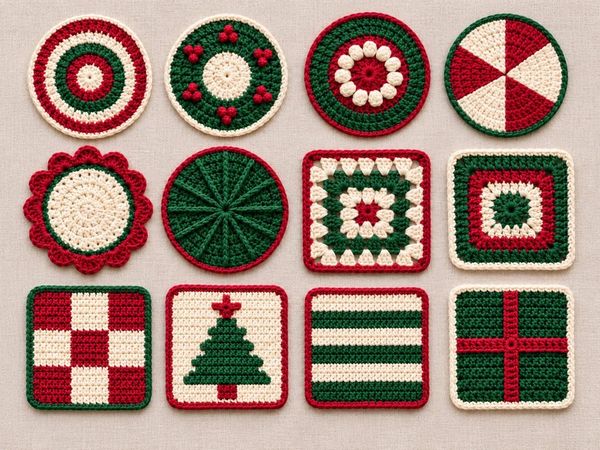
A crochet coaster is a small flat round or square, worked in rounds from a magic ring or in rows, that sits under a mug or glass. These 16 coasters come from two patterns: four Beginner designs about 4 in (10 cm) across in weight 3, light (DK) cotton, and twelve Christmas designs about 4.5 in (11.5 cm) across in weight 4, medium (worsted) cotton, all on a 4 mm (G-6) hook.
Half are round and half are square. The Beginner four are a granny square, a solid round and a two-tone version of each, while the Christmas twelve share one palette of cranberry, cream and pine, so any mix of them looks like a set. You get the Solid Round Coaster in full on this page, free.
The lead photo shows the Cranberry Bullseye: a cream centre, rings of cranberry, pine, cream and cranberry, and a cream edge.
The table sorts all sixteen by set, shape, colours, build, size and yarn.
Crochet coaster patterns at a glance: shape, colours, size and yarn
Each row of this table is one crochet coaster pattern, in the same order as the cards that follow, so you can compare them before you pick one.
| Coaster | Set | Shape | Colours | Built with | Size across | Yarn used |
|---|---|---|---|---|---|---|
| Classic Granny Square | Beginner | square | one colour | 3 dc groups, ch-2 corners | 4 in (10 cm) side to side | about 16 yd (15 m) |
| Solid Round | Beginner | round | one colour | dc rounds, 12 increases a round | 4 in (10 cm) | about 16 yd (15 m) |
| Two-Tone Granny Square | Beginner | square | two colours | as the classic square, Rounds 3 and 4 in colour B | 4 in (10 cm) side to side | contrast about 6.5 yd (6 m) |
| Two-Tone Round | Beginner | round | two colours | as the solid round, Round 4 in colour B | 4 in (10 cm) | contrast about 6.5 yd (6 m) |
| Cranberry Bullseye | Christmas | round | cream, cranberry, pine | one colour per round | 4.5 in (11.5 cm) | about 19 yd (17.5 m) |
| Holly Wreath | Christmas | round | cream, pine, cranberry | dc rounds, 18 French knots | 4.5 in (11.5 cm) | about 20 yd (18.5 m) |
| Snow Starburst | Christmas | round | cranberry, cream, pine | 12 puff stitches | 4.5 in (11.5 cm) | about 19 yd (17.5 m) |
| Peppermint Wheel | Christmas | round | cranberry, cream, pine | six two-colour wedges | 4.5 in (11.5 cm) | about 21 yd (19.5 m) |
| Scalloped Snow | Christmas | round | cream, pine, cranberry | 12 shells on the edge | 4.5 in (11.5 cm) | about 16 yd (14.5 m) |
| Evergreen Ribs | Christmas | round | pine, cranberry | 12 front post ribs | 4.5 in (11.5 cm) | about 19 yd (17 m) |
| Classic Christmas Granny | Christmas | square | cranberry, cream, pine | granny rounds, sc edge | 4.5 in (11.5 cm) side to side | about 16 yd (15 m) |
| Evergreen Frame | Christmas | square | pine, cream, cranberry | solid granny rounds, sc edge | 4.5 in (11.5 cm) side to side | about 17 yd (15.5 m) |
| Cranberry Check | Christmas | square | cranberry, cream, pine | 20 sc rows from a chart, border | 4.5 in (11.5 cm) side to side | about 27 yd (24.5 m) |
| Little Pine Tree | Christmas | square | cream, cranberry, pine | 20 sc rows from a chart, border | 4.5 in (11.5 cm) side to side | about 27 yd (24.5 m) |
| Pine Stripe | Christmas | square | pine, cream, cranberry | 12 hdc rows, border | 4.5 in (11.5 cm) side to side | about 18 yd (16.5 m) |
| Gift Box | Christmas | square | pine, cranberry, cream | 20 sc rows from a chart, border | 4.5 in (11.5 cm) side to side | about 27 yd (24.5 m) |
Read down the Set column and the page splits in two. Four plain coasters teach you the round. Twelve colourwork coasters dress the Christmas table. A Beginner coaster takes about 20 to 30 minutes.
Start your first coaster with the Solid Round, because the pattern says it has the simplest count to check. The Beginner set carries the pattern’s own label, Beginner. That is not a Craft Yarn Council level. Every Christmas design is labelled Easy, which the Craft Yarn Council “Project Levels” defines as “Projects may include simple stitch patterns, color work, and/or shaping.” Learn the round first. Colour comes after.
Beginner crochet coasters: granny square and solid round
The four Beginner coasters come from one pattern, the Beginner Coasters (titled Modern Coaster Set). They share one rhythm. You start each one with a magic ring, and the beginning ch 3 counts as the first double crochet. Each round adds exactly 12 stitches: 12, 24, 36, 48. Four rounds make a coaster. There is no sewing and no seam, so your only job is the count. New to the stitches? Your first hook, yarn and stitches are in How to Crochet for Beginners: Hooks, Yarn, Stitches, Projects.
Classic Granny Square Coaster
- Yarn
- 3, light (DK)
- Hook
- 4 mm (G-6)
- Skill level
- Beginner
- Best for
- a first granny square in one colour
The Classic Granny Square is a one-colour square of 3 dc groups with open ch-2 corners: Beginner Coasters, design 1 of 4. Round 1 is four groups of 3 dc in a magic ring. Each corner then takes two groups. Each side gains one group a round.
It ends on 48 stitches after Round 4, about 4 in (10 cm) side to side and 4.25 in (11 cm) corner to corner. Keep your ch-2 corners loose, because tight corners pull the square into a diamond.
Solid Round Coaster
- Yarn
- 3, light (DK)
- Hook
- 4 mm (G-6)
- Skill level
- Beginner
- Best for
- a first coaster: the pattern's own starting point
The Solid Round is a flat one-colour circle of double crochet: Beginner Coasters, design 2 of 4. Round 1 is a ch 3 and 11 dc in a magic ring, 12 stitches.
You increase in every stitch, then every second, then every third, so the circle ends on 48 after 4 rounds. It is about 4 in (10 cm) across. Put a marker in each beginning ch 3, because the join is easy to lose. Every round is in the free Solid Round crochet coaster pattern further down this page.
Two-Tone Granny Square Coaster
- Yarn
- 3, light (DK)
- Hook
- 4 mm (G-6)
- Skill level
- Beginner
- Best for
- two colours with one change
The Two-Tone Granny Square works exactly like the classic square with one colour change: Beginner Coasters, design 3 of 4. Rounds 1 and 2 are colour A and Rounds 3 and 4 are colour B. The counts stay 12, 24, 36, 48.
Join the new colour at a corner, because the change is far less visible there than mid-side. Weave each colour’s tails into its own rounds. A dark tail carried through a cream round shows.
Two-Tone Round Coaster
- Yarn
- 3, light (DK)
- Hook
- 4 mm (G-6)
- Skill level
- Beginner
- Best for
- a contrast rim, made in multiples
The Two-Tone Round is the solid round with a contrast rim: Beginner Coasters, design 4 of 4. Rounds 1 to 3 are colour A and Round 4 is colour B, with the same 48 stitches at the end.
The pattern calls it the fastest of the four. Make it in multiples. Keep the contrast to one round, because two contrast rounds start to look like a target. Finish the last stitch of Round 3 with colour B for the cleanest change.
Round Christmas coasters: rings, holly, puffs, peppermint and scallops
The six round Christmas coasters start the same way: a magic ring with 12 dc in it, then joined rounds, most of which grow by 12 stitches. In this set the chain at the start of a round does not count as a stitch. Five of the six end with a round of single crochet (UK double crochet) that brings the edge to 66 stitches. All twelve Christmas coasters finish about 4.5 in (11.5 cm) across, so any round and any square mix and match as one set. Most take under an hour.
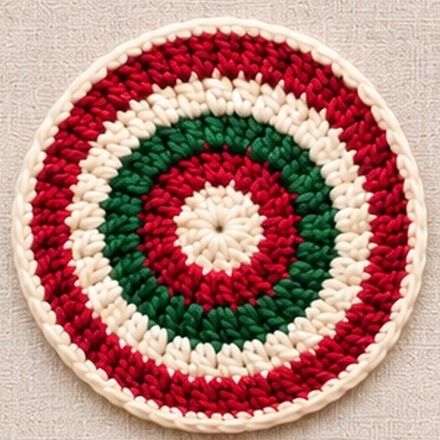
Cranberry Bullseye Coaster
- Yarn
- 4, medium (worsted)
- Hook
- 4 mm (G-6)
- Skill level
- Easy
- Best for
- a colour change every round
The Cranberry Bullseye has a cream centre, rings of cranberry, pine, cream and cranberry, and a cream edge: Christmas Coaster Collection, design 1 of 12. Every round is one colour. Each ring you see is one round: 12, 24, 36, 48 and 60 dc, then the sc edge to 66.
It uses about 19 yd (17.5 m) across the three colours. Move the join to a new spot each round, so the seam does not stack into a line.
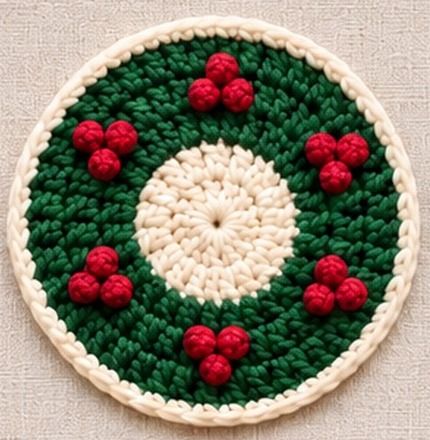
Holly Wreath Coaster
- Yarn
- 4, medium (worsted)
- Hook
- 4 mm (G-6)
- Skill level
- Easy
- Best for
- French knot berries
The Holly Wreath is a cream centre in a wide pine ring, with six groups of three cranberry berries: design 2 of 12. Rounds 1 and 2 are cream, Rounds 3 to 5 are pine and Round 6 is a cream sc edge, so the berries on Round 4 sit in the middle of the green.
The 18 berries are French knots in groups of three, with 8 stitches between groups. Wrap the yarn twice round the needle for each knot, so they look fuller and stay put. The pine takes most of the 20 yd (18.5 m).
Snow Starburst Coaster
- Yarn
- 4, medium (worsted)
- Hook
- 4 mm (G-6)
- Skill level
- Easy
- Best for
- a first ring of puff stitches
The Snow Starburst rings a small cranberry centre with 12 cream puff stitches like a snowy star, then a cranberry ring, a wide pine band and a cranberry edge: design 3 of 12. Round 2 is a puff and a ch 1, 12 times.
Round 3 skips the puffs. It puts 3 dc in each ch-1 space, 36 stitches. Pull every puff loop up to the same height, about 0.6 in (1.5 cm), so the star comes out even. It uses about 19 yd (17.5 m).
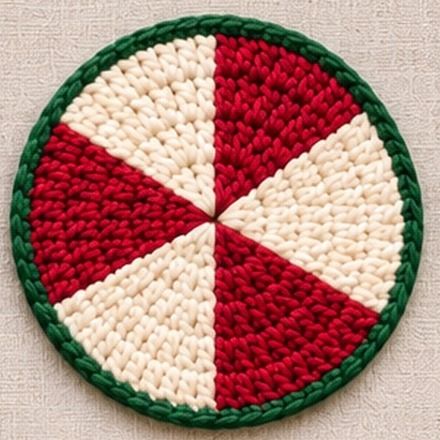
Peppermint Wheel Coaster
- Yarn
- 4, medium (worsted)
- Hook
- 4 mm (G-6)
- Skill level
- Easy
- Best for
- two colours in one round
The Peppermint Wheel is a peppermint candy: six straight wedges, three cranberry and three cream, meeting in the middle, with a pine edge: design 4 of 12. Round 1 is 2 dc cranberry and 2 dc cream, three times, into one magic ring.
Every wedge sits on the wedge of the same colour below. If your colour lands on the other one, recount that round. Carry the colour you are not using inside the stitches, so nothing floats on the back. Yarn: about 21 yd (19.5 m).
Scalloped Snow Coaster
- Yarn
- 4, medium (worsted)
- Hook
- 4 mm (G-6)
- Skill level
- Easy
- Best for
- a shell edge
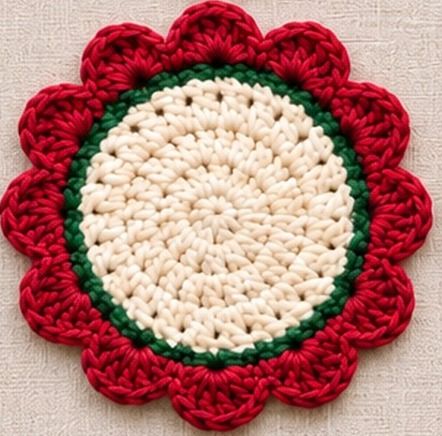
The Scalloped Snow is a solid cream circle, a thin pine ring and a frilly cranberry edge of 12 shells: design 5 of 12. Three cream rounds and one pine round bring it to 48 stitches.
The last round is sc 1, skip 1, 5 dc in the next stitch, skip 1, twelve times, 72 stitches. Each shell sits in the third stitch of every four, so 12 shells fit the 48 exactly. Pin the shells open when you block it. It takes the least yarn of the rounds, about 16 yd (14.5 m).
Evergreen Ribs Coaster
- Yarn
- 4, medium (worsted)
- Hook
- 4 mm (G-6)
- Skill level
- Easy
- Best for
- front post stitches
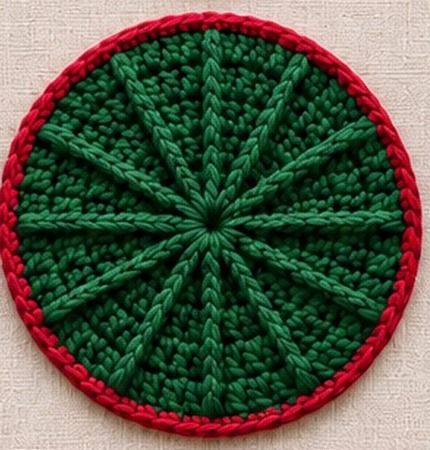
The Evergreen Ribs is a pine circle with 12 raised front post ribs running out like spokes, and a cranberry edge: design 6 of 12. Round 2 works a front post double crochet and a dc into each stitch, 24 stitches.
Every FPdc after that goes round the post of the FPdc below, so the 12 ribs run in straight lines. Keep the post stitches relaxed, because they pull the fabric in and a tight coaster will not lie flat. It uses about 19 yd (17 m), almost all pine.
Square Christmas coasters: granny, frame, check, tree, stripes and gift box
The six square Christmas coasters are built two ways. The two granny squares are worked in rounds from a magic ring, then a round of sc brings them to 72 stitches. The other four are worked in rows. One border round with 3 sc in each corner edges them, so all six finish about 4.5 in (11.5 cm) side to side.
Classic Christmas Granny Coaster
- Yarn
- 4, medium (worsted)
- Hook
- 4 mm (G-6)
- Skill level
- Easy
- Best for
- a granny square in three colours
The Classic Christmas Granny is a classic granny square: a cranberry centre, then cream, pine and cream rounds, and a cranberry sc edge: design 7 of 12. The counts run 12, 24, 36, 48, then 72 for the edge.
The 3 dc groups always go into spaces, never into stitches, until the sc edge, and a quarter turn of the square between rounds keeps the corners square instead of letting them drift. Spaces, not stitches. It uses about 16 yd (15 m).
Evergreen Frame Coaster
- Yarn
- 4, medium (worsted)
- Hook
- 4 mm (G-6)
- Skill level
- Easy
- Best for
- a solid square with no gaps
The Evergreen Frame is a solid square with no gaps: a pine centre, cream, cranberry and pine rounds, and a cream sc edge: design 8 of 12. Round 1 is the classic granny start. After that you work plain dc along the sides.
Each side grows by 4 stitches a round, 3, 7, 11, 15, so count one side before you join. The total runs 12, 28, 44, 60, 72. It uses about 17 yd (15.5 m).
Cranberry Check Coaster
- Yarn
- 4, medium (worsted)
- Hook
- 4 mm (G-6)
- Skill level
- Easy
- Best for
- colourwork from a chart
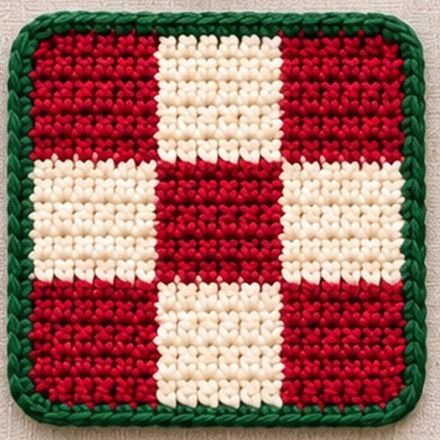
The Cranberry Check is a bold 3 by 3 checkerboard, cranberry in the corners and the centre, with a pine edge: design 9 of 12. You chain 19 and work 18 sc across for 20 rows. Each block is 6 stitches wide.
Change colour on the last yarn over of the stitch before the new colour. Carry the colour you are not using along the top of the row and work over it, so the back stays clean. The pine border brings it to 84 stitches. Yarn: about 27 yd (24.5 m).
Little Pine Tree Coaster
- Yarn
- 4, medium (worsted)
- Hook
- 4 mm (G-6)
- Skill level
- Easy
- Best for
- a picture worked from a chart
The Little Pine Tree is a cream square with a stepped pine tree, a cranberry trunk, a small cranberry star and a cranberry edge: design 10 of 12. It is 18 sc wide and 20 rows tall, read from a chart, and the tree narrows by one stitch at each side every two rows until only two pine stitches are left at the top.
That is the whole shape. Only two colours are ever in one row, so you carry one strand at a time. Cut the cranberry after the trunk and join it again for the star. It uses about 27 yd (24.5 m).
Pine Stripe Coaster
- Yarn
- 4, medium (worsted)
- Hook
- 4 mm (G-6)
- Skill level
- Easy
- Best for
- half double crochet stripes
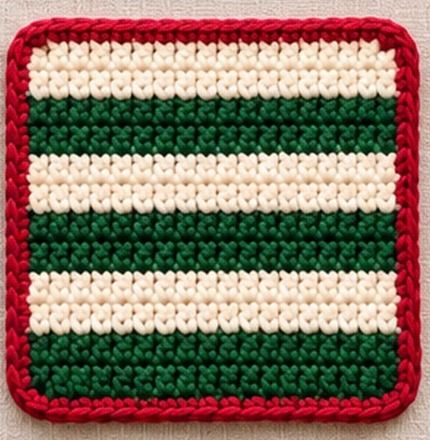
The Pine Stripe is six wide stripes of pine and cream in half double crochet (UK half treble), with a cranberry edge: design 11 of 12. You chain 18 and work 16 hdc for 12 rows, two rows to each stripe.
Carry the colour not in use up the side instead of cutting it, because the border hides it. The border puts 2 sc in each hdc row end and brings the edge to 88 stitches. It uses about 18 yd (16.5 m).
Gift Box Coaster
- Yarn
- 4, medium (worsted)
- Hook
- 4 mm (G-6)
- Skill level
- Easy
- Best for
- a ribbon cross from a chart
The Gift Box is a pine square crossed by a cranberry ribbon two stitches wide each way, with a cream edge: design 12 of 12. It is 18 sc wide and 20 rows tall. It looks like a wrapped present.
The ribbon is always the same two stitches in the middle of each row, stitches 9 and 10. Rows 10 and 11 are all cranberry, so you can carry the pine through them. Pine is more than half of its 27 yd (24.5 m).
The first two sets below hold all sixteen coasters, and the 62 pattern Christmas collection also includes coasters.
How do you crochet a coaster?
You crochet a coaster in one of three ways: in rounds from a magic ring for a circle, in grouped rounds with chain corners for a square, or in rows with a border round. The start decides the shape. Rounds and granny squares begin with a magic ring. The row squares begin with a chain.
| Method | Start | How it grows | Used for |
|---|---|---|---|
| Round in rounds | magic ring, 12 dc | 12 more stitches each round, increases spaced one stitch further apart | Solid Round, Two-Tone Round, all six round Christmas coasters |
| Square in rounds | magic ring, four groups of 3 dc with ch-2 corners | two 3-dc groups in each corner and one more group along each side; the Evergreen Frame puts 2 dc, ch 2, 2 dc in each corner and 4 more dc along each side | Classic Granny Square, Two-Tone Granny Square, Classic Christmas Granny, Evergreen Frame |
| Square in rows | ch 19 (or ch 18 for hdc) | the same stitches every row, then one border round | Cranberry Check, Little Pine Tree, Pine Stripe, Gift Box |
The table shows that twelve of the sixteen start from a magic ring, which makes it the one technique to learn before your first coaster, whichever shape you choose.
For the ring, wrap your yarn twice around two fingers. Insert the hook, pull up a loop and work Round 1 into the ring over both strands. Then pull the tail to close the centre. A round coaster grows by the same 12 stitches every round, so the increases move one stitch further apart each time: every stitch, then every second, then every third. The Beginner pattern calls that progression the whole design.
Makers often find a coaster diagram hard to read: all lines and symbols, no clear start. The fix here is written rounds, each with its stitch count at the end. The three chart squares do use a chart. Its rule is plain. Every square on the chart is one sc, and Row 1 is at the bottom. You read right side rows from right to left and wrong side rows from left to right.
Free Solid Round crochet coaster pattern
The Solid Round crochet coaster pattern is free here in full: a flat circle of 48 double crochet over 4 rounds, about 4 in (10 cm) across. You need weight 3, light (DK) cotton and a 4 mm (G-6) hook. The rounds below are copied from the Beginner Coasters pattern with every stitch count, so you can make the whole coaster from this page. The two-tone version follows at the end.
What you need for the Solid Round Coaster
- Yarn: weight 3, light (DK) cotton, about 16 yd (15 m) for one coaster.
- Hook: 4 mm (G-6).
- Notions: yarn needle, scissors, a stitch marker, blocking pins and a towel.
- Gauge: Rounds 1 to 3 measure about 3.25 in (8 cm) across.
- Finished size: about 4 in (10 cm) across, 4 rounds.
- Skill level: Beginner, for anyone comfortable with a magic ring and double crochet.
The pattern uses US terms: dc is double crochet (UK treble), sl st is slip stitch, ch is chain and st is stitch. The beginning ch 3 counts as the first dc in every round. Every round is joined with a sl st into the top of that ch 3, with the right side facing; do not turn. The number at the end of each round below is the stitch count, so count your stitches there before you go on.
Solid Round Coaster, round by round
Start with the magic ring. Wrap the yarn twice around two fingers to form a loose ring, leaving a 4 in (10 cm) tail. Insert the hook into the ring, yarn over and pull up a loop, then chain 1 to secure the ring; that chain does not count as a stitch. Work Round 1 into the ring itself, over both strands. Do not close the ring until Round 1 is finished.
| Round | Instructions | Stitch count |
|---|---|---|
| Round 1 | Make a magic ring. Ch 3 (counts as first dc), 11 dc into ring. Join with sl st to top of beginning ch 3. Pull the tail to close the ring. | 12 sts |
| Round 2 | Ch 3, dc into the same st as the join, 2 dc into each remaining st around. Join with sl st to top of beginning ch 3. | 24 sts |
| Round 3 | Ch 3, dc into the same st as the join, 1 dc into next st, [2 dc into next st, 1 dc into next st] eleven times. Join with sl st to top of beginning ch 3. | 36 sts |
| Round 4 | Ch 3, dc into the same st as the join, 1 dc into each of next 2 sts, [2 dc into next st, 1 dc into each of next 2 sts] eleven times. Join with sl st to top of beginning ch 3. | 48 sts |
Fasten off. Weave in all ends.
Walk the counts and they add up. Round 1 is the ch 3 and 11 dc: 12. Round 2 is 1 + 1 + 22: 24. Round 3 is 1 + 1 + 1 + 33: 36. Round 4 is 1 + 1 + 2 + 44: 48. Each round has 12 increases, counting the one at the join, so you can count increases instead of stitches.
Give the tail a second gentle tug after Round 2, because cotton loosens as you work. Then measure. If your circle after Round 3 is larger than 3.25 in (8 cm), your stitches are loose: try a 3.5 mm (E-4) hook. Smaller? Try a 4.5 mm (US 7) hook.
Two-tone rim, blocking and finishing
For the Two-Tone Round, work Rounds 1 to 3 in colour A and Round 4 in colour B. The stitch counts are unchanged, 12, 24, 36, 48. For the cleanest change, make the final yarn over pull through of the last Round 3 stitch with colour B.
- Lay the coaster flat on a towel, mist it lightly with water and pat it into shape with your hands.
- Ease the edge into an even circle and pin it at eight evenly spaced points.
- Let it dry completely before you use it. Do not iron it.
- Weave each tail through at least 1.5 to 2 in (4 to 5 cm) of stitches, changing direction once, then trim it flush.
Weave in more than you think you need, because a coaster is washed more often than most crochet. Run your thumb across the back. A bump you can feel shows through the mug.
More patterns written out like this one, round by round, are gathered in Free Crochet Patterns with Step by Step Photos.
What yarn and hook do crochet coasters need?
Crochet coasters on this page need cotton yarn and a 4 mm (G-6) hook: weight 3, light (DK) for the Beginner set and weight 4, medium (worsted) for the Christmas set. Both patterns call for cotton. The Beginner pattern says cotton holds its shape under a warm mug and washes well, and the Christmas pattern says 100% cotton absorbs drips and does not melt under a hot mug.
| Item | Beginner set | Christmas set |
|---|---|---|
| Yarn weight | 3, light (DK / light worsted) | 4, medium (worsted) |
| Fibre | cotton | 100% cotton |
| Colours | one main colour, one contrast | cranberry, cream, pine |
| Yarn for one coaster | about 16 yd (15 m) | about 16 to 27 yd (14.5 to 24.5 m) |
| Yarn for the whole set | about 66 yd (60 m) for all four | about 75 yd (68.5 m) cranberry, 81 yd (74 m) cream, 90 yd (82.5 m) pine |
| Hook | 4 mm (G-6) | 4 mm (G-6) |
| Gauge | Rounds 1 to 3 of the Solid Round = 3.25 in (8 cm) | Rounds 1 to 3 of the Cranberry Bullseye = 3 in (7.5 cm); 17 sc and 19 rows = 4 in (10 cm) |
| Notions | yarn needle, scissors, stitch marker, blocking pins | tapestry needle, scissors, stitch marker, blocking pins |
The table shows how little one coaster takes. Your leftovers may be enough.
Can you crochet coasters with acrylic yarn? The Beginner pattern says acrylic will work but flattens faster and does not tolerate heat as well. Cotton it is.
Your hook is smaller than the yarn label suggests. The Craft Yarn Council “Standard Yarn Weight System” gives category 3 yarn a 4.5 to 5.5 mm (7 to I-9) hook and category 4 yarn a 5.5 to 6.5 mm (I-9 to K-10 1/2) hook. It calls those ranges guidelines only. Both patterns still use 4 mm, so trust the pattern’s gauge check over the label. Choose a smooth cotton: the Beginner pattern names mercerised cotton for the crispest stitches and the flattest coaster. Swapping yarn? Swatch first, because the Craft Yarn Council “FAQs” page says the weight system is not an interchangeability chart. UK patterns call gauge tension. The mm and US letters for every hook are in Crochet Hook Size Chart: mm to US Size Converter, and the weights are set out in Yarn Weight Chart: Find Your Crochet Yarn Weight.
What size should a crochet coaster be?
A crochet coaster should be about 4 to 4.5 in (10 to 11.5 cm) across, so it leaves a margin round the mug. The Beginner pattern puts a standard mug base at roughly 3 in (7 to 8 cm). A 4 in (10 cm) coaster clears it on every side.
The Beginner coasters measure 4 in (10 cm) across the round and side to side on the square, and the square reaches 4.25 in (11 cm) corner to corner, because the corners add reach. Each is about 4 to 5 mm thick. The Christmas twelve all finish about 4.5 in (11.5 cm): rounds across, squares side to side.
Gauge decides the size. The Beginner pattern says gauge is not critical for a coaster but decides the finished diameter, so check yours if you want a set to match. Measure your first coaster flat, without stretching it. Then set it under your own mugs before you make the rest.
Why does a crochet coaster ruffle, cup or turn into a diamond?
A crochet coaster ruffles when a round has too many increases or loose tension, and cups when it has too few or tight tension; a granny square turns into a diamond when its corner chains are too tight. The count at the end of each round tells you which. Count first.
| Problem | Cause | Fix |
|---|---|---|
| The circle ruffles at the edge | too many increases, or tension too loose | recount Rounds 3 and 4, try a smaller hook |
| The circle cups into a bowl | too few increases, or tension too tight | check each round used every stitch, try a larger hook |
| Round 1 counts 11 dc | the beginning ch 3 was not counted | the ch 3 always counts as the first dc |
| You have 47 stitches after Round 4, not 48 | an increase was missed | count the increases: there should be 11 after the one at the join |
| The square turns into a diamond | corner ch-2 spaces worked too tightly | loosen the corner chains, block firmly to square |
| The sides of the square are uneven | a ch-1 side space was missed | compare all four sides; the short one is missing a group |
| A peppermint wedge lands on the other colour | a miscount in that round | recount that round |
| The ribbed coaster will not lie flat | post stitches worked tightly | keep the post stitches relaxed |
| Small holes show at the increases | the stitch after an increase is loose | pull it snug and check where each increase goes |
Six of the nine rows come back to one habit: count at the end of every round.
The Beginner pattern puts it simply: almost every count error in the set is a missed ch-1 or an uncounted beginning ch 3. Pull back one round rather than fixing a count in the next, because a miscount found early costs one round, not four. Two coasters in different sizes? Check your hook before the pattern. The Online Crochet Row Counter: Count Rows and Stitches keeps the tally in your browser while you work.
Coaster or mug rug: how big can a crochet coaster get?
These sixteen are coasters, 4 to 4.5 in (10 to 11.5 cm) across, and one more round turns a Beginner coaster into a small mug rug. The Beginner pattern says five rounds make a generous coaster or a small mug rug. Six rounds is closer to a trivet.
The rule for a fifth round is the one you already know: each extra round adds 12 dc, and on the solid round the plain stitches between increases go up by one. Nothing else changes.
| Round 5 | Instructions | Stitch count | Size |
|---|---|---|---|
| Solid round | ch 3, dc into same st, 1 dc into each of next 3 sts, [2 dc into next st, 1 dc into each of next 3 sts] eleven times. Join. | 60 dc | about 4.75 in (12 cm) |
| Granny square | work as Round 4, but with three 3-dc groups along each side instead of two | 60 dc | about 5 in (13 cm) |
Allow roughly 5.5 yd (5 m) of extra yarn per coaster for each extra round. Add the round to every coaster in your set or to none, because a mixed-size set looks accidental.
A mug rug sits under the mug. That is not a cozy. A cozy wraps round the mug itself, and those are in 10 Crochet Mug Cozy Patterns for Christmas Cups and Mugs. Flower, animal, fruit, pumpkin and sunflower coasters are other builds. None of them is here.
How do you wash and block crochet coasters?
You wash crochet coasters as each pattern says and dry them flat, because both patterns say to reshape the cotton while it is damp. For the Beginner set, hand wash in cool water with a mild detergent, or use a cool gentle cycle in a mesh bag. Reshape, dry flat, never tumble dry. The Christmas pattern says its 100% cotton coasters can be machine washed warm and dried flat.
To block, pin each coaster flat to size on a towel or mat, mist it and leave it to dry. Squares get a pin in every corner. Rounds get eight. Block your whole set together, so the coasters end up the same size. Darker colours hide coffee rings. Cream shows everything.
Which crochet techniques do the coasters use?
Ten techniques run through the sixteen coasters. Double crochet and the magic ring make every round. The granny squares add chain-space corners. Single crochet makes the Christmas edges and the three chart squares, and the steps are in How to Single Crochet: A Step by Step Guide for Beginners. Half double crochet makes the Pine Stripe. The Snow Starburst uses puff stitches, the Evergreen Ribs front post double crochet, and the Scalloped Snow a 5 dc shell. Colours change on the last yarn over, so each new colour starts clean, and the Holly Wreath berries are French knots. Every abbreviation, with its UK name, is in Crochet Abbreviations and US to UK Stitch Names.
More Christmas crochet patterns
The coasters belong to a larger family of table and tree makes, so your next project can match them. Ornaments, stockings and tree decor are in Christmas Crochet Patterns: Ornaments, Stockings and Decor. A stack of four coasters tied with ribbon makes an easy gift. More quick gifts are in Crochet Gift Ideas: Easy Gifts to Make by Person and Time. Every pattern on the site is sorted in Crochet Patterns to Make: Christmas Decor and Winter Wear.
Questions makers ask
Can you crochet coasters with acrylic yarn?
You can, but cotton is the better choice for a coaster. The Beginner pattern says acrylic will work but flattens faster and does not tolerate heat as well, while cotton holds its shape under a warm mug and washes well. The Christmas pattern asks for 100% cotton, which absorbs drips.
How long does it take to crochet a coaster?
A Beginner coaster takes about 20 to 30 minutes, because it is only four rounds of double crochet. Once that rhythm is in your hands, the pattern says the whole set of four takes an evening. Most of the twelve Christmas coasters take under an hour each.
Can granny squares be used as coasters?
Yes. Four of the coasters on this page are granny squares: the Classic and Two-Tone Granny Square at about 4 in (10 cm), and the Classic Christmas Granny and Evergreen Frame at about 4.5 in (11.5 cm). Block each one with a pin in every corner, so it lies square under a mug.
How many coasters are in a set?
The Beginner set is four: the pattern has four designs, one of each. The Christmas pattern holds twelve designs and suggests a stack of four tied with ribbon as a gift. Make any set in the same yarn and hook, and in two colours rather than four, so the coasters match in size and look.
Can I sell coasters I make from the patterns?
Yes, in small quantities. Both patterns let you sell coasters you crochet yourself, and the Christmas pattern asks you to credit the pattern when you do. The written instructions, charts and pattern pages may not be copied, shared, translated or resold, so point friends to the pattern instead.