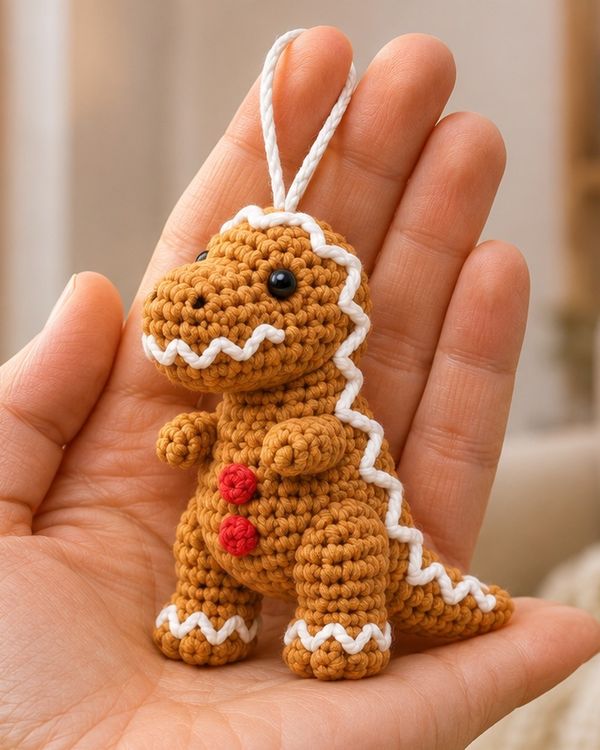
Christmas amigurumi are small stuffed crochet figures made from parts worked in continuous rounds, stuffed, sewn together and hung on the tree. These six gingerbread dinosaur ornaments, a T-Rex, Stegosaurus, Triceratops, Brontosaurus, Pterodactyl and Ankylosaurus, measure 3.25 to 4.25 in (8 to 11 cm) in weight 3, light (DK) yarn on a 2.75 mm (C-2) hook, and each takes 2 to 3 hours.
Each dinosaur is worked in warm gingerbread brown. The white icing goes on last with surface slip stitch, back stitch and French knots, so you pipe it onto the finished shape the way icing goes onto a cookie. A seventh piece, the Pompom Hat, is a red hat with a folded cream brim and a fluffy pompom. The Gingerbread T-Rex is free in full on this page.
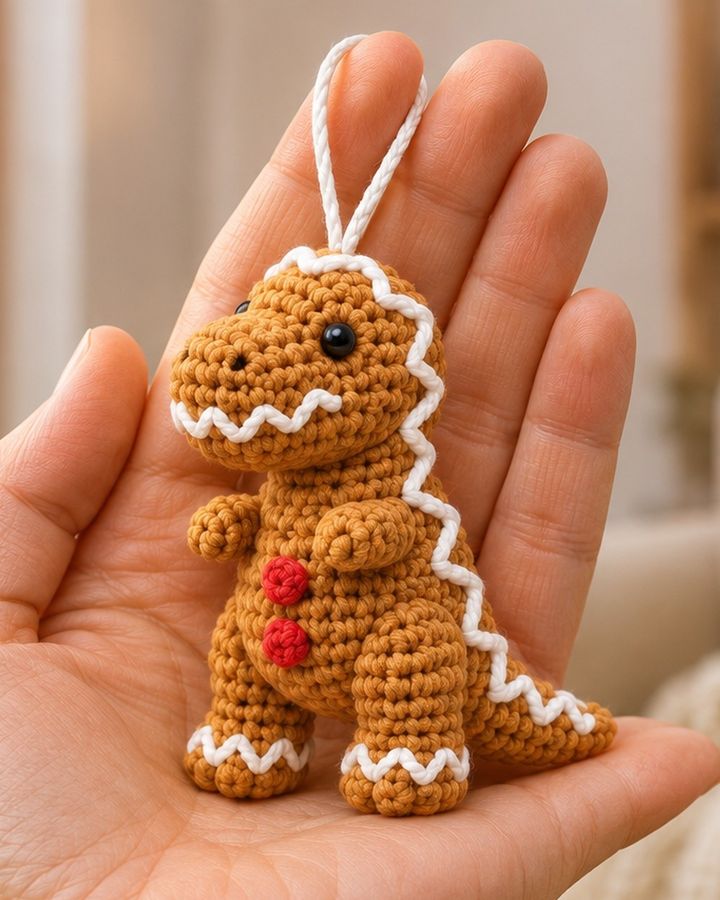
The lead photo shows the Gingerbread T-Rex in an open hand, its white loop at the top of the head and two red candy buttons on the belly.
The table compares all seven by size, rounds, yarn and time.
Christmas amigurumi at a glance: size, rounds, yarn and time
The seven Christmas amigurumi here measure 2.5 to 4.25 in (6.5 to 11 cm), take 20 to 50 rounds and rows, use 16 to 34 yd (15 to 31 m) of yarn and take 40 minutes to about 3 hours each. Each row is one ornament, in the same order as the cards that follow, so you can compare the build before you choose.
| Ornament | Size | Rounds and rows | Yarn used | Time | Trim |
|---|---|---|---|---|---|
| Gingerbread T-Rex | 3.5 in (9 cm) tall | 48 | 28 yd (26 m) | about 2.5 hours | icing zigzag, 2 red candy buttons |
| Gingerbread Stegosaurus | 4 in (10 cm) long | 41 | 25 yd (23 m) | about 2.5 hours | 7 iced plates, mint bow |
| Gingerbread Triceratops | 3.75 in (9.5 cm) long | 44 | 28 yd (26 m) | about 2.5 hours | scalloped frill, 3 white horns |
| Gingerbread Brontosaurus | 4.25 in (11 cm) tall | 50 | 34 yd (31 m) | about 3 hours | icing dots, red bow |
| Gingerbread Pterodactyl | 4.25 in (11 cm) wingspan | 37 | 16 yd (15 m) | about 2 hours | iced wings, 2 mint candy buttons |
| Gingerbread Ankylosaurus | 3.75 in (9.5 cm) long | 39 | 26 yd (24 m) | about 3 hours | icing lattice, red candy dots |
| Pompom Hat Ornament | 2.5 in (6.5 cm) tall with the pompom | 20 | 16 yd (15 m) | 40 to 60 minutes | cream brim, pompom |
The Pterodactyl is the shortest dinosaur at 37, the Brontosaurus the longest at 50. Time runs about 2 to 3 hours each.
For a first Christmas amigurumi, start with the Stegosaurus or the Triceratops, because the pattern says their four short legs and round body teach the whole set. Every other dinosaur uses the same shapes. The Iced Gingerbread Dinos are labelled Advanced beginner as a set and Medium for each dinosaur; those are the pattern’s own labels, not Craft Yarn Council levels, since the Craft Yarn Council “Project Levels” use only Basic, Easy, Intermediate and Complex.
You can compare the dinosaurs with baubles, stars and mini sweaters in Crochet Christmas Ornament Patterns: 15 Types to Make.
Gingerbread dinosaur ornaments: six iced dinos to crochet
All six gingerbread dinosaurs you can make here share one palette of four colours: Gingerbread (warm brown), Icing White, Candy Red and Mint. The stuffed parts are worked in continuous spiral rounds and the flat parts, such as plates, wings and bows, in rows. The icing comes last, so you pipe it over a finished shape and can plan it with pins first. Make all the parts of one dinosaur before you sew anything. Every dinosaur ends with an Icing White hanging loop.
The set sits with the tree, mantel and table pieces in Christmas Crochet Patterns: Ornaments, Stockings and Decor.
Gingerbread T-Rex
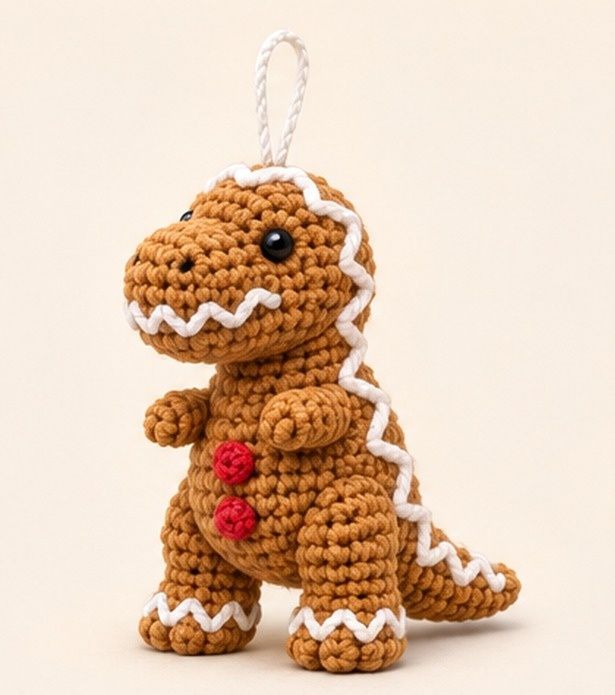
Gingerbread T-Rex
- Yarn
- 3, light (DK)
- Hook
- 2.75 mm (C-2)
- Skill level
- Medium
- Time
- about 2.5 hours
- Best for
- a standing ornament, free in full on this page
The Gingerbread T-Rex is a chubby standing T-Rex with a round head, a short snout, two tiny arms and a little tail: Iced Gingerbread Dinos, design 1 of 6. A white icing zigzag runs from the top of his head to the tip of his tail, and two red candy buttons sit on his belly.
He has 10 parts and 48 rounds. He uses about 28 yd (26 m) of yarn. Stuff the neck firmly before the last few stitches, because a firm neck stops the head from nodding. He is free in full below.
Gingerbread Stegosaurus
Gingerbread Stegosaurus
- Yarn
- 3, light (DK)
- Hook
- 2.75 mm (C-2)
- Skill level
- Medium
- Time
- about 2.5 hours
- Best for
- a first dinosaur, as the pattern suggests
The Gingerbread Stegosaurus is a round Stegosaurus on four short legs, with seven back plates outlined in white icing and a mint bow on his tail: design 2 of 6. You work three large and four small plates in rows and sew them in one line along the back, the large three in the middle.
A wavy icing line runs along each side, with 5 French knots above each line. Sew each plate through its bottom row only, so it stands up straight. He takes 41 rounds and rows. Yarn: about 25 yd (23 m).
Gingerbread Triceratops
Gingerbread Triceratops
- Yarn
- 3, light (DK)
- Hook
- 2.75 mm (C-2)
- Skill level
- Medium
- Time
- about 2.5 hours
- Best for
- a first dinosaur with a flat round frill
The Gingerbread Triceratops is a sturdy Triceratops with a round frill, three white horns and a wavy icing line along his back: design 3 of 6. The frill is worked in joined rounds, and its last round in Icing White makes 6 scallops of 5 double crochet (UK treble) each.
You add six French knots to the frill, one above each scallop. The horns are Icing White. They stay stiff without stuffing, so you roll each one between your fingers to shape the point. He takes 44 rounds. Yarn: about 28 yd (26 m).
Gingerbread Brontosaurus
Gingerbread Brontosaurus
- Yarn
- 3, light (DK)
- Hook
- 2.75 mm (C-2)
- Skill level
- Medium
- Time
- about 3 hours
- Best for
- the top of the tree, as the tallest of the set
The Gingerbread Brontosaurus is a tall Brontosaurus with a long neck, a long tail, white icing dots and a red bow on his neck: design 4 of 6. The neck and head are one part of 17 rounds, which you sew upright onto the front of the body.
You make seven French knots along the top of his back, with a wavy icing line along each side. Stuff the neck in very small pieces, a little at a time, so it stays smooth and straight. At 50 rounds and rows and about 34 yd (31 m), he has the most rounds and uses the most yarn of the six.
Gingerbread Pterodactyl
Gingerbread Pterodactyl
- Yarn
- 3, light (DK)
- Hook
- 2.75 mm (C-2)
- Skill level
- Medium
- Time
- about 2 hours
- Best for
- the quickest dinosaur of the set
The Gingerbread Pterodactyl is a little flying Pterodactyl with a pointed beak and crest, two triangle wings edged in white icing and two mint candy buttons on his chest: design 5 of 6. You work the wings in rows and sew them along the sides of the body, points out.
Your three French knots cross the middle of each wing. Steam the wings flat under a damp cloth before you sew them on, so they stay crisp. He needs only 37 rounds and rows. Yarn: about 16 yd (15 m).
Gingerbread Ankylosaurus
Gingerbread Ankylosaurus
- Yarn
- 3, light (DK)
- Hook
- 2.75 mm (C-2)
- Skill level
- Medium
- Time
- about 3 hours
- Best for
- practising surface slip stitch and back stitch icing
The Gingerbread Ankylosaurus is a wide, low Ankylosaurus with a domed shell, a white icing rim and lattice, red candy dots and a round club on the end of his tail: design 6 of 6. One back loop round gives the shell a crisp rim and a flat belly.
The icing rim is surface slip stitch worked into the free front loops of the round below. The lattice is 4 lines of back stitch one way and 4 the other, with a red French knot in each diamond, so plan your lines with pins first. He takes 39 rounds. Yarn: about 26 yd (24 m).
The six cards share one hook, one yarn weight and one difficulty, so your choice comes down to shape and time.
Is there a crochet Santa hat ornament in these patterns?
No: none of these patterns is a Santa hat; the nearest piece is the Pompom Hat, a red hat with a folded cream brim and a fluffy pompom. It is ornament 18 of 20 in the Hearthside Christmas Ornaments and hangs beside the dinosaurs on a Gold loop. Like the dinosaurs, it is a small stuffed piece worked in amigurumi spiral rounds, so the rounds you learn on one carry to the other. It is also the quickest piece here.
Pompom Hat Ornament
Pompom Hat Ornament
- Yarn
- 4, medium (worsted)
- Hook
- 3.5 mm (E-4)
- Skill level
- Medium
- Time
- 40 to 60 minutes
- Best for
- a quick red and cream ornament beside the dinosaurs
The Pompom Hat is a red hat with a folded cream brim and a fluffy pompom: Hearthside Christmas Ornaments, design 18 of 20. You work the hat in Red from a magic ring, growing from 6 to 24 stitches in 4 rounds, then straight for 6 rounds. Rounds 11 to 16 are worked in Cream in the back loops only, and you fold Rounds 14 to 16 up over 11 to 13 to make the brim.
A flat Red base of 4 rounds is sewn inside at the fold line, so the brim hides the seam. The pompom is 1 in (2.5 cm) across, made from 40 wraps around two fingers. The hat measures 2 in (5 cm) across and 2.5 in (6.5 cm) tall with the pompom. Yarn: about 16 yd (15 m). The 40 to 60 minutes is the time the pattern gives its stuffed ornaments.
The Pompom Hat is free in full, with its rounds and stitch counts, in Free Crochet Christmas Ornament Patterns: 20 Baubles, Stars and Bells.
How are Christmas amigurumi built?
Christmas amigurumi are built from small parts, each started from a magic ring and worked in continuous spiral rounds, then stuffed, closed and sewn together. Flat parts such as plates and wings are worked in rows. You add the icing and the hanging loop last.
| Step | What you do | Where the dinosaurs use it |
|---|---|---|
| 1. Start a magic ring | work the first round into a loop of yarn, then pull the tail to close the centre | every stuffed part |
| 2. Work spiral rounds | do not join; move a stitch marker to the first stitch of each round | heads, bodies, legs, tails |
| 3. Increase and decrease | 2 sc in one stitch grows the piece; an invisible decrease shrinks it | every ball and cone |
| 4. Work a back loop round | single crochet in the back loops only leaves a ridge | the flat sole of each foot, the Ankylosaurus rim |
| 5. Fit safety eyes | push the post through, press the washer on, then stuff | every head |
| 6. Stuff and close | add small pieces of stuffing, then thread the tail through the last 6 stitches | heads, bodies, the club |
| 7. Sew the parts on | pin, then whip stitch round the open edge | legs, arms, tails, plates, wings |
| 8. Pipe the icing | surface slip stitch, back stitch and French knots in Icing White | every dinosaur |
The table runs in build order, so you take each part from step 1 to step 8.
The shaping comes from the stitch count. Six increases a round spread evenly, so the T-Rex head grows into a flat circle of 24 stitches in 4 rounds. Plain rounds add no stitches, so the sides then go straight up like a tube. Six decreases a round close it again. That is a ball. Change the counts and you get a cone, a leg or a tail.
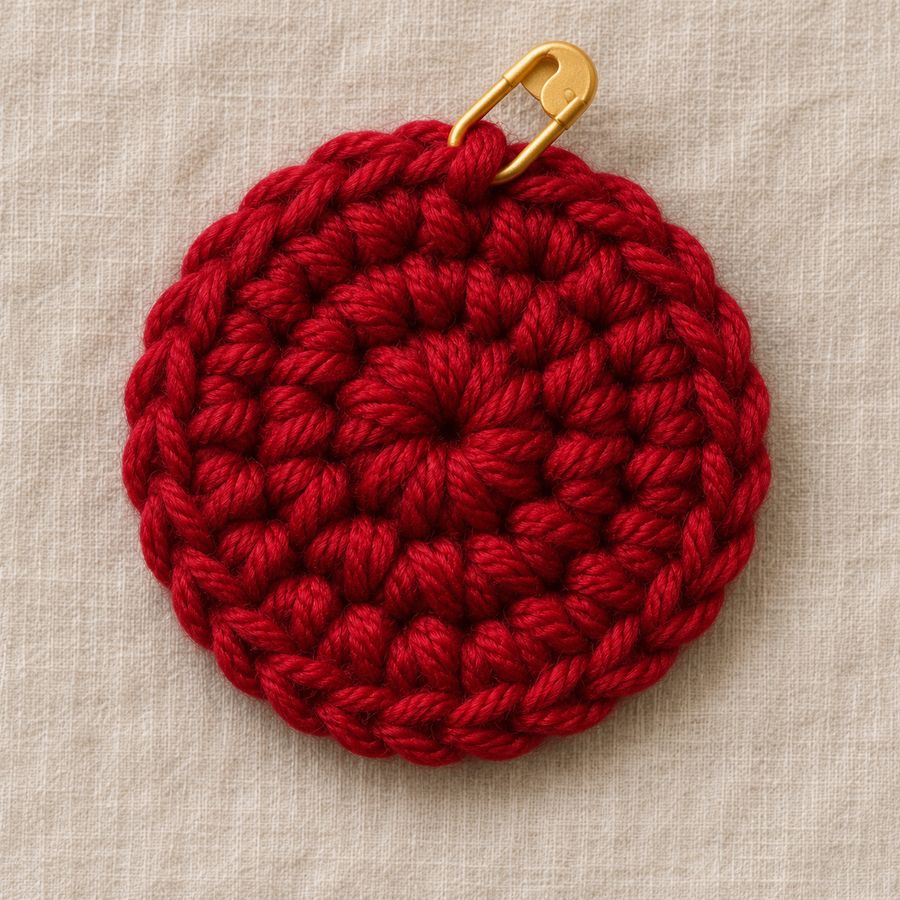
The photo shows the Pompom Hat crown after Round 4, a flat circle of 24 stitches with the marker in the first stitch; the T-Rex head makes the same circle in its first 4 rounds.
The stitches are US terms. Sc is single crochet, UK double crochet; sl st is slip stitch in both. The invisible decrease goes through the front loops of 2 stitches, so it is almost invisible on small stuffed pieces. Single crochet is every round of the stuffed parts; its steps are in How to Single Crochet: A Step by Step Guide for Beginners.
What yarn and hook do small amigurumi need?
The gingerbread dinosaurs need weight 3, light (DK) yarn in cotton, a cotton blend or acrylic on a 2.75 mm (C-2) hook, a much smaller hook than the yarn weight usually takes. The Craft Yarn Council “Standard Yarn Weight System” recommends 4.5 to 5.5 mm (US 7 to I-9) for weight 3, and calls its ranges guidelines only. The pattern goes far smaller, so the fabric stays tight. No stuffing shows.
| Item | Gingerbread dinosaurs | Pompom Hat |
|---|---|---|
| Yarn weight | 3, light (DK) | 4, medium (worsted) |
| Fibre | cotton, cotton blend or acrylic | acrylic or cotton blend |
| Colours | Gingerbread, Icing White, Candy Red, Mint | Red, Cream, Gold |
| Hook | 2.75 mm (C-2) | 3.5 mm (E-4) |
| Yarn | 131 yd (120 m) Gingerbread, 20 yd (18 m) Icing White, 4 yd (4 m) Candy Red, 3 yd (3 m) Mint for all six | about 16 yd (15 m) |
| Stuffing | fibrefill, about 40 g for all six | fibrefill, a little |
| Eyes | 12 black 5 mm safety eyes, or black yarn | none |
| Gauge | 11 sc and 12 rounds = 2 in (5 cm) | 9 sc and 10 rows = 2 in (5 cm) |
The table shows one rule across both: a hook smaller than the yarn weight usually takes.
Gauge changes only the size of an ornament, never whether it works, the pattern says. Your tension matters for the stuffing, not the fit. If the stuffing shows between stitches, go down a hook size. To swap yarns in the same weight, the Craft Yarn Council asks for a gauge swatch first, because its weight system is not an interchangeability chart. The Crochet Hook Size Chart: mm to US Size Converter and the Yarn Weight Chart: Find Your Crochet Yarn Weight cover the sizes on this page.
Colour decides how your icing reads. The pattern asks for a warm caramel or toffee brown, because a very dark brown hides the stitches on the tree. It asks for bright white, not cream, so your piping stands out. Cotton, it says, gives the crispest stitches and the neatest icing lines; acrylic is softer and a little fuzzier.
The same stitch counts work at other sizes. Crochet a swatch in your yarn and measure 11 sc across:
| Your 11 sc measure | Size factor | T-Rex height |
|---|---|---|
| 1.8 in (4.5 cm) | x 0.9 | about 3.25 in (8 cm) |
| 2 in (5 cm), as written | x 1 | about 3.5 in (9 cm) |
| 2.4 in (6 cm) | x 1.2 | about 4.25 in (11 cm) |
| 3 in (7.5 cm) | x 1.5 | about 5.25 in (13.5 cm) |
Bigger pieces use more yarn, so buy extra. Keep one yarn and one hook for the whole set, so the six match.
Free Gingerbread T-Rex crochet pattern
The Gingerbread T-Rex is free in full below: 10 parts and 48 rounds, about 3.5 in (9 cm) tall and 2.75 in (7 cm) from snout to tail, in weight 3, light (DK) yarn on a 2.75 mm (C-2) hook, in about 2.5 hours. Every round ends with its stitch count, so you can check each part before you sew it.
What you need for the Gingerbread T-Rex
The Gingerbread T-Rex needs three colours of DK yarn, one hook, two safety eyes and a little stuffing.
- Weight 3, light (DK) yarn in Gingerbread, Icing White and Candy Red, about 28 yd (26 m) in total, including the loop
- A 2.75 mm (C-2) hook
- 2 black safety eyes, 5 mm, or black yarn to embroider the eyes
- Fibrefill stuffing
- A yarn needle, a stitch marker, pins and scissors
Abbreviations (US terms): MR = magic ring; sc = single crochet (UK double crochet); inc = increase, 2 sc in the same stitch; dec = invisible decrease; BLO = back loop only; sl st = slip stitch; st = stitch; Rnd = round.
Gauge: 11 sc and 12 rounds = 2 in (5 cm). Your T-Rex should measure about 3.5 in (9 cm) tall. If yours comes out bigger, you crochet loosely, so use a smaller hook. If it comes out smaller, use a bigger one.
Before you start:
- Stuffed parts are worked in a continuous spiral: do not join the rounds unless the line says join. Move your stitch marker up at the start of every round.
- The Stitch count column gives the number of stitches each round makes. A decrease counts as one stitch.
- “in BLO” at the start of a round means the whole round is worked in the back loops. It makes the flat sole of each foot.
- Leave an 8 in (20 cm) tail when you fasten off any part that will be sewn on. Parts that are closed (the head) are sewn on with a separate length of Gingerbread.
Magic ring: wrap the yarn round two fingers, insert the hook under the strands, pull up a loop and ch 1 (this ch does not count). Work the first round into the ring, then pull the tail firmly to close the centre.
Invisible decrease (dec): insert the hook into the front loop of the next stitch, then straight into the front loop of the stitch after it (3 loops on the hook). Yarn over, pull through the 2 front loops, yarn over and pull through both loops.
Safety eyes: push the post of the eye through the gap between two stitches from the outside, then press the washer on from the inside until it clicks. Always fit the eyes before you stuff and close a head. For a child under 3, embroider the eyes instead: 3 small straight stitches on top of each other in black yarn.
Gingerbread T-Rex, part by part
All parts are Gingerbread except the candy buttons. You work every part in a spiral unless the line says join.
Head (make 1)
| Round | Instructions | Stitch count |
|---|---|---|
| 1 | with Gingerbread, 6 sc in MR | 6 |
| 2 | inc in each st around | 12 |
| 3 | (sc, inc) 6 times | 18 |
| 4 | (sc 2, inc) 6 times | 24 |
| 5 to 9 | sc in each st around | 24 |
| 10 | (sc 2, dec) 6 times | 18 |
| 11 | (sc, dec) 6 times | 12 |
| 12 | dec 6 times | 6 |
Fit the safety eyes between Rnds 6 and 7, with 5 stitches between them. Stuff firmly after Round 11. After Round 12, fasten off and close the opening: thread the tail through the front loop of each of the last 6 stitches, pull tight and push the needle into the part to hide the end.
Snout (make 1)
| Round | Instructions | Stitch count |
|---|---|---|
| 1 | with Gingerbread, 6 sc in MR | 6 |
| 2 | (sc, inc) 3 times | 9 |
| 3 | (sc 2, inc) 3 times | 12 |
| 4 to 5 | sc in each st around | 12 |
Fasten off, leaving a tail for sewing. Stuff lightly.
Body (make 1)
| Round | Instructions | Stitch count |
|---|---|---|
| 1 | with Gingerbread, 6 sc in MR | 6 |
| 2 | inc in each st around | 12 |
| 3 | (sc, inc) 6 times | 18 |
| 4 | (sc 2, inc) 6 times | 24 |
| 5 | (sc 3, inc) 6 times | 30 |
| 6 to 9 | sc in each st around | 30 |
| 10 | (sc 3, dec) 6 times | 24 |
| 11 to 12 | sc in each st around | 24 |
| 13 | (sc 2, dec) 6 times | 18 |
| 14 | sc in each st around | 18 |
| 15 | (sc, dec) 6 times | 12 |
Fasten off, leaving a tail for sewing. Stuff firmly, keeping the bottom (Rnd 1) flat so he stands.
Legs (make 2)
| Round | Instructions | Stitch count |
|---|---|---|
| 1 | with Gingerbread, 6 sc in MR | 6 |
| 2 | inc in each st around | 12 |
| 3 | in BLO, sc in each st around | 12 |
| 4 to 5 | sc in each st around | 12 |
| 6 | (sc 2, dec) 3 times | 9 |
Fasten off, leaving a tail for sewing. Stuff lightly.
Arms (make 2)
| Round | Instructions | Stitch count |
|---|---|---|
| 1 | with Gingerbread, 5 sc in MR | 5 |
| 2 to 3 | sc in each st around | 5 |
Fasten off, leaving a tail for sewing. Do not stuff.
Tail (make 1)
| Round | Instructions | Stitch count |
|---|---|---|
| 1 | with Gingerbread, 4 sc in MR | 4 |
| 2 | (sc, inc) 2 times | 6 |
| 3 | (sc, inc) 3 times | 9 |
| 4 | (sc 2, inc) 3 times | 12 |
| 5 | (sc 3, inc) 3 times | 15 |
| 6 | sc in each st around | 15 |
Fasten off, leaving a tail for sewing. Stuff lightly.
Candy Buttons (make 2)
| Round | Instructions | Stitch count |
|---|---|---|
| 1 | with Candy Red, 6 sc in MR, join with sl st to first sc | 6 |
Fasten off, leaving a tail for sewing.
Each count follows from the round before it. In the head, (sc 2, dec) 6 times works 6 x 4 = 24 stitches into 6 x 3 = 18, so the round uses every stitch of Round 9. Count at the end of every round on your first dinosaur, because a missed increase shows as 29 stitches after Body Round 5 instead of 30. After that you will feel when one is missing.
Sewing and icing the T-Rex
The T-Rex is sewn in five steps and iced in five more, with the icing last, after every part is on.
Assembly:
- Sew the open edge of the body (Rnd 15) to the underside of the head, around the closed end (Rnd 12), a little towards the back so the face looks forward.
- Sew the snout to the front of the head, centred below the eyes and covering Rnds 7 to 10, with the open edge flat against the head.
- Sew the legs under the body on Rnd 3, one each side of the centre, with 4 stitches between them. Check that he stands before you finish the second leg.
- Sew the arms to the front of the body on Rnd 12, one each side, 6 stitches apart.
- Sew the tail to the back of the body, centred on Rnds 4 to 8, so its tip touches the table.
Icing and finishing:
- With Icing White, work surface slip stitch in a zigzag along the back: start at the top of the head, go down the back of the head and the body, and finish at the tip of the tail. Make each point 2 stitches wide and 2 rounds tall.
- Sew the 2 candy buttons on the belly, one on Rnd 9 and one on Rnd 6, on the centre line.
- With Icing White, back stitch a zigzag smile along the lower edge of the snout, from one side of the snout to the other.
- With Icing White, work surface slip stitch in a small zigzag round each leg on Rnd 4, like an icing cuff.
- Add an Icing White hanging loop through the top of the head (the magic ring).
Surface slip stitch: hold Icing White behind the work. Insert the hook from the front between two stitches, pull up a loop, then insert the hook one stitch further along, pull up a loop and pull it through the loop on the hook. Repeat along the line you want. It looks like a piped line of icing.
Back stitch: a line of small stitches, each starting one stitch length ahead and going back to meet the last.
Hanging loop: cut 10 in (25 cm) of Icing White. Thread it through one stitch at the top of the ornament, knot the two ends together to make a 2 in (5 cm) loop and hide the knot inside the ornament.
The round parts are stuffed, so they need no wet blocking: shape each part with your fingers as you stuff it, then roll it gently between your palms to even out the stitches. Do not iron the stuffed parts. If he tips backwards, move the legs half a stitch towards the tail. The tiny arms look best pointing forward and slightly down.
More free patterns with every step written out sit in Free Crochet Patterns with Step by Step Photos.
Which Christmas amigurumi hang on a tree?
All seven hang on a tree, because every dinosaur ends with an Icing White hanging loop and the Pompom Hat with a Gold loop beside its pompom. Each dinosaur loop is 10 in (25 cm) of Icing White knotted into a 2 in (5 cm) loop, with the knot hidden inside; the Pompom Hat’s loop is a Gold chain of 15, folded in half and sewn to the top.
| Ornament | Where the loop goes |
|---|---|
| T-Rex | through the top of the head (the magic ring) |
| Stegosaurus | the top of the back, beside the middle large plate |
| Triceratops | the top of the frill, at the middle scallop |
| Brontosaurus | the top of the back, above the front legs |
| Pterodactyl | the top of the body, between the wings |
| Ankylosaurus | the top of the shell (the magic ring) |
| Pompom Hat | beside the pompom |
Where the loop sits decides how the ornament hangs. The pattern puts the Brontosaurus loop on his back above the front legs so he hangs level, and the Pterodactyl loop exactly between the wings so he flies level on the tree. A tiny dab of fabric glue on the knot keeps a loop secure.
You get four more places for the set from the pattern. Hang all six on a small tabletop tree with a few red and white baubles between them. Tie one onto the ribbon of a wrapped present instead of a bow, an idea that fits Crochet Gift Ideas: Easy Gifts to Make by Person and Time. Make one dinosaur a week through December and hang each new one on the tree. Or thread all six on 5 ft (1.5 m) of Icing White yarn as a garland, with a knot either side of each loop to keep the spacing. A countdown with 24 pockets instead of a weekly dinosaur is Crochet Advent Calendar Pattern: 24 Pocket Christmas Countdown.
Why does the stuffing show or a dinosaur tip over?
Stuffing shows in amigurumi when the stitches are loose or the part is overstuffed, and a dinosaur tips over when the legs or the head sit off balance. Both have fixes in the pattern’s own tables and tips.
| Problem | Cause | Fix |
|---|---|---|
| The stuffing shows through the stitches | the stitches are loose, or the piece is stuffed too tightly | use a smaller hook and work firmly; stuff in small pieces and stop when the shape is firm |
| The opening will not close neatly | a decrease was missed, so too many stitches are left | count against the last round, fix the round, then thread the tail through the front loops and pull tight |
| Small holes show at the increases | the stitch after an increase is loose, or the increase is in the wrong place | pull the stitch after each increase snug; use a slightly smaller hook |
| No ridge shows at the leg’s Round 3 | the round was worked through both loops | undo the round and work it into the back loop only |
| The count is off after several plain rounds | the marker moved or fell out | put the marker in the first stitch of every round and count before you move it |
| The T-Rex tips backwards | no cause given | move the legs half a stitch towards the tail |
| The head nods or droops | no cause given | add more stuffing to the neck before the last few stitches; on the Triceratops, add a few stitches between the frill and the body |
| The finished piece is bigger or smaller than given | your tension or yarn differs from the gauge | make a gauge swatch and change the hook size to match |
The first five rows are about the fabric. The last three are about balance and size.
A counter saves most of these. You can keep your place through the plain rounds with the Online Crochet Row Counter: Count Rows and Stitches, because the plain rounds are where a marker slips.
Penguins, reindeer and snowmen: where these patterns stop
No penguin, reindeer, snowman or gingerbread man amigurumi pattern is among these: the Christmas amigurumi here are six gingerbread dinosaurs and one pompom hat. That is not a gap in the guide. It is the edge of what the patterns contain, so the page stops here.
Snowmen and gnomes have their own page, Crochet Gnome Ideas: Christmas Gnomes, Beards and Snowmen. If the Pompom Hat makes you want a hat to wear, Free Christmas Beanie Crochet Patterns: 8 Hats from Baby to Adult sizes Christmas beanies from baby to adult.
Are crochet Christmas amigurumi toys or decorations?
These are decorations, not toys: the pattern says the ornaments contain small parts and safety eyes, so keep them away from babies and young children. For a child under 3, embroider the eyes with 3 small straight stitches on top of each other in black yarn instead of fitting safety eyes.
Care is simple. Weave every end in through at least 1.25 in (3 cm) of stitches before you trim it. Store your ornaments in a box with tissue paper, so the necks, tails and loops keep their shape. Hand wash cool if you need to. Squeeze gently in a towel and dry flat.
More Christmas crochet patterns
More Christmas crochet patterns sit beside the dinosaurs: cone, flat and bobble mini trees for a tabletop dino tree are in Crochet Christmas Tree Patterns: Mini Trees and Tree Squares, so your amigurumi have a tree of their own size. You can see every pattern on the site, Christmas decor and winter wear, in Crochet Patterns to Make: Christmas Decor and Winter Wear, so the whole range sits in one grid.
Questions makers ask
What is amigurumi?
Amigurumi is small stuffed crochet figures worked in tight rounds of single crochet, so the stuffing stays inside. The gingerbread dinosaurs are Christmas amigurumi: each is built from small parts started from a magic ring, stuffed, sewn together, then iced in white and hung from a loop.
How long does a crochet gingerbread dinosaur take?
About 2 to 3 hours each. The Pterodactyl is the quickest at about 2 hours; the T-Rex, Stegosaurus and Triceratops take about 2.5 hours; the Brontosaurus and Ankylosaurus take about 3 hours. All six together come to about 15.5 hours of crochet.
Can you make the dinosaurs without safety eyes?
Yes. The pattern gives black yarn as the other choice: embroider each eye as 3 small straight stitches on top of each other. It asks for embroidered eyes for any child under 3, and it treats the finished dinosaurs as decorations, not toys, because they contain small parts.
Can I make a bigger gingerbread dinosaur?
Yes. Keep the stitch counts and change to a thicker yarn with a matching hook. Measure 11 sc on your swatch: at 3 in (7.5 cm) instead of 2 in (5 cm), every piece comes out 1.5 times bigger, so the T-Rex stands about 5.25 in (13.5 cm). Bigger pieces need more yarn.
Can I sell the ornaments I make from these patterns?
Yes, in small quantities. The pattern welcomes sales of finished ornaments and asks you to credit the pattern. It does not allow sharing, copying, translating or reselling the pattern itself or its photos, so you sell the dinosaurs, never the instructions.